
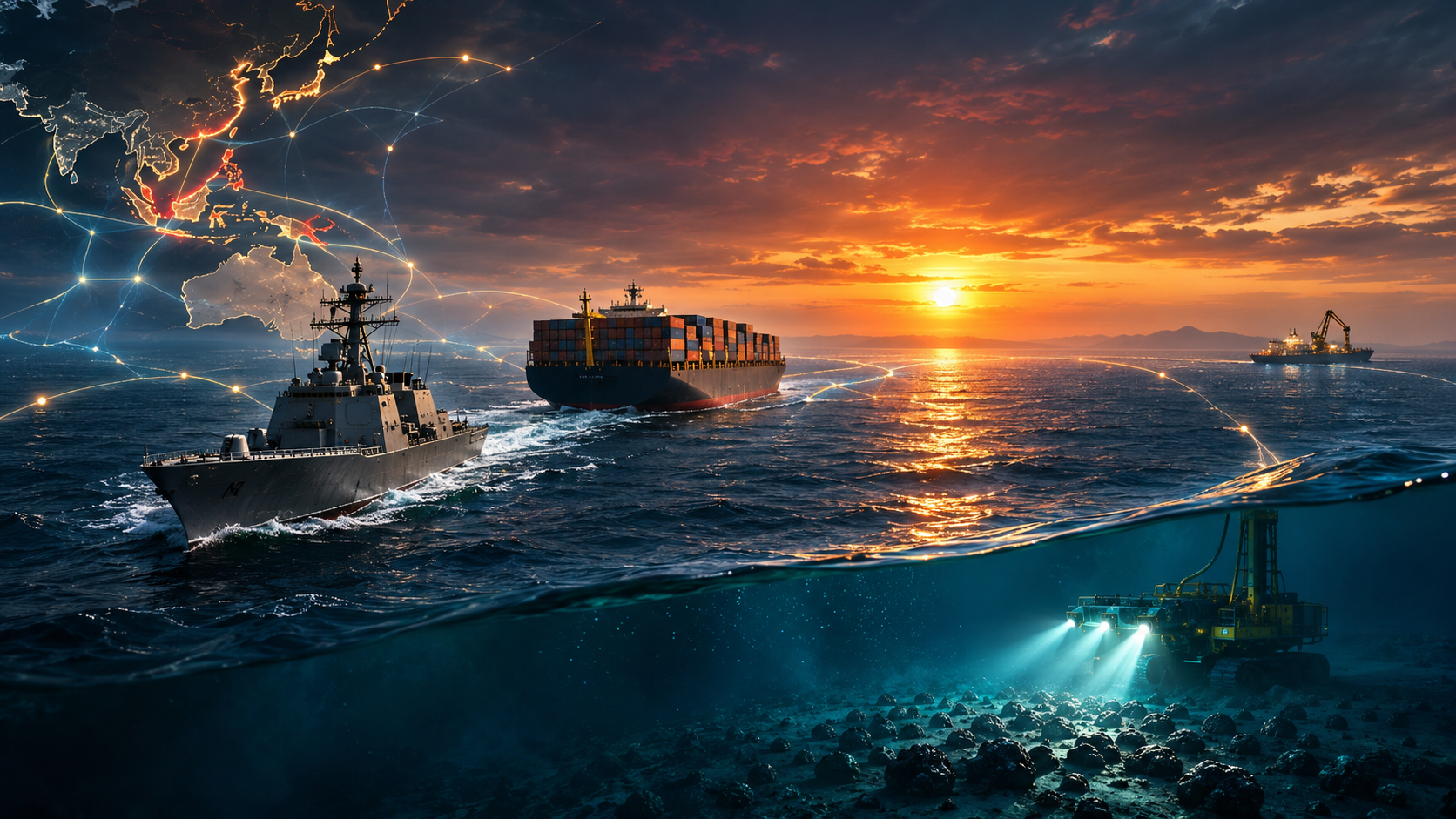
From deep-sea minerals and contested shipping lanes to naval rearmament, the world’s oceans are becoming a new frontier of geopolitical and economic competition. The consequences could extend far beyond maritime security, potentially reshaping global trade, commodity markets, and the international economic order.
For centuries, control over land has determined the rise and fall of empires. Territory provided access to resources, strategic depth, agricultural production, and the ability to impose taxes. The oceans, however, gradually developed under a different system. Rather than being divided entirely among competing powers, much of the maritime world remained accessible to international navigation.
That arrangement became one of the foundations of modern globalization.
Container ships could cross oceans carrying manufactured goods, oil tankers could transport energy between continents, and industrial economies could build supply chains spanning thousands of kilometers. The system was never entirely free of conflict, but the principle of freedom of navigation helped make international commerce remarkably efficient.
Now that arrangement is coming under increasing pressure.
From the South China Sea to the Strait of Hormuz, governments and armed groups are challenging the conditions under which vessels can operate. Meanwhile, competition is expanding beneath the surface, where enormous deposits of strategically important minerals are attracting the attention of governments and mining companies.
The emerging struggle is not simply about territory. It concerns who can control access to the resources, infrastructure, and trade routes upon which the global economy depends.
And if maritime access becomes increasingly subject to geopolitical bargaining, the economic consequences could be profound.
The Maritime Order That Made Globalization Possible
The modern maritime system rests on a compromise between national sovereignty and international freedom of navigation.
Under the United Nations Convention on the Law of the Sea (UNCLOS), coastal states generally exercise sovereignty over territorial waters extending up to 12 nautical miles from their shores. They also possess extensive economic rights within exclusive economic zones, which can extend up to 200 nautical miles.
Beyond these zones, the high seas remain subject to international freedoms, including navigation.
The deep seabed beyond national jurisdiction is governed by a separate framework under which its mineral resources are designated the common heritage of mankind.
This distinction matters. A coastal state may possess exclusive rights to exploit offshore resources without having unlimited authority to restrict international shipping.
For decades, the United States was among the principal beneficiaries and defenders of this arrangement.
Its commercial interests depended on access to global markets, while its naval superiority allowed it to project military power across distant oceans. Freedom of navigation therefore served both economic and strategic objectives.
Washington never ratified UNCLOS, largely because of objections surrounding the international seabed mining regime, although it recognizes many of the convention’s navigational provisions as customary international law.
The broader maritime system nevertheless developed around an assumption that powerful countries would generally benefit more from preserving access than from attempting to monopolize the oceans.
That assumption is increasingly being tested.
The Return of Maritime Power Politics
The South China Sea offers one of the clearest examples of the growing divide between international legal rights and effective military control.
China claims extensive maritime rights across an area that overlaps with the claims and internationally recognized maritime entitlements of several neighboring countries.
In 2016, an international arbitral tribunal rejected the legal basis for China’s expansive historic-rights claims insofar as they exceeded the entitlements permitted by UNCLOS.
Beijing rejected the ruling.
Since then, Chinese coast guard vessels, maritime militia, and naval forces have continued operating throughout disputed areas. Artificial islands and military installations have strengthened China’s ability to maintain a persistent presence.
The result is an increasingly important geopolitical distinction: legal entitlement does not necessarily guarantee practical access.
A country may possess internationally recognized rights over particular waters while lacking the military capacity to exercise those rights without interference.
China does not need universal recognition of its maritime claims to influence activity in contested areas. A sufficiently powerful and persistent presence can alter the practical balance of control.
Yet China also faces a strategic contradiction.
Its economy remains deeply dependent on international shipping, imported energy, and access to foreign markets. An international maritime system dominated entirely by unilateral restrictions would ultimately threaten China’s own economic interests.
The same contradiction applies to other major powers.
Governments generally favor freedom of navigation when it protects their economic interests, but may seek exceptions when strategic priorities become more important.
This tension is becoming a defining feature of contemporary maritime geopolitics.
Strategic Chokepoints: The World’s Economic Pressure Points
Although the oceans cover approximately 71% of Earth’s surface, global shipping is concentrated along a comparatively small number of strategically important passages.
Among the most consequential are the Strait of Hormuz, Bab el-Mandeb, the Suez Canal, and the Strait of Malacca.
These waterways function as critical arteries of international commerce.
The Strait of Hormuz connects the Persian Gulf with international markets and carries a substantial share of internationally traded petroleum. Bab el-Mandeb connects the Red Sea with the Gulf of Aden, making it essential to shipping between Europe and Asia through the Suez Canal.
The Strait of Malacca provides one of the shortest maritime connections between the Indian and Pacific Oceans.
Disruption at any of these locations can have consequences extending far beyond the immediate region.
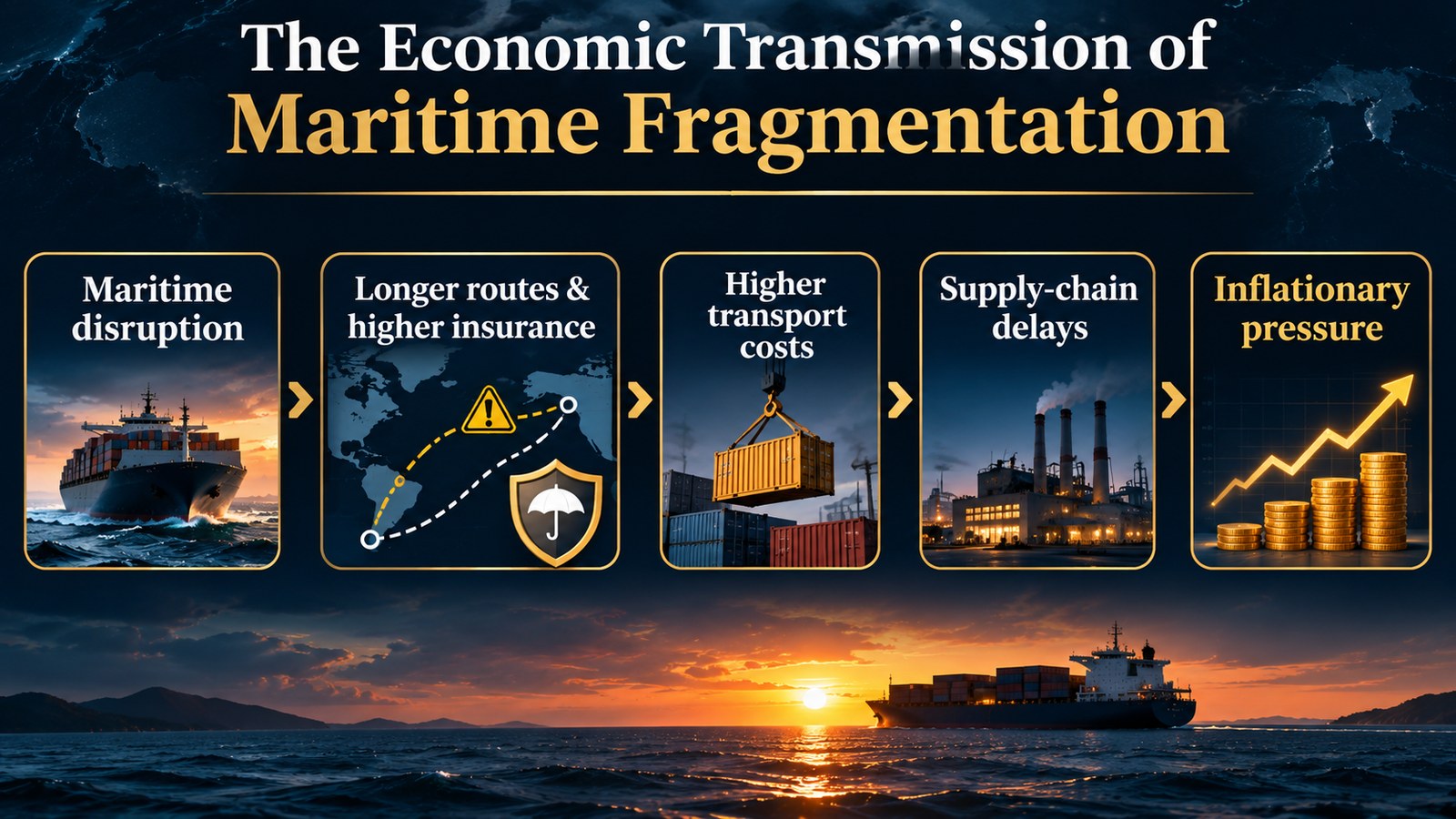
Attacks against commercial vessels in the Red Sea have demonstrated how relatively inexpensive military capabilities can force shipping companies to reconsider established routes. Vessels diverted around the Cape of Good Hope face longer journeys, additional fuel consumption, higher operating costs, and potentially greater insurance expenses.
The economic effect is not necessarily a permanent reduction in global trade.
Instead, it is a deterioration in the efficiency of the system.
More vessels, more fuel, and more working capital may be required to transport the same quantity of goods.
For an international economy built around minimizing transportation costs and inventory requirements, even relatively modest disruptions can become expensive.
The broader implication is that maritime chokepoints are not merely geographic features. They are instruments of potential economic coercion.
A government or armed group capable of threatening passage through a critical waterway may gain influence disproportionate to its overall economic or military strength.
The Next Frontier: Mining the Deep Ocean
The struggle for maritime influence is also expanding beneath the surface.
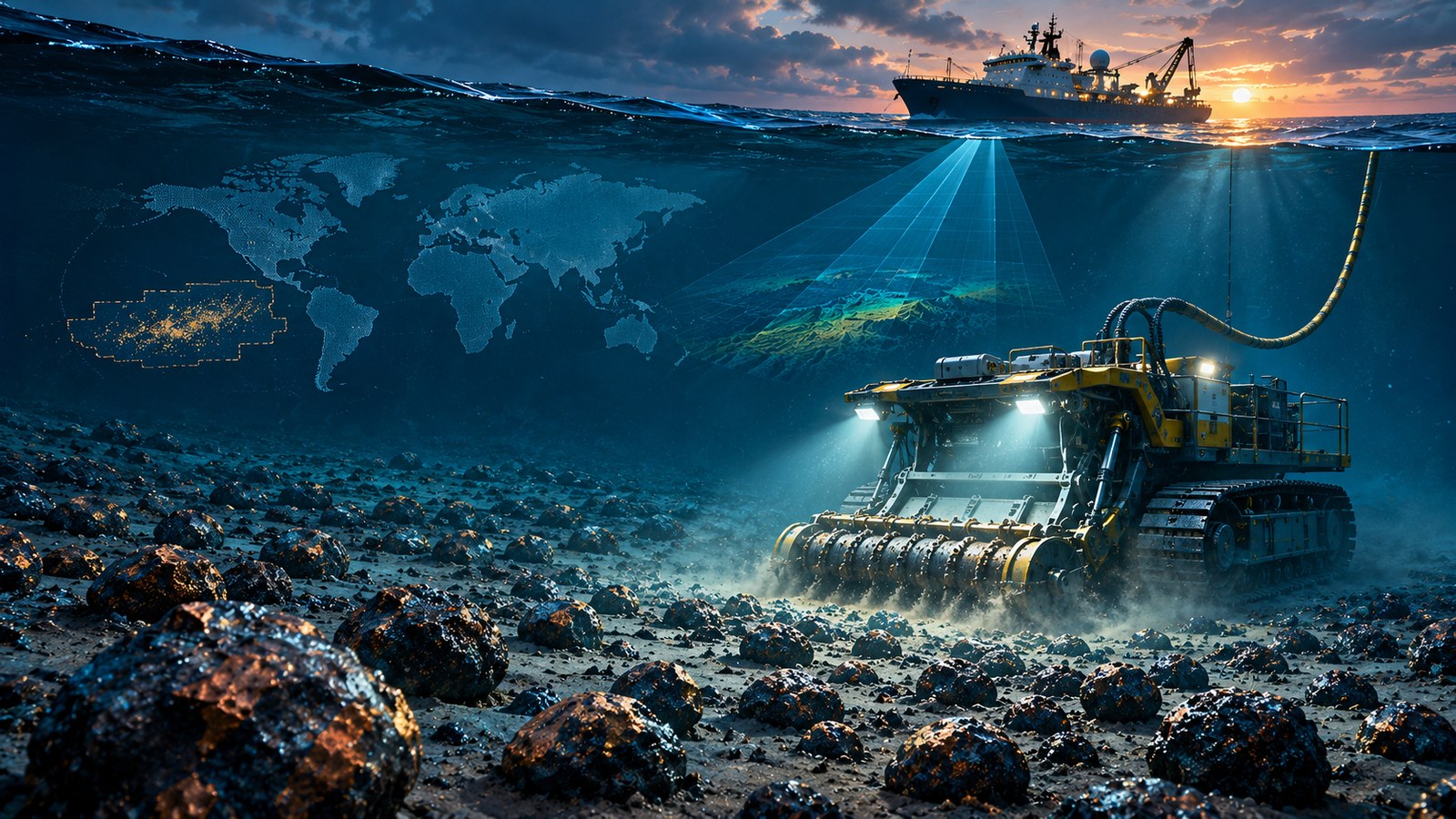
Across parts of the Pacific and Indian Oceans, the seabed contains vast concentrations of polymetallic nodules.
These formations develop over millions of years and can contain economically valuable quantities of manganese, nickel, copper, and cobalt.
Such materials are important to industrial manufacturing, electrical infrastructure, battery production, aerospace applications, and defense technology.
One particularly important region is the Clarion-Clipperton Zone, a vast area of the Pacific Ocean between Hawaii and Mexico.
The region contains extensive nodule deposits that have attracted exploration interest from governments and private companies.
Under UNCLOS, mineral activities in the international seabed area are administered through the International Seabed Authority (ISA).
However, negotiations over the regulatory framework for commercial exploitation have proved difficult.
Environmental concerns are substantial. Deep-ocean ecosystems remain poorly understood, and industrial extraction could damage habitats, disturb sediments, and create ecological effects that are difficult to predict.
Nevertheless, strategic interest continues to grow.
In April 2025, the Trump administration issued an executive order intended to accelerate American offshore critical-mineral development, including activities in areas beyond national jurisdiction under US domestic law.
This approach creates an important legal and geopolitical controversy.
Because the United States has never ratified UNCLOS, it is not bound by the convention in the same way as its parties. However, unilateral commercial mining in international seabed areas challenges the collective regulatory framework supported by countries participating in the ISA.
For Washington, the strategic rationale is clear.
China occupies a dominant position in the processing and refining of numerous critical minerals. Developing alternative sources could reduce American dependence on supply chains vulnerable to geopolitical pressure.
But there is a broader consequence.
If major powers increasingly establish competing systems for authorizing seabed extraction, access to ocean resources could become another arena of strategic competition.
This would not automatically invalidate international law. It could, however, weaken the practical authority of collective institutions and encourage competing legal interpretations.
From Global Efficiency to Strategic Security
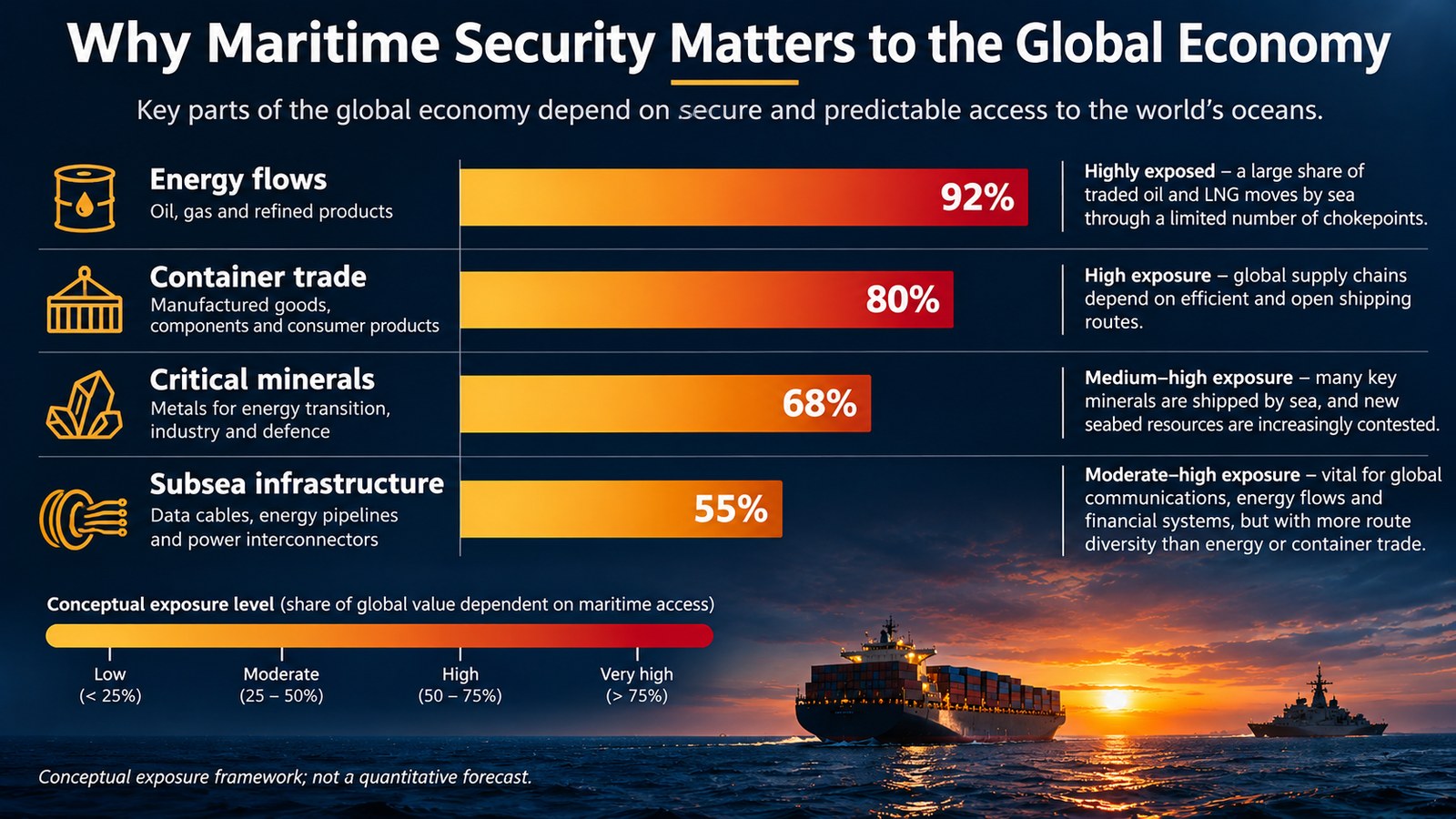
The economic significance of these developments extends beyond the maritime sector.
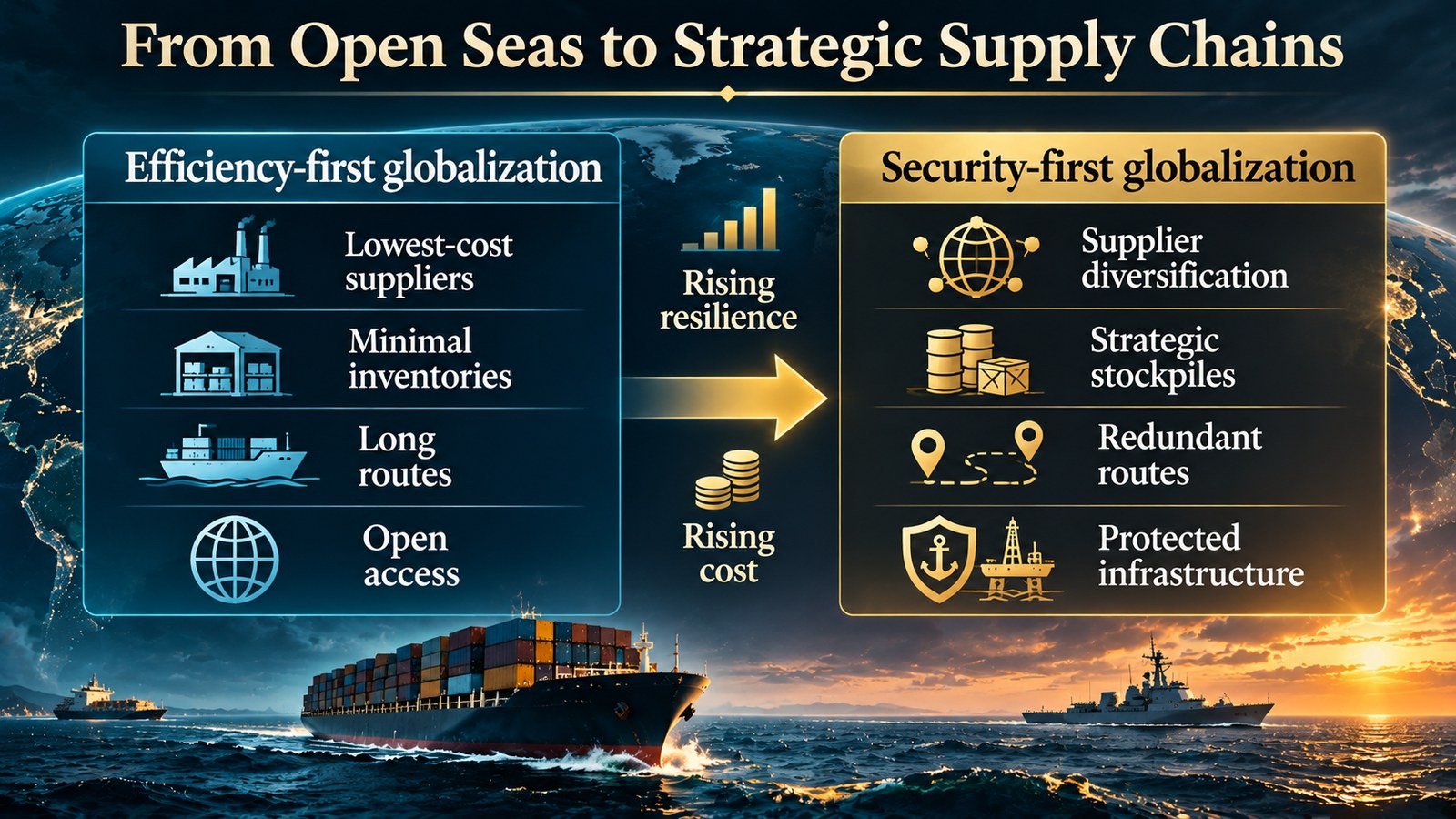
For several decades, globalization encouraged companies to organize production around efficiency.
Manufacturing moved toward locations offering lower costs, supply chains became increasingly specialized, and businesses minimized inventories to reduce capital requirements.
The system depended on relatively predictable access to transportation, energy, raw materials, and international markets.
Geopolitical fragmentation changes those calculations.
If access to critical resources becomes less reliable, companies and governments have incentives to invest in redundancy rather than pure efficiency.
They may diversify suppliers, increase strategic inventories, develop domestic processing facilities, and construct alternative transportation infrastructure.
These decisions can improve resilience, but they also require additional capital.
The result is a potentially important structural change in the global economy.
Economic security increasingly carries a price, and that price may be reflected in higher investment requirements, more expensive supply chains, and greater demand for strategic resources.
This does not mean that every geopolitical disruption automatically produces inflation.
Higher transportation costs can be offset by weaker demand, technological improvements, or increased competition elsewhere.
Nevertheless, a persistent shift away from the cheapest available suppliers toward more secure alternatives would tend to raise costs relative to an otherwise comparable, efficiency-driven system.
In that sense, maritime fragmentation could contribute to longer-term inflationary pressures even without a sustained acceleration in global consumption.
The Commodity Implications: A New Strategic Premium
The emerging maritime competition could have particularly important consequences for commodity markets.
Energy is the most immediate example.
Oil and liquefied natural gas depend heavily on maritime transportation. When shipping routes become less secure, the delivered cost of energy can rise even if global production remains unchanged.
This creates a distinction between physical supply shortages and logistical disruptions.
An oil-producing country may continue pumping crude at normal levels while buyers elsewhere face higher freight costs, insurance premiums, or delivery delays.
Refined products can become especially vulnerable when specialized shipping capacity, refinery geography, and regional fuel specifications limit the ability to redirect supplies quickly.
Critical minerals represent another dimension.
Governments concerned about dependence on foreign processing capacity may invest more heavily in mining, refining, recycling, and strategic stockpiles.
Copper could benefit from additional investment in electrical grids, industrial infrastructure, and defense systems. Nickel, cobalt, manganese, and rare earth elements may attract greater strategic attention, although demand prospects differ substantially between individual minerals and technologies.
Not all commodities would necessarily benefit equally.
Deep-sea mining, if it becomes commercially viable, could eventually increase the supply of certain metals and place downward pressure on their prices.
The broader bullish argument for commodities therefore depends less on simple resource scarcity than on the capital intensity, geopolitical risks, and infrastructure requirements associated with building more secure supply systems.
The most important change may be the growing willingness of governments to pay a premium for reliable access.
Naval Rearmament and the Industrial Consequences
As maritime competition intensifies, naval power could become increasingly important.
Protecting international shipping requires more than aircraft carriers and submarines.
It also depends on escort vessels, maritime patrol aircraft, surveillance systems, minesweepers, autonomous underwater vehicles, satellite communications, and the industrial capacity to maintain fleets over extended periods.
Subsea infrastructure adds another layer of complexity.
Telecommunications cables, offshore energy installations, pipelines, and electricity interconnectors are economically important but often difficult to protect.
Concerns about sabotage and interference have increased the strategic importance of seabed monitoring and underwater security capabilities.
These developments could support a prolonged period of investment in naval and maritime industrial capacity.
Shipyards, propulsion manufacturers, specialist steel producers, electronics companies, underwater robotics developers, and defense contractors may all benefit from increased spending.
However, expanding naval capacity is neither quick nor inexpensive.
Modern warships require sophisticated components, specialized labor, and lengthy production schedules. Many Western countries face constraints in shipbuilding capacity and skilled industrial workforces.
Consequently, increased defense budgets may translate into rising order books and production bottlenecks long before they produce substantially larger fleets.
This creates a potential industrial investment cycle extending well beyond the defense sector itself.
Could the Oceans Become Divided?
The most dramatic scenario would involve a gradual transformation of the oceans into competing spheres of influence.
Under such a system, powerful states might increasingly determine access to shipping corridors, fishing grounds, seabed resources, and strategically important infrastructure through military presence and economic leverage.
Formal territorial annexation would not necessarily be required.
Practical control could develop through inspections, licensing requirements, persistent naval deployments, restrictions on resource extraction, or threats against commercial shipping.
However, this outcome is far from inevitable.
The major trading powers retain powerful incentives to preserve open maritime routes. China, the United States, Europe, Japan, India, and numerous smaller economies all benefit enormously from predictable international shipping.
Even governments seeking greater regional influence generally have reasons to avoid a complete breakdown of maritime commerce.
A more plausible outcome may therefore be selective fragmentation.
Most international shipping could remain open while particular regions become increasingly militarized, contested, or expensive to navigate.
This would produce neither a fully open maritime system nor a world of completely partitioned oceans.
Instead, it would create a patchwork of legal rights, strategic exceptions, and increasingly unequal capacities to enforce access.
Three Possible Futures for the Maritime Economy
Scenario One: Managed Competition
Major powers continue competing for maritime influence while preserving the basic principles of freedom of navigation.
Regional incidents and disputes persist, but international institutions retain sufficient legitimacy to prevent widespread unilateral restrictions.
Under this scenario, shipping costs experience periodic volatility while the broader globalization system remains functional.
Scenario Two: Selective Maritime Fragmentation
Strategic chokepoints, contested maritime regions, and critical seabed resources become increasingly subject to political and military competition.
Governments invest heavily in naval security, alternative supply chains, domestic mineral processing, and strategic inventories.
Global trade continues, but the cost of maintaining reliable access rises.
This scenario could favor defense industries, selected commodity producers, maritime infrastructure providers, and countries with secure access to energy and natural resources.
Scenario Three: Confrontation and Economic Blocs
A major regional conflict or prolonged maritime blockade causes significant disruption to international shipping.
Trade becomes increasingly organized around geopolitical alliances, with competing systems governing resource access, technology, finance, and transportation.
The immediate consequences could include severe commodity price volatility, shortages, and declining economic activity.
Although some resource producers might benefit from higher prices, a sufficiently severe global downturn could overwhelm those gains.
The distinction matters: geopolitical fragmentation can be structurally supportive for certain industries without being uniformly positive for financial markets.
Conclusion: The Price of an Open Ocean
The modern global economy was built on an extraordinary assumption: that the world’s oceans would remain sufficiently open for goods, energy, and raw materials to move between distant markets at relatively low cost.
That assumption has not disappeared, but it can no longer be taken entirely for granted.
Maritime chokepoints are becoming instruments of geopolitical leverage. Deep-sea minerals are attracting strategic competition. Underwater infrastructure is increasingly viewed as a national security concern, while governments are investing in naval capabilities and more resilient supply chains.
The emerging contest is not necessarily a new territorial partition of the oceans.
It may instead represent something more subtle: the gradual transformation of maritime access from a largely predictable commercial condition into an increasingly strategic economic asset.
For investors, manufacturers, and policymakers, this distinction is crucial.
The next phase of globalization may not be characterized by the disappearance of international trade, but by a sustained increase in the resources required to secure it.
And in a world where security increasingly takes precedence over efficiency, the ability to control energy, minerals, infrastructure, and maritime access could become one of the defining sources of economic power.
The oceans may remain legally open. The question is how much it will cost to keep them that way.