
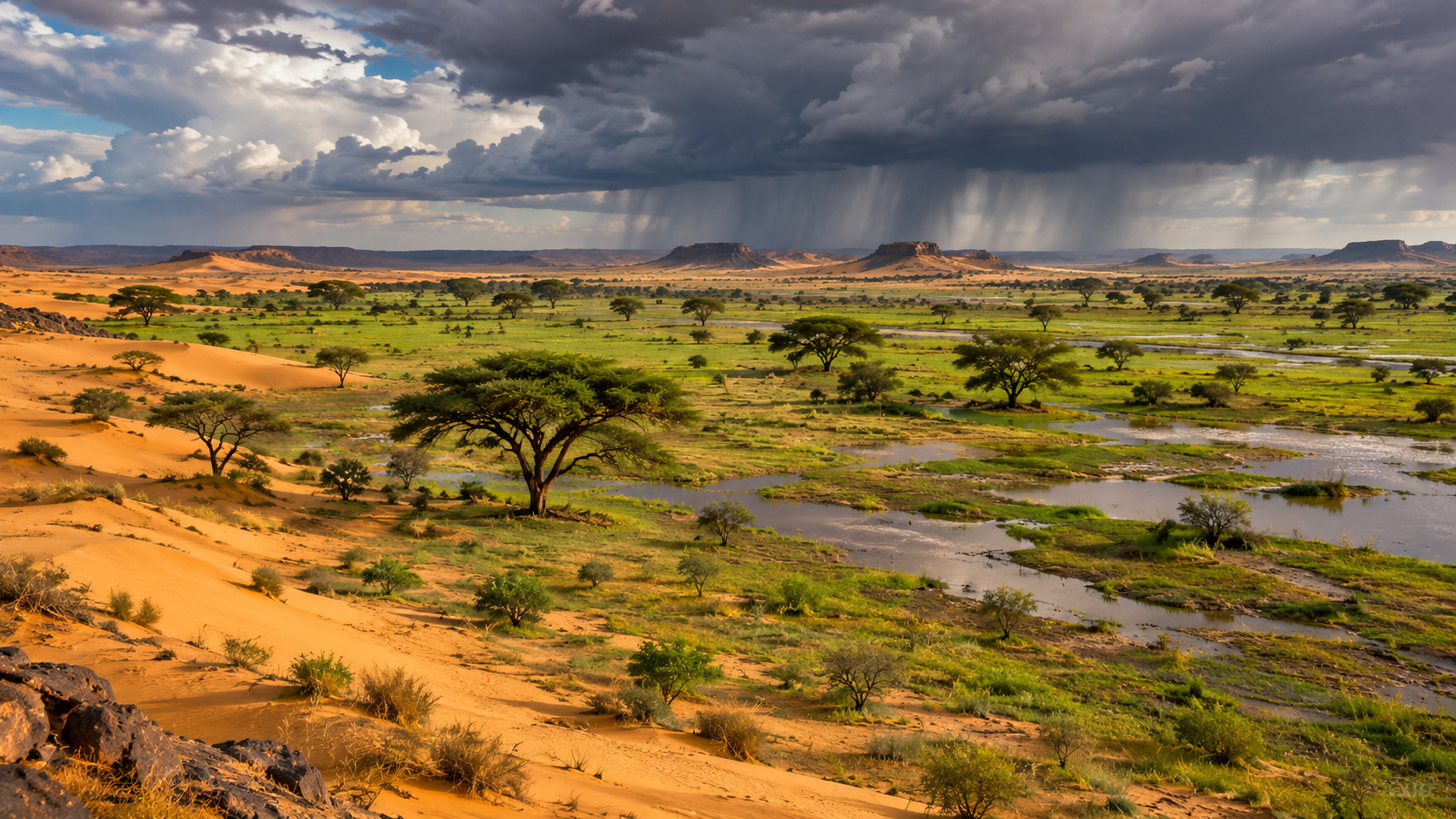
Satellite observations reveal expanding vegetation across parts of Africa’s drylands. Rising carbon dioxide, changing rainfall patterns and a recovering monsoon are helping plants flourish in some unexpected places. But the return of greenery comes with a warning.
For centuries, the Sahara has symbolized one of the most inhospitable environments on Earth. Its enormous expanses of sand, rock and sun-scorched plains stretch across North Africa, covering an area comparable to the United States.
Yet something remarkable is happening along the desert’s southern frontier.
Satellite observations show that substantial parts of the Sahel, the semi-arid region separating the Sahara from the more humid landscapes farther south, have become greener over recent decades.
Grasslands are recovering. Shrubs and trees are expanding in some areas. Seasonal vegetation is appearing in places historically associated with severe drought.
The explanation is surprisingly complex. Rising atmospheric carbon dioxide can help plants use water more efficiently, while changes in atmospheric circulation have brought increased rainfall to some regions.
Scientists are discovering that climate change does not simply make every dry region drier. In certain environments, it can produce the opposite effect.
But does this mean the Sahara itself is shrinking?
A Green Transformation Visible From Space
The greening of the Sahel is not merely anecdotal. Researchers have documented it using decades of satellite observations.
A 2026 study examining rainfall and vegetation patterns between 1990 and 2022 identified substantial increases in vegetation across parts of Niger, Chad, Senegal and Mauritania.
The researchers used satellite-derived vegetation indices alongside rainfall measurements to distinguish between areas recovering from drought and regions experiencing more complicated ecological changes.
Their findings revealed a striking geographical pattern.
In many locations, vegetation increased alongside rainfall. In others, greenery expanded even without a corresponding increase in precipitation.
This distinction matters because it suggests that rainfall alone cannot explain Africa’s changing landscapes.
Some of the transformation may be connected to the atmosphere itself.
How Rising CO₂ Can Help Plants Grow
Carbon dioxide is essential for photosynthesis, the process through which plants convert sunlight into chemical energy.
As atmospheric CO₂ concentrations rise, many plants can increase their photosynthetic activity under suitable conditions.
But there is another important mechanism.
Plants absorb carbon dioxide through microscopic openings in their leaves called stomata. These openings also allow water vapor to escape.
When atmospheric CO₂ concentrations increase, certain plants can absorb sufficient carbon dioxide while keeping their stomata less widely open.
This can reduce water loss and improve water-use efficiency.
In semi-arid environments, where access to water frequently determines whether vegetation survives, even modest improvements can make a difference.
The effect is particularly interesting in drylands, where additional water-use efficiency can support increased leaf growth and vegetation cover.
However, CO₂ fertilization is not unlimited. Nutrient shortages, extreme heat, soil degradation and insufficient rainfall can constrain or reverse its benefits.
Rising carbon dioxide may help explain some observed greening, but it cannot turn a waterless desert into a forest by itself.
The Return of the African Monsoon
One of the most important explanations for Sahelian greening is the recovery of seasonal rainfall.
During the 1970s and 1980s, the Sahel experienced devastating droughts that contributed to crop failures, livestock losses and severe humanitarian crises.
Rainfall subsequently recovered across substantial parts of the region, although the recovery has been uneven.
Scientists have linked these changes to ocean temperatures, atmospheric circulation, greenhouse gases and airborne pollution.
A 2026 study published in Communications Earth & Environment examined the role of human-produced aerosols in historical Sahel rainfall changes.
Its findings emphasized the importance of atmospheric pollution in altering tropical circulation and contributing to the severe droughts of previous decades.
As atmospheric conditions changed, rainfall patterns changed with them.
The result has been a partial recovery of vegetation in numerous locations.
Importantly, this recovery does not mean that drought has disappeared. Rainfall remains highly variable, and some areas continue to experience environmental degradation.
[Insert second illustration here]
Illustration: A conceptual reconstruction of a greener Sahelian landscape following seasonal rainfall. The image is an artistic visualization, not a photograph of a documented location.
The Sahara Was Once a Green Paradise
Perhaps the most extraordinary aspect of this story is that a green Sahara is not unprecedented.
Between approximately 11,000 and 5,000 years ago, during a period commonly known as the African Humid Period, large parts of today’s Sahara were dramatically wetter.
The landscape contained extensive grasslands, lakes, wetlands and river systems.
Animals including hippos, crocodiles and large grazing mammals inhabited regions that are now among the driest places on Earth.
Human communities lived across landscapes that today appear almost entirely uninhabitable.
Evidence for this ancient environment survives in geological deposits, fossil records, lake sediments and prehistoric rock art.
The principal driver was a change in Earth’s orbital configuration, which strengthened Northern Hemisphere summer sunlight and altered the African monsoon.
Vegetation and atmospheric feedbacks helped reinforce the wetter conditions.
Eventually, changing orbital conditions weakened the monsoon, and the region gradually transitioned toward the arid environment familiar today.
The historical lesson is important: the Sahara is not a geographically permanent climatic feature.
Its boundaries and ecosystems have changed profoundly over thousands of years.
Is the Sahara Actually Shrinking?
Here the scientific evidence requires a crucial distinction.
The greening of parts of the Sahel does not necessarily mean that the Sahara as a whole is becoming smaller.
A study published in the Journal of Climate in 2018 examined African rainfall records between 1920 and 2013.
The researchers estimated that the Sahara expanded by approximately 10% over that period when its boundaries were defined using annual rainfall.
That finding is not automatically contradicted by more recent evidence of greening.
The studies measure different phenomena, across different periods and geographical areas.
A landscape can become greener because plants are growing more vigorously without receiving enough rainfall to cease being classified as desert.
Likewise, some areas may become wetter while others become drier.
Satellite measurements of vegetation cannot, on their own, establish that the entire Sahara is retreating.
The scientifically supported conclusion is therefore more nuanced: significant areas along the Sahara’s margins are becoming greener, but a sustained contraction of the desert as a whole has not been established.
The Dangerous Side of a Greener Desert
More rainfall might initially sound like an unambiguous benefit for communities living in some of the world’s driest environments.
Additional vegetation can support grazing, agriculture, soil protection and ecosystem recovery.
But the same atmospheric changes can also increase the risk of destructive flooding.
Warmer air can hold more water vapor, potentially allowing storms to produce more intense rainfall when the necessary atmospheric conditions develop.
In dry regions, intense rainfall may run rapidly across hardened or degraded soils rather than soaking into the ground.
Rivers and seasonal waterways can overflow, destroying homes, crops and infrastructure.
A region can therefore experience both increased vegetation and greater flood vulnerability.
A 2025 study published in Nature Communications found that most climate models examined projected increased year-to-year variability in Sahel rainfall under a high-emissions warming scenario.
This suggests that future rainfall may become less predictable, even where average precipitation increases.
For farmers, the distinction between more rainfall and more reliable rainfall is fundamental.
A single destructive flood cannot compensate for months of inadequate moisture.
Could Africa Become Significantly Greener?
The long-term implications extend far beyond the Sahara.
Africa’s drylands cover enormous areas, and relatively small changes in rainfall or vegetation productivity can influence regional ecosystems, agriculture and carbon cycling.
A 2026 paper titled Greener Southern Sahara: An Enhanced Carbon Sink investigated seasonal precipitation, vegetation activity and carbon exchange in the southern Sahara.
The researchers found that seasonal increases in rainfall were associated with stronger photosynthetic activity and increased biological carbon uptake.
Such findings demonstrate that even extremely dry environments can participate dynamically in the global carbon cycle.
Nevertheless, projecting a permanent transformation into extensive grasslands or forests would be premature.
The future will depend on the interaction between monsoon behavior, rising temperatures, atmospheric carbon dioxide, land management and human activity.
There is also an important difference between seasonal greening and long-term ecological recovery.
A landscape that becomes green for several weeks following heavy rainfall has not necessarily undergone a lasting climatic transformation.
A More Complicated Climate Story
The emerging scientific picture challenges simplistic assumptions about how a warming planet changes the natural world.
Climate change does not produce identical outcomes everywhere.
Some regions become drier. Others become wetter. Some experience greater vegetation growth while simultaneously facing more extreme weather.
Across parts of the Sahel, increasing rainfall, changes in atmospheric circulation and the physiological effects of carbon dioxide are contributing to a measurable expansion of vegetation.
Yet the same region remains vulnerable to drought, flooding, heat and land degradation.
The Sahara’s ancient history reminds us that even the world’s greatest deserts are not static.
Thousands of years ago, parts of this immense landscape supported lakes, grasslands, wildlife and human settlements.
Today, satellite observations reveal another chapter in the relationship between climate and vegetation.
The Sahara is not simply disappearing beneath a carpet of green. But along its margins, nature is responding to a changing climate in ways that are both surprising and scientifically fascinating.
Scientific References
- Rainfall variability, vegetation dynamics, and the rainfall-NDVI relationship in the Sahel (1990–2022): a spatio-temporal analysis using CHIRPS and PKU GIMMS-MODIS data. Environmental Research Communications (2026). https://doi.org/10.1088/2515-7620/ae7ceb
- Greener Southern Sahara: An Enhanced Carbon Sink. Journal of Geophysical Research: Atmospheres (2026). https://doi.org/10.1029/2025JD045921
- Nnamchi, H. C. & Fiedler, S. Anthropogenic aerosols override greenhouse gases in Sahel climate change. Communications Earth & Environment (2026). https://doi.org/10.1038/s43247-026-03474-3
- Yang, K. et al. Increased interannual variability of Sahel rainfall under greenhouse warming. Nature Communications (2026). https://doi.org/10.1038/s41467-025-67885-0
- Thomas, N. & Nigam, S. Twentieth-Century Climate Change over Africa: Seasonal Hydroclimate Trends and Sahara Desert Expansion. Journal of Climate (2018). https://doi.org/10.1175/JCLI-D-17-0187.1