Close Menu
Illustrated Curiosity | Economics, History, Science, Space, Technology, Health, Physics, Earth
    Facebook X (Twitter) Instagram YouTube
    Illustrated Curiosity | Economics, History, Science, Space, Technology, Health, Physics, Earth
    • Earth
    • Economics
    • Environment
      • Environmental Tech
      • Pollution
      • Wildlife
    • Health
      • Health Tech
      • Medicine
      • Nutrition
      • Exercise
    • History
      • Prehistory
      • Ancient History
      • Postclassical Era
      • Modern History
    • Humans
      • Human Brain
      • Psychology
    • Life
      • Animals & Plants
      • Genetics
      • Paleontology
      • Evolution
      • Genetic Engineering
    • Physics
    • Space
      • Astrobiology
      • Astronomy
      • Extrasolar Planets
      • Space Tech
      • Spaceflight
    • Technology
      • Artificial Intelligence
      • Energy
      • Engineering
      • Materials
      • Robotics
      • Vehicles
    Illustrated Curiosity | Economics, History, Science, Space, Technology, Health, Physics, Earth
    Home » Earth’s Core Is Actually Solid According to New Research
    Earth

    Earth’s Core Is Actually Solid According to New Research

    October 22, 20182 Mins Read
    Image: Illustrated Curiosity
    Share
    Facebook Twitter LinkedIn Pinterest Email

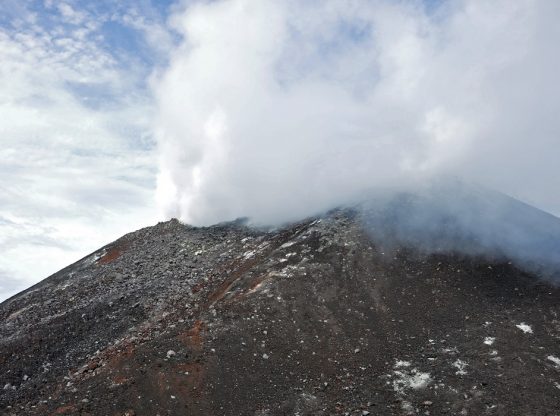
    Science is now sure the center of the Earth is solid and not hollow as some fiction writers like to depict it.

    Scientists predicted that the Earth has a solid inner core and liquid outer core 80 years ago, based on measurements inconsistent with a single core.

    A solid core should accompany a special kind of seismic wave, called J waves, but it’s been difficult to actually detect the waves—until now.

    Seismologists from the Australian National University (ANU) have adapted a method used successfully to study the Earth’s crust and upper mantle to provide new evidence of what lies inside.

    In their recent work, the ANU’s Hrvoje Tkalčić and Thanh-Son Pham cross-correlated recordings of a range of large earthquakes on a planetary scale and identified previously unobserved seismic phases in Earth’s correlation wavefield.

    “We found the inner core is indeed solid, but we also found that it’s softer than previously thought,”
    “It turns out, if our results are correct, the inner core shares some similar elastic properties with gold and platinum.

    “The inner core is like a time capsule, if we understand it we’ll understand how the planet was formed, and how it evolves.”

    – Associate Professor Hrvoje Tkalčić.

    So, rather than spotting the waves directly, the researchers looked at global seismogram data and correlated the result, and among all of the different ways that the waves could travel, outer core and inner core, they were able to pick out specific signals representing the J waves traveling through the inner core.

    In their paper published in the journal Science, the pair says they were able to detect shear waves in the inner core, but in so doing developed new estimates for properties such as shear-wave speed, resistance to shear, and attenuation.

    The researchers explain that there’s further work to be done, such as taking more data from more seismograms and placing seismic measuring equipment in new places.

    Share. Facebook Twitter Pinterest LinkedIn Tumblr Email Copy Link

    Related Posts

    The Looming Giant: Grindavik’s Potential Volcanic Eruption and its Global Implications

    November 13, 2023

    Geoengineering, to Combat Global Warming, May Harm Crop Production

    August 15, 2018

    Earth’s Coldest Spot Even Colder Than Thought

    August 8, 2018
    Recent Posts
    • The Day the Alliance Died
    • Evaluating Heart Disease: How Cumulative Diet Choices Compound Your Risk
    • What Would Happen If China Attacked Taiwan?
    • Geopoliticisation as a Structural Tailwind for Commodity Prices
    • America’s Economic Remodel: Who’s Really Paying the Bill?
    • Why Inflation May Be Preparing for a Second Act
    • How the End of Bretton Woods Reshaped Our Economies — and Our Politics
    • Can the U.S. Really Handle 250% Debt-to-GDP? Why Jackson Hole’s Daring Paper Is Wrong
    • Japan’s Fiscal Trap: What Happens If Austerity Is No Longer an Option?
    • The Rise of Range Extended Electric Vehicles (REEVs): A New Era of Hybrid Mobility
    © 2025 Illustrated Curiosity

    Type above and press Enter to search. Press Esc to cancel.