
Close Menu
Illustrated Curiosity | Economics, History, Science, Space, Technology, Health, Physics, Earth
    Facebook X (Twitter) Instagram YouTube
    Illustrated Curiosity | Economics, History, Science, Space, Technology, Health, Physics, Earth
    • Earth
    • Economics
    • Environment
      • Environmental Tech
      • Pollution
      • Wildlife
    • Health
      • Health Tech
      • Medicine
      • Nutrition
      • Exercise
    • History
      • Prehistory
      • Ancient History
      • Postclassical Era
      • Modern History
    • Humans
      • Human Brain
      • Psychology
    • Life
      • Animals & Plants
      • Genetics
      • Paleontology
      • Evolution
      • Genetic Engineering
    • Physics
    • Space
      • Astrobiology
      • Astronomy
      • Extrasolar Planets
      • Space Tech
      • Spaceflight
    • Technology
      • Artificial Intelligence
      • Energy
      • Engineering
      • Materials
      • Robotics
      • Vehicles
    Illustrated Curiosity | Economics, History, Science, Space, Technology, Health, Physics, Earth
    Home » Fascinating Discovery Suggests Neanderthals Invented String
    Prehistory

    Fascinating Discovery Suggests Neanderthals Invented String

    April 13, 20203 Mins Read
    Image: Illustrated Curiosity
    Share
    Facebook Twitter LinkedIn Pinterest Email

    Tiny bits of twisted plant fibers found on an ancient stone tool suggest that Neanderthals were able to make and use sophisticated cords like string and rope.

    The discovery of the oldest known direct evidence of fiber technology — yarn — is reported in Scientific Reports this week. The finding furthers our understanding of the cognitive abilities of Neanderthals.

    The discovery was made by scientists working in the south of France at the Abri du Maras site, a well-known and well-documented Neanderthal site.

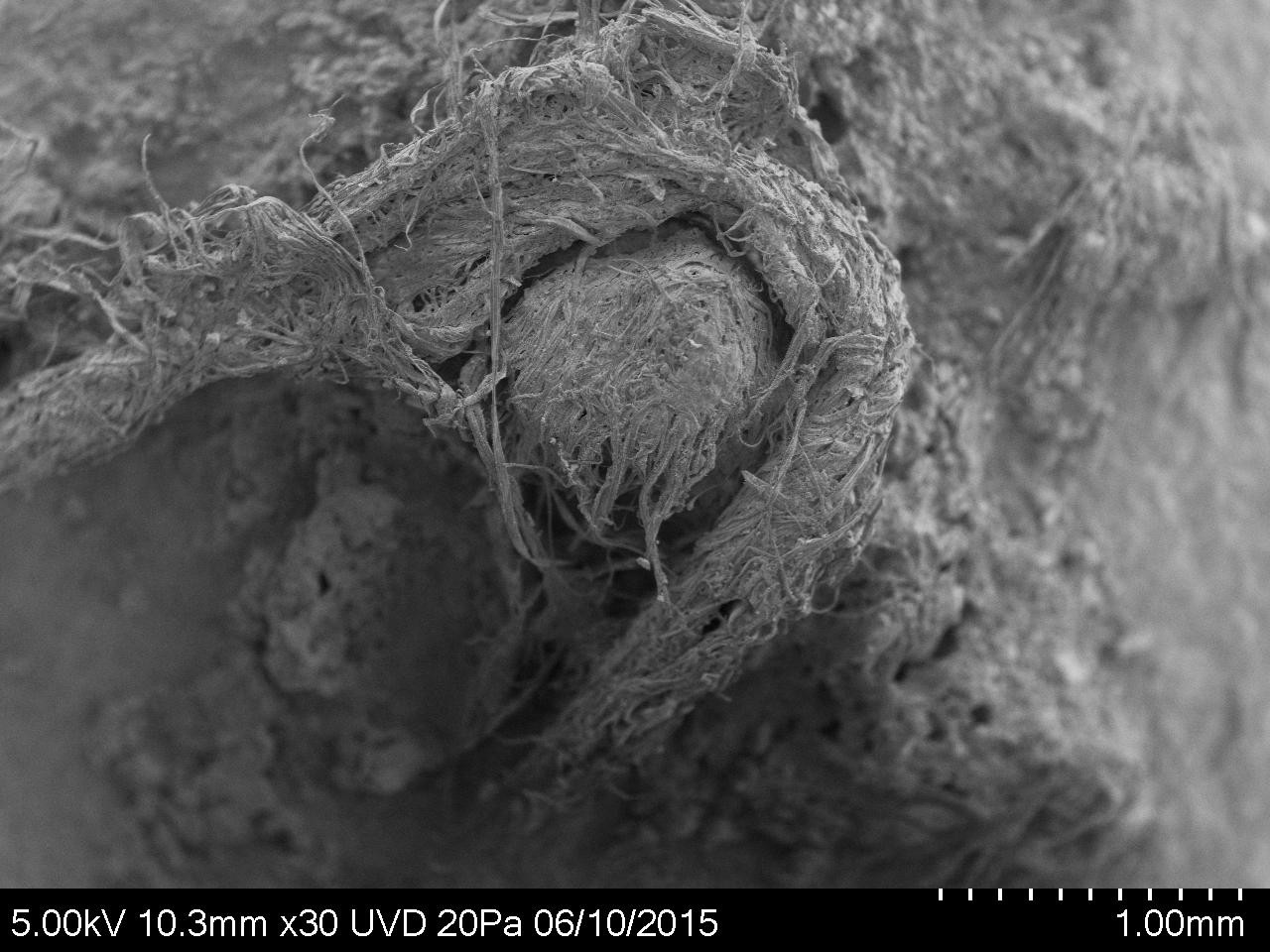
    Bruce Hardy and colleagues discovered a six-millimeter-long cord fragment consisting of three bundles of fibers twisted together and adhering to a 60-millimeter-long, thin stone tool. The paper authors speculate that the cord was wrapped around the tool as a handle or was a part of a net or bag containing the tool.

    Microscopic analysis of these bundles showed that they had been intertwined, proof of their modification by humans.

    “There are three bundles of fibers that are twisted counterclockwise, and then those bundles, once they are twisted, are twisted back the other way, clockwise, around each other to form a cord or string,”

    – Archaeologist Bruce Hardy, a researcher from Kenyon College in Ohio and the first author of the new study.

    The string was dated to between 41,000 and 52,000 years ago, which predates the arrival of homo sapiens to the region. These dates were derived from the stratigraphic layer in which the items were found.

    The importance of this cord fragment is in the full breadth of possibilities it opens up. Generally, we get to see stone tools and bones for archeological sites as old as this. While bones and stones were certainly important, perishable materials, however, comprised the vast majority of material culture items, and these items, by and large, have not survived the years.
    Prior to this discovery, the oldest discovered fiber fragments in the Ohalo II site in Israel dated back to around 19,000 years ago. The findings of the new study suggest that fiber technology is much older and is even more proof that the cognitive abilities of Neanderthals were probably very similar to those of modern humans.

    Neanderthals manufactured glue, wore eagle talons as jewelry, decorated themselves with feathers, started their own fires, made cave paintings, and fashioned tools from seashells. We can now add fiber technology to this impressive list, thanks to the new research published in Scientific Reports.

    Reference:

    B. L. Hardy, M.-H. Moncel, C. Kerfant, M. Lebon, L. Bellot-Gurlet & N. Mélard Direct evidence of Neanderthal fibre technology and its cognitive and behavioral implications


    Homo Neanderthalensis Neanderthals
    Share. Facebook Twitter Pinterest LinkedIn Tumblr Email Copy Link

    Related Posts

    Northern Europeans’ Genetic Pre-Historic is Repeated Genocide

    February 6, 2024

    Sets of 120,000-Year-Old Footprints Belonging to Humans Have Been Discovered in Saudi Arabia

    September 29, 2020

    Ancient Footprints Show Neanderthals May Have Been Taller than Thought

    May 14, 2020

    The oldest known Homo sapiens outside Africa was Greek

    July 15, 2019

    Jawbone Fossil Reveals More About the Denisovans

    May 6, 2019

    Ancient, Unknown Strain of Plague Found in 5 000-Year-Old Tomb in Sweden

    December 18, 2018
    Recent Posts
    • The Day the Alliance Died
    • Evaluating Heart Disease: How Cumulative Diet Choices Compound Your Risk
    • What Would Happen If China Attacked Taiwan?
    • Geopoliticisation as a Structural Tailwind for Commodity Prices
    • America’s Economic Remodel: Who’s Really Paying the Bill?
    • Why Inflation May Be Preparing for a Second Act
    • How the End of Bretton Woods Reshaped Our Economies — and Our Politics
    • Can the U.S. Really Handle 250% Debt-to-GDP? Why Jackson Hole’s Daring Paper Is Wrong
    • Japan’s Fiscal Trap: What Happens If Austerity Is No Longer an Option?
    • The Rise of Range Extended Electric Vehicles (REEVs): A New Era of Hybrid Mobility
    © 2025 Illustrated Curiosity

    Type above and press Enter to search. Press Esc to cancel.