Close Menu
Illustrated Curiosity | Economics, History, Science, Space, Technology, Health, Physics, Earth
    Facebook X (Twitter) Instagram YouTube
    Illustrated Curiosity | Economics, History, Science, Space, Technology, Health, Physics, Earth
    • Earth
    • Economics
    • Environment
      • Environmental Tech
      • Pollution
      • Wildlife
    • Health
      • Health Tech
      • Medicine
      • Nutrition
      • Exercise
    • History
      • Prehistory
      • Ancient History
      • Postclassical Era
      • Modern History
    • Humans
      • Human Brain
      • Psychology
    • Life
      • Animals & Plants
      • Genetics
      • Paleontology
      • Evolution
      • Genetic Engineering
    • Physics
    • Space
      • Astrobiology
      • Astronomy
      • Extrasolar Planets
      • Space Tech
      • Spaceflight
    • Technology
      • Artificial Intelligence
      • Energy
      • Engineering
      • Materials
      • Robotics
      • Vehicles
    Illustrated Curiosity | Economics, History, Science, Space, Technology, Health, Physics, Earth
    Home » Neanderthals Might Not Be the Hunched Cavemen We Thought They Were, New Study Says
    Prehistory

    Neanderthals Might Not Be the Hunched Cavemen We Thought They Were, New Study Says

    December 13, 20183 Mins Read
    Image: Illustrated Curiosity
    Share
    Facebook Twitter LinkedIn Pinterest Email


    Neanderthals may not have sported the barrel-chested bodies and hunched posture we see in museums and textbooks, according to a new study.

    The first 3D virtual reconstruction of a Neanderthal ribcage has revealed that they had straighter spines and a greater lung capacity than modern humans. The findings of the Neanderthals were published last week in the journal Nature Communications.
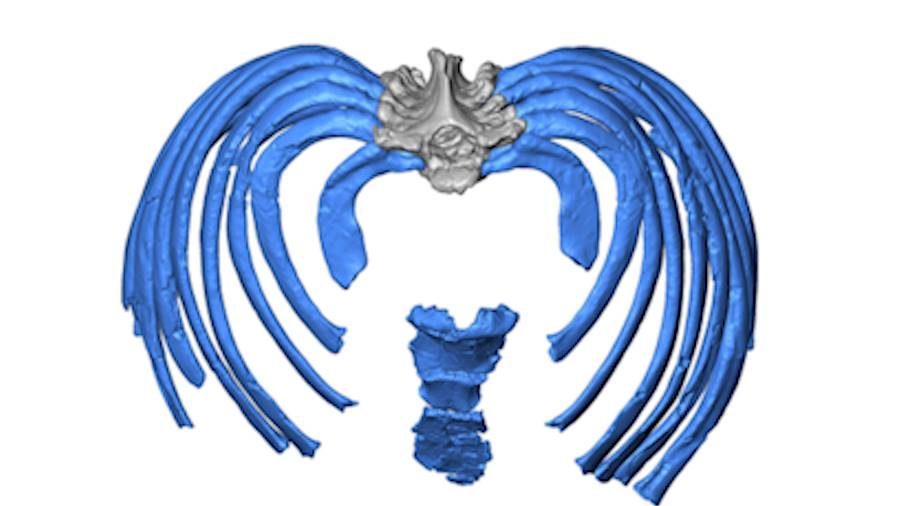
    Using CT scans of fossils from an approximately 60,000-year-old male skeleton, researchers were able to create a 3D model of the chest – one that is different from the longstanding image of the barrel-chested, hunched-over ‘caveman’.

    “The shape of the thorax is key to understanding how Neanderthals moved in their environment because it informs us about their breathing and balance,”

    “Neanderthals are closely related to us with complex cultural adaptations much like those of modern humans, but their physical form is different from us in important ways,”

    “Understanding their adaptations allows us to understand our own evolutionary path better.”

    – Asier Gomez-Olivencia, an Ikerbasque Fellow at the University of the Basque Country and the study’s lead author.

    The CT scans of the fossil of a male skeleton known as Kebara 2, from which the researchers were able to create a 3D model of the chest. They then used a technique called morphometric analysis to compare the images of Neanderthal bones with medical scans of bones from present-day adult men. The researchers’ conclusions point to what may have been an upright individual with greater lung capacity and a straighter spine than today’s modern human.
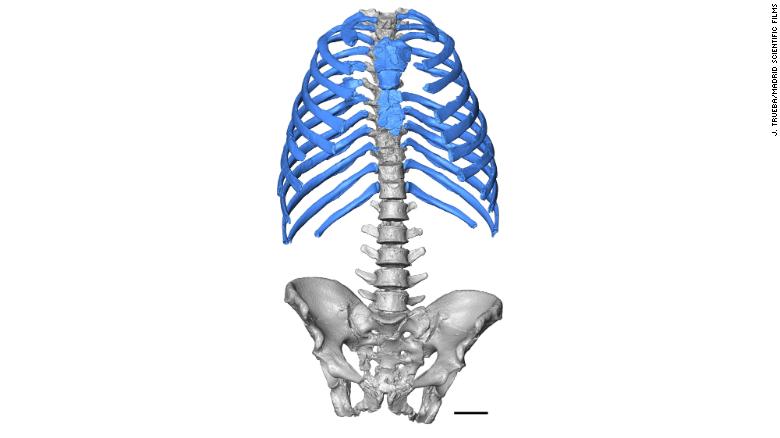
    Neanderthal ribs connected to the spine more inwardly, which forces the chest cavity out and causes the spine to tilt back. The result is a spinal column that lacks the lumbar curve of modern humans. This skeletal structure not only provided Neanderthals with more stability but also allowed for a larger diaphragm and more lung capacity.

    The skeleton analyzed by the research team was first uncovered in 1983 in Israel’s Kebara Cave and is considered to be the most complete Neanderthal remains to date, although missing a cranium. In life, the male Neanderthal, known as Kebara 2, stood around 168 centimeters (5 1/2 feet) tall and weighed 75 kilos (166 pounds). He walked the planet about 60,000 years ago and died at the age of 32.

    The novel 3D modeling used in the study could open up this field of research.

    Reference:

    Asier Gómez-Olivencia et al. 3D virtual reconstruction of the Kebara 2 Neandertal thorax https://doi.org/10.6084/m9.figshare.7012256

    Homo Neanderthalensis Neanderthal
    Share. Facebook Twitter Pinterest LinkedIn Tumblr Email Copy Link

    Related Posts

    Northern Europeans’ Genetic Pre-Historic is Repeated Genocide

    February 6, 2024

    Sets of 120,000-Year-Old Footprints Belonging to Humans Have Been Discovered in Saudi Arabia

    September 29, 2020

    Ancient Footprints Show Neanderthals May Have Been Taller than Thought

    May 14, 2020

    Fascinating Discovery Suggests Neanderthals Invented String

    April 13, 2020

    The oldest known Homo sapiens outside Africa was Greek

    July 15, 2019

    Jawbone Fossil Reveals More About the Denisovans

    May 6, 2019
    Recent Posts
    • The Day the Alliance Died
    • Evaluating Heart Disease: How Cumulative Diet Choices Compound Your Risk
    • What Would Happen If China Attacked Taiwan?
    • Geopoliticisation as a Structural Tailwind for Commodity Prices
    • America’s Economic Remodel: Who’s Really Paying the Bill?
    • Why Inflation May Be Preparing for a Second Act
    • How the End of Bretton Woods Reshaped Our Economies — and Our Politics
    • Can the U.S. Really Handle 250% Debt-to-GDP? Why Jackson Hole’s Daring Paper Is Wrong
    • Japan’s Fiscal Trap: What Happens If Austerity Is No Longer an Option?
    • The Rise of Range Extended Electric Vehicles (REEVs): A New Era of Hybrid Mobility
    © 2025 Illustrated Curiosity

    Type above and press Enter to search. Press Esc to cancel.