

We all know that plant and animal species across the world are steadily disappearing due to human activity. But despite all the gloomy reports about the present state and future scenarios published, it is possible to reverse the negative trend according to a new comprehensive study.
Biodiversity is the variety and abundance of species, along with the extent and quality of the ecosystems that these species live in – has been declining at an alarming rate for many years. It is clear that we cannot allow the current trend to continue. If it does, there will simply not be enough nature left to support future generations.
It is possible to reverse the negative trend and at the same time as we produce enough food for a growing world population – according to a new study published in the journal Nature.
But to do so, much more comprehensive action is required in both agriculture and nature conservation. A big lesson from this study is that we cannot focus on nature conservation measures alone, no measures alone will be enough to mitigate the current trend. But by combining them in a somewhat smart and efficient way, you can actually achieve the goals that we hope for, according to the study.
Food is a crucial question for whether we want to preserve the earth’s wide variety of life forms and environments, to ensure that natural resources are used in a sustainable way. For food production, land requires space, and the more the crops spread out, the less space the animals and plants have to live on.
In the new study, an international research group, therefore, presents seven future scenarios that combine various major initiatives that preserve nature, both from the point of view of nature conservation and the global food supply.
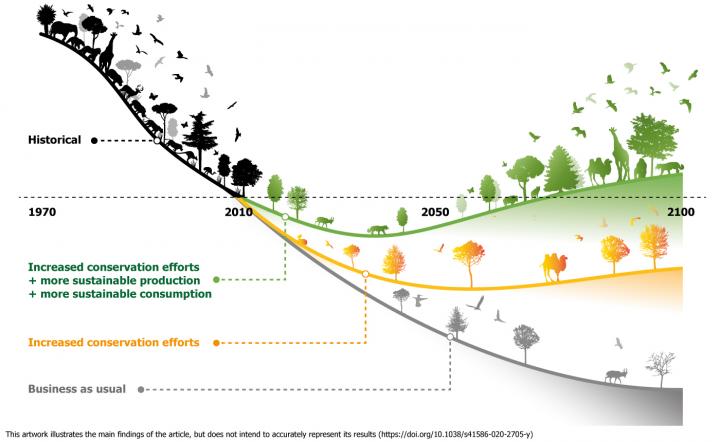
The researchers found that there was one scene where the loss of biodiversity can be stopped by the year 2050, in line with the ambitions of the UN Convention on Biological Diversity.
This scenario combines ambitious, integrated action combining conservation and restoration efforts with a transformation of the food system. It outlines a combination of increased investments in nature conservation as protected areas, and more environmentally friendly agriculture together with reduced food waste and less meat consumption.
The study assumes that protected areas quickly reach 40% of global terrestrial areas. This should happen in tandem with large efforts to restore degraded land (reaching about 8% of terrestrial areas by 2050 in the study scenarios) and land use planning efforts that balance production and conservation objectives on all managed land.
“In a scenario with increased conservation and restoration efforts alone, almost half of biodiversity losses estimated in the counterfactual business-as-usual scenario could not be avoided, a bending was not observed for all models, and when it did occur, it was often only in the second half of the 21st century. In addition, we found that bold conservation and restoration efforts alone might increase the price of food products, thereby potentially hampering future progress on eliminating hunger,”
Additional measures are needed to address global pressures on the food system. Efforts to bend the curve of global terrestrial biodiversity include reduced food waste, diets that have a lower environmental impact, and further sustainable intensification and trade.
Integrated action would however need to be taken in both areas simultaneously to bend the biodiversity loss curve upward by 2050 or earlier. According to the authors, a true reversal of biodiversity declines will however likely necessitate an even broader set of actions, addressing biodiversity loss jointly with climate change.
Reference:
D. Leclère et al. Bending the curve of terrestrial biodiversity needs an integrated strategy. Nature 10 September 2020. DOI: 10.1038/s41586-020-2705-y.