
We could reach The Paris Agreement’s 1.5-degree target with half as much money as has now been invested in economic recovery due to the corona pandemic, according to a new study.
To date, the countries of the world have invested a total of $ 12 trillion in crisis aid as a result of the corona pandemic. This response is three times larger than the 2008-2009 global financial crisis recovery spending and represents around 15 percent of global gross domestic product (GDP).
A new analysis published today in Science, led by researchers from Imperial College London, Climate Analytics in Berlin, and the Electric Power Research Institute in the United States, shows that if just a tenth of this money was invested each year over the next five years in climate-positive recovery plans for the global energy system, the world could be put on track to meet the goals of the Paris Agreement.
In total, this investment is of about half of what the countries of the world have so far invested in corona recovery would be needed.
The Paris Agreement is an agreement within the United Nations Framework Convention on Climate Change (UNFCCC), dealing with greenhouse-gas-emissions mitigation, adaptation, and finance, signed in 2016.
The Agreement’s long-term temperature goal is to keep the increase in global average temperature to well below 2 °C (3.6 °F) above pre-industrial levels; and to pursue efforts to limit the increase to 1.5 °C (2.7 °F), recognizing that this would substantially reduce the risks and impacts of climate change.
To reach the goal as agreed upon in the Paris Agreement will require a reduction in the use of fossil fuels, a shift to low-carbon renewable sources of energy, such as solar and wind power, and large improvements in energy efficiency.
Current efforts by governments worldwide are insufficient to reach the Paris Agreement goals. In fact, today’s policies are instead leading us towards a world 3°C above pre-industrial averages.
The new analysis shows that an ambitious path to a 1.5°C world is well within reach if just a fraction of COVID-19 funding is invested in a ‘climate-positive’ recovery, with the dual aims of stimulating the global economy and accelerating the deployment of low-carbon energy supply and energy efficiency measures. This could be achieved, for example, via direct stimulus and investments as well as via supporting policies such as incentives and rebates.
“If just a fraction of this money was invested in climate-positive recovery plans, the world could achieve net-zero carbon energy by mid-century,”
“This is not about diverting money from COVID-19 stimulus or other low-carbon investments in industry, research & development, but providing for the win-win solution of a boosted economy that simultaneously helps our efforts to stall climate change.”
– First author Marina Andrijevic, from Climate Analytics and Humboldt University
The analysis also showed that addressing both crises will be easier for some countries than others and highlights the necessity for international collaboration so that a climate-positive recovery benefits everyone, everywhere.
Covid-19 stimulus packages (left-hand bars) compare to the annual investment needed for a Paris-compatible pathway (middle) and the shift required compared to existing policies (right-hand).
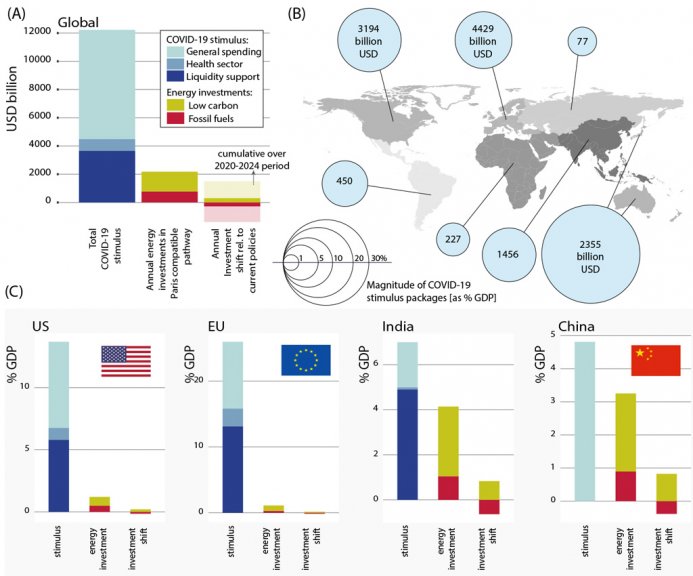
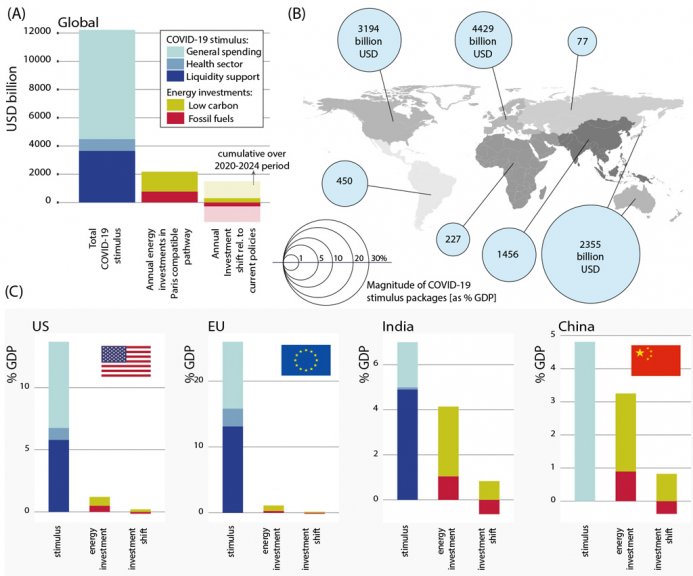
The team’s analysis shows that a climate-positive recovery also needs a strong, near-term focus on actively avoiding a polluting recovery, such as stimulus packages that bailout fossil fuels.
“Our findings show that investing in solutions to limit warming to 1.5°C is well within budget. In fact, the increase in low-carbon energy investments required over the next five years to move the world on track to meet the Paris Agreement targets is about eight times smaller than the total current COVID-19 stimulus.”
– Senior author Dr. Joeri Rogelj, from the Grantham Institute
The analysis shows that this will be easier for some countries than others. The US and the European Union have pledged the most in post-pandemic recovery, and also need to invest the least, relative to the size of their economies, in low-carbon energy to be on track to reach the Paris Agreement goals. Meanwhile, emerging economies like India have put forward less funding for pandemic recovery, but require proportionally more investments to provide their populations with reliable, clean, and affordable energy.
The last decade was the hottest on record, according to independent data analyses from NASA and the US National Oceanic and Atmospheric Administration. The reality of climate change is sinking in, with millions now feeling its effects—from rising sea levels and disappearing coastlines to more frequent extreme weather such as droughts, floods, and wildfires.
Reference:
Marina Andrijevic, Carl-Friedrich Schleussner, Matthew J. Gidden, David L. McCollum, Joeri Rogelj COVID-19 recovery funds dwarf clean energy investment needs DOI: 10.1126/science.abc9697