
Scientists have gathered some of the most compelling evidence yet for the existence of water on the moon – and it may be relatively accessible. The discovery has implications for future missions to the moon and deeper space exploration.
Now, this is not the first time water has been indicated on the moon but its the best evidence of its existenace yet.
If human civilization would ever to build bases on the Moon, those bases will need water. Residents will require it not only for their own sustenance but also as a raw material for rocket fuel to power further adventures in our solar system, beyond our near neighborhood.
Given the cost of blasting things off the surface of gravity-well Earth, however, such a bridgehead base would be best served by finding its water locally. A pair of studies published on October 26th, in Nature Astronomy, would therefore raise the hope of future would-be lunar settlers.
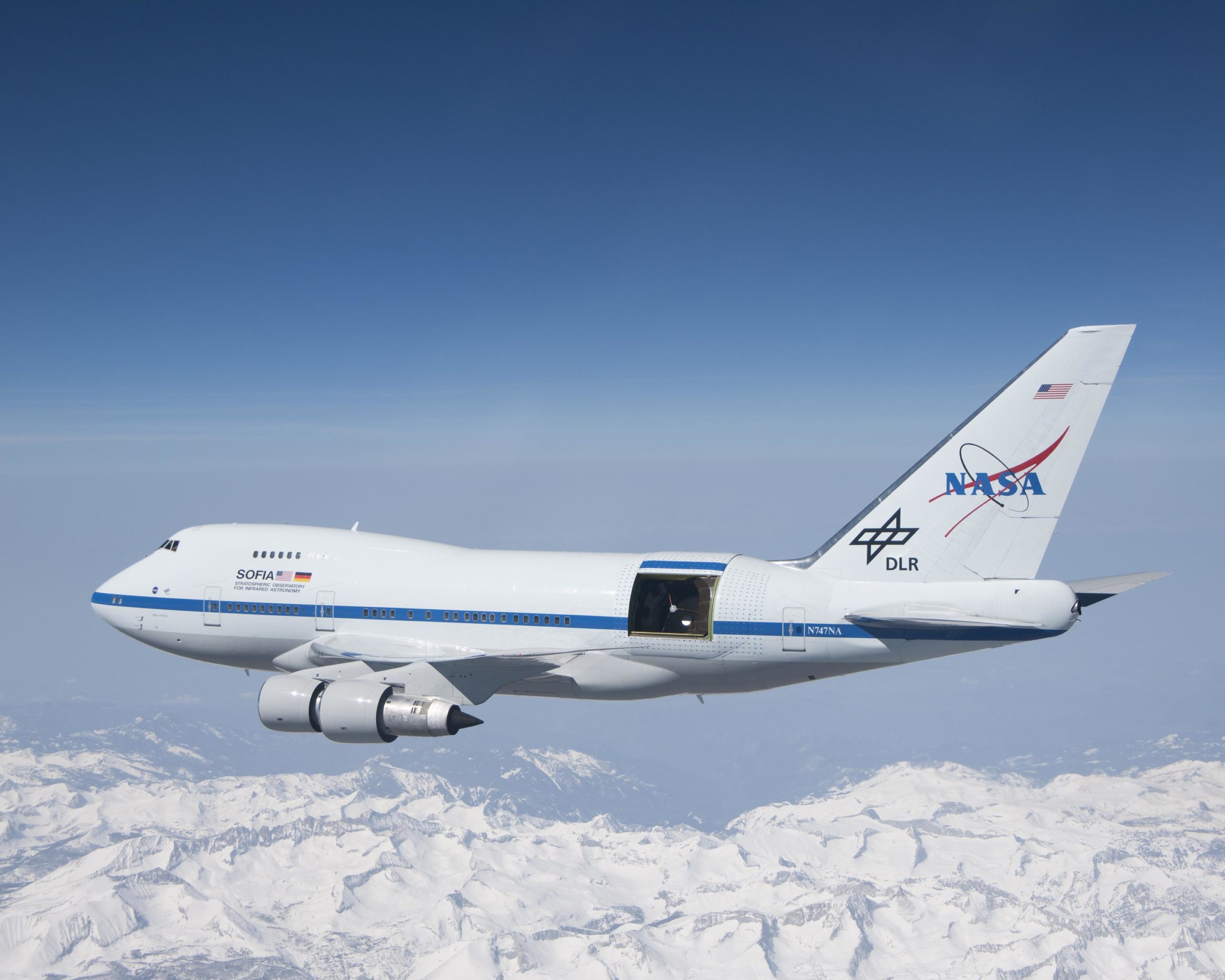
Now, Casey Honniball at Nasa’s ASA Goddard Space Flight Center in Maryland, US, and colleagues have detected a chemical signature that is unambiguously H2O, by measuring the wavelengths of sunlight reflecting off the moon’s surface. The data was gathered by the Stratospheric Observatory for Infrared Astronomy (Sofia), a modified Boeing 747 carrying a 2.7-meter reflecting telescope.
Unlike previous detections of water in permanently shadowed parts of lunar craters, the scientists detected the molecule in sunlit regions of the Moon’s surface. These new discoveries suggest that water is more abundant than previously thought.
“The amount of water is roughly equivalent to a 12-ounce bottle of water in a cubic meter of lunar soil.”
– Speaking during a virtual teleconference, co-author Casey Honniball, a postdoctoral fellow at Nasa’s Goddard Space Flight Center in Maryland.
The researchers think it is stored in bubbles of lunar glass or between grains on the surface that protect it from the harsh environment. Since this fine water ice is likely to be everywhere on the moon – not just in this one crater – the total quantity could be enormous.
However, how deep this newly confirmed water source extends is yet unknown. If it is restricted to the uppermost few microns or millimeters, then its practical significance would be minimal and the only real way to find out is to go to the moon and start drilling.
Although extracting it might be tricky, harvesting it from dark, steep-walled craters where the temperature rarely climbs above -230C – which is where the bulk of any frozen water was assumed to lie – would be a perilous undertaking.
In the other study, scientists looked for permanently shadowed areas – known as cold traps – where water could be captured and remain permanently. They found these cold traps at both poles and concluded that “approximately 40,000 kilometers squared of the lunar surface has the capacity to trap water”.
The researchers believe these small regions are cold enough to store frozen ice. Unlike the giant craters at the south pole, these ones are small and easy for, say, an astronaut to reach.
“There are billions and billions of them, which means that you could land in an area that is lit by the Sun, and then bend over or get down on your hands and knees and extract samples from these micro-cold traps,”
– Paul Hayne, a planetary scientist at the University of Colorado and a lead author on one of the Nature studies.
The existence of water has implications for future lunar missions because it could be treated and used for drinking; separated into hydrogen and oxygen for use as a rocket propellant; and the oxygen could be used for breathing.
The NASA VIPER (Volatiles Investigating Polar Exploration Rover) is a lunar rover currently planned to be delivered to the surface of the Moon in November 2023. The rover will be tasked with prospecting for lunar resources in permanently shadowed areas in the lunar south pole region, especially by mapping the distribution and concentration of water ice
The Viper will map where the water ice is on the surface and collect samples. But even before that happens, a private company called Intuitive Machines plans to send a robotic lander to the lunar surface in 2022, equipped with the same drill that Viper will use. That mission, done in partnership with NASA, should demonstrate if the drill is able to work and scoop up some of this water ice.
Data from those rovers, combined with future remote observations, will eventually determine whether future lunar astronauts will be able to use any of this water.
Reference:
Honniball, C.I., Lucey, P.G., Li, S. et al. Molecular water detected on the sunlit Moon by SOFIA. Nat Astron (2020). https://doi.org/10.1038/s41550-020-01222-x
Hayne, P.O., Aharonson, O. & Schörghofer, N. Micro cold traps on the Moon. Nat Astron (2020). https://doi.org/10.1038/s41550-020-1198-9