Close Menu
Illustrated Curiosity | Economics, History, Science, Space, Technology, Health, Physics, Earth
    Facebook X (Twitter) Instagram YouTube
    Illustrated Curiosity | Economics, History, Science, Space, Technology, Health, Physics, Earth
    • Earth
    • Economics
    • Environment
      • Environmental Tech
      • Pollution
      • Wildlife
    • Health
      • Health Tech
      • Medicine
      • Nutrition
      • Exercise
    • History
      • Prehistory
      • Ancient History
      • Postclassical Era
      • Modern History
    • Humans
      • Human Brain
      • Psychology
    • Life
      • Animals & Plants
      • Genetics
      • Paleontology
      • Evolution
      • Genetic Engineering
    • Physics
    • Space
      • Astrobiology
      • Astronomy
      • Extrasolar Planets
      • Space Tech
      • Spaceflight
    • Technology
      • Artificial Intelligence
      • Energy
      • Engineering
      • Materials
      • Robotics
      • Vehicles
    Illustrated Curiosity | Economics, History, Science, Space, Technology, Health, Physics, Earth
    Home » A ‘Bridge’ 10 Million-Light Years Long Links Colliding Galaxy Clusters
    Astronomy

    A ‘Bridge’ 10 Million-Light Years Long Links Colliding Galaxy Clusters

    June 10, 20192 Mins Read
    NASA
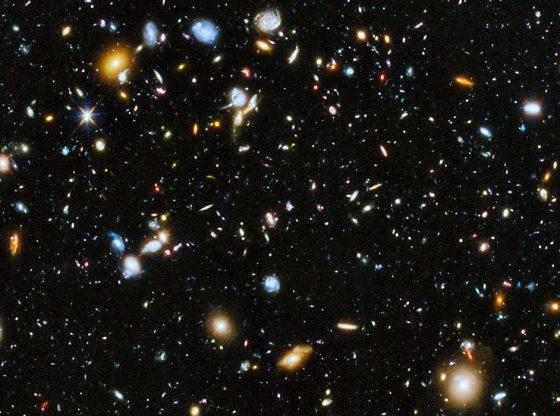
    This portrait of our universe's history is called the Hubble Ultra Deep Field (or HUDF). It is a minuscule patch of sky first targeted by the Hubble Space Telescope in 2002 and revisited over and over again since then. This version of the HUDF is extra special, though. It combines observations of the field taken with Hubble's Advanced Camera for Surveys and the Wide Field Camera 3 from 2002 to 2012, providing one of the farthest views into the universe we've ever seen. Plus, it includes light not just from the visible part of the spectrum but from the (invisible) infrared and ultraviolet ranges, too, giving us different details of the story of how galaxies came to be. Infrared light lets us see the universe's youngest galaxies. These galaxies lie far, far away from us, and as their light travels across the universe, it gets stretched by the expansion of space. Wavelengths of visible light grow longer, becoming infrared light by the time it reaches us. Combining Hubble's observations of the HUDF in visible and infrared light, a team of astronomers led by Garth Illingworth of the University of California identified more than 5,500 galaxies in a central portion of the field, some so faint that they are just one ten-billionth the brightness of what the human eye can see. Image: NASA
    Share
    Facebook Twitter LinkedIn Pinterest Email

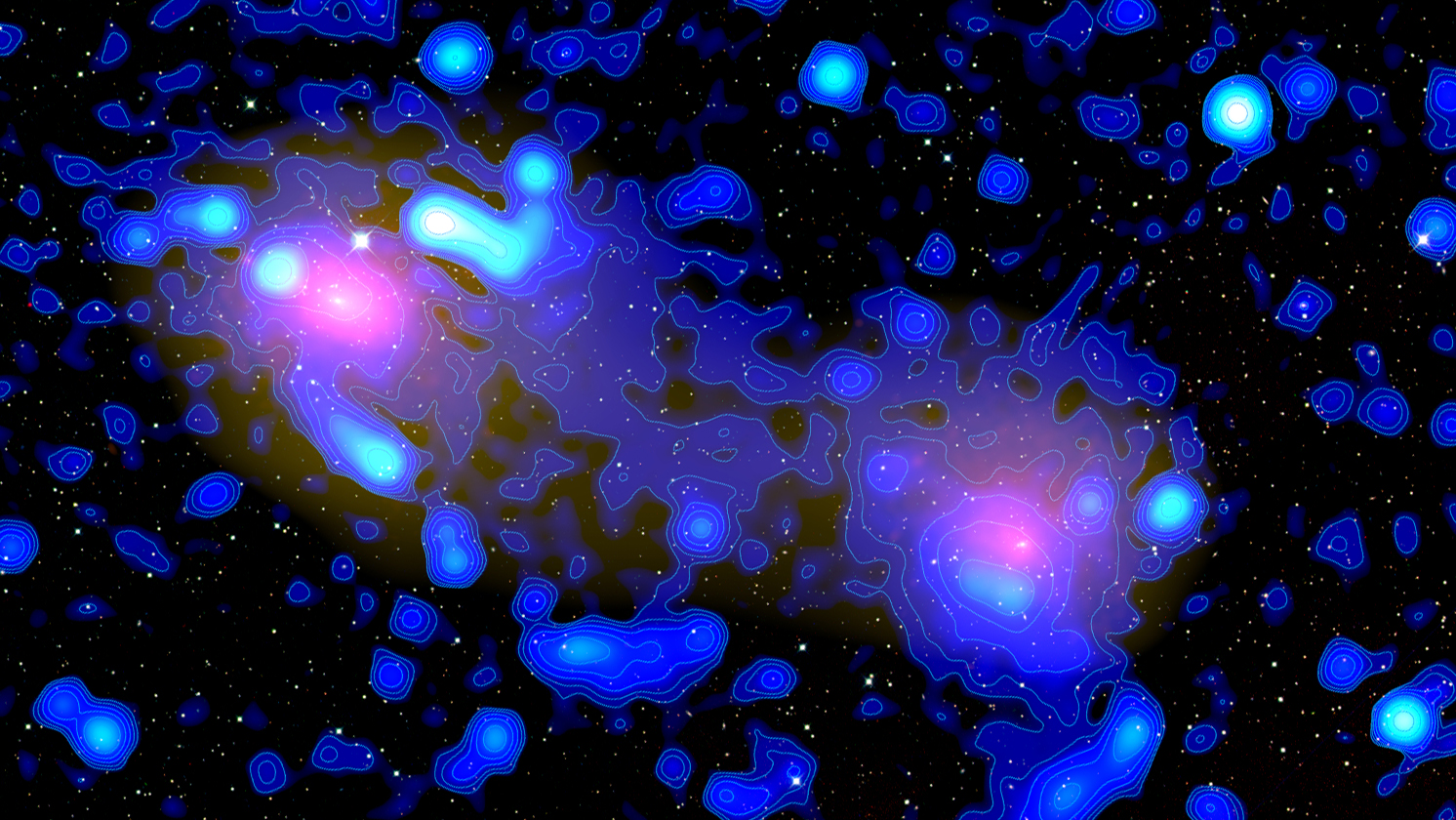
    Astronomers have spotted a bridge of radio emissions 10 million light-years long joining two galaxy clusters that are slowly colliding with each other.

    The bridge stretches more than nine million light-years across and traces one of the filaments in the so-called cosmic web, the structure thought to describe the large-scale organization of the universe.

    A team of astronomers led by Federica Govoni at the Italian National Institute for Astrophysics has discovered, for the first time, a “ridge” of plasma emitting radio waves and connecting two galaxy clusters in the process of merging: Abell 0399 and Abell 0401.

    This ridge is part of the cosmic web along which galaxy clusters tend to gather, stretches for about 10 million light-years, and shows evidence of both a magnetic field and relativistic particles — electrons moving at close to the speed of light.
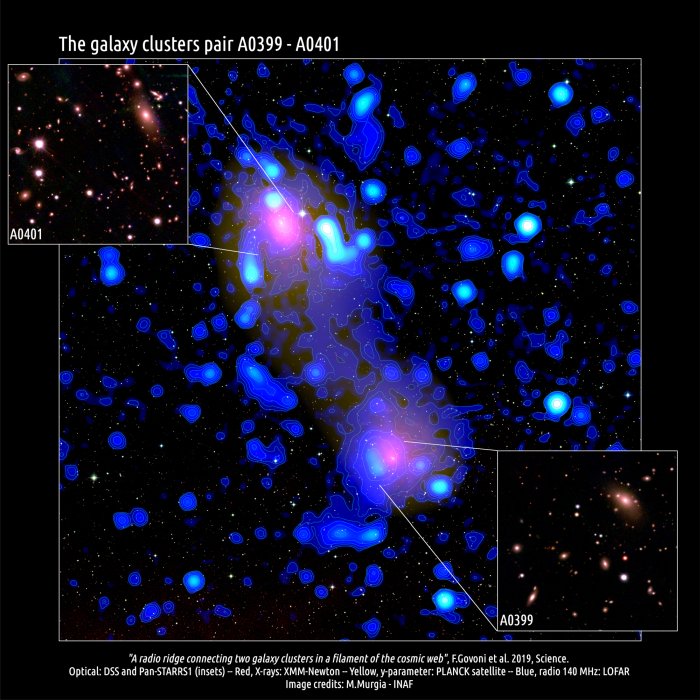
     

    Researchers used the Low-Frequency Array telescope network to observe the two galaxy clusters. They found a strip of radio emissions extending for millions of light years. The presence of the emissions suggests that within the filament, there is a magnetic field and relativistic electrons—the structure is larger than any other model can account for.

    Since electrons could only travel at relativistic speeds required for distances far shorter than the length of the filament. This fact, the researchers say, must mean that there is some unknown mechanism that re-accelerates the electrons.

    The discovery is exciting as it provides an insight into how the cosmic web really works. But the findings suggest current theories about particle acceleration in intergalactic space need to be revisited.

    The research has been published in Science.

    Reference:

    F. Govoni1 et al. A radio ridge connecting two galaxy clusters in a filament of the cosmic web DOI: 10.1126/science.aat7500
    Share. Facebook Twitter Pinterest LinkedIn Tumblr Email Copy Link

    Related Posts

    The James Webb Space Telescope DeliversThe Deepest Image of the Universe (yet)

    July 13, 2022

    There Is Now Rigorous Evidence for Water on the Moon

    November 2, 2020

    The Dwarf Planet Ceres Might Be Home to an Underground Ocean of Water

    August 12, 2020

    Mysterious Repeating Fast Radio Burst Traced to Nearby Galaxy

    January 13, 2020

    Mercury Transit 2019 4K UHD

    November 12, 2019

    A Second Interstellar Visitor Detected in Our Solar System

    September 20, 2019
    Recent Posts
    • The Day the Alliance Died
    • Evaluating Heart Disease: How Cumulative Diet Choices Compound Your Risk
    • What Would Happen If China Attacked Taiwan?
    • Geopoliticisation as a Structural Tailwind for Commodity Prices
    • America’s Economic Remodel: Who’s Really Paying the Bill?
    • Why Inflation May Be Preparing for a Second Act
    • How the End of Bretton Woods Reshaped Our Economies — and Our Politics
    • Can the U.S. Really Handle 250% Debt-to-GDP? Why Jackson Hole’s Daring Paper Is Wrong
    • Japan’s Fiscal Trap: What Happens If Austerity Is No Longer an Option?
    • The Rise of Range Extended Electric Vehicles (REEVs): A New Era of Hybrid Mobility
    © 2025 Illustrated Curiosity

    Type above and press Enter to search. Press Esc to cancel.