Close Menu
Illustrated Curiosity | Economics, History, Science, Space, Technology, Health, Physics, Earth
    Facebook X (Twitter) Instagram YouTube
    Illustrated Curiosity | Economics, History, Science, Space, Technology, Health, Physics, Earth
    • Earth
    • Economics
    • Environment
      • Environmental Tech
      • Pollution
      • Wildlife
    • Health
      • Health Tech
      • Medicine
      • Nutrition
      • Exercise
    • History
      • Prehistory
      • Ancient History
      • Postclassical Era
      • Modern History
    • Humans
      • Human Brain
      • Psychology
    • Life
      • Animals & Plants
      • Genetics
      • Paleontology
      • Evolution
      • Genetic Engineering
    • Physics
    • Space
      • Astrobiology
      • Astronomy
      • Extrasolar Planets
      • Space Tech
      • Spaceflight
    • Technology
      • Artificial Intelligence
      • Energy
      • Engineering
      • Materials
      • Robotics
      • Vehicles
    Illustrated Curiosity | Economics, History, Science, Space, Technology, Health, Physics, Earth
    Home » The Universe May Be Billions of Years Younger Than We Thought
    Astronomy

    The Universe May Be Billions of Years Younger Than We Thought

    September 16, 20194 Mins Read
    Share
    Facebook Twitter LinkedIn Pinterest Email
    NASA
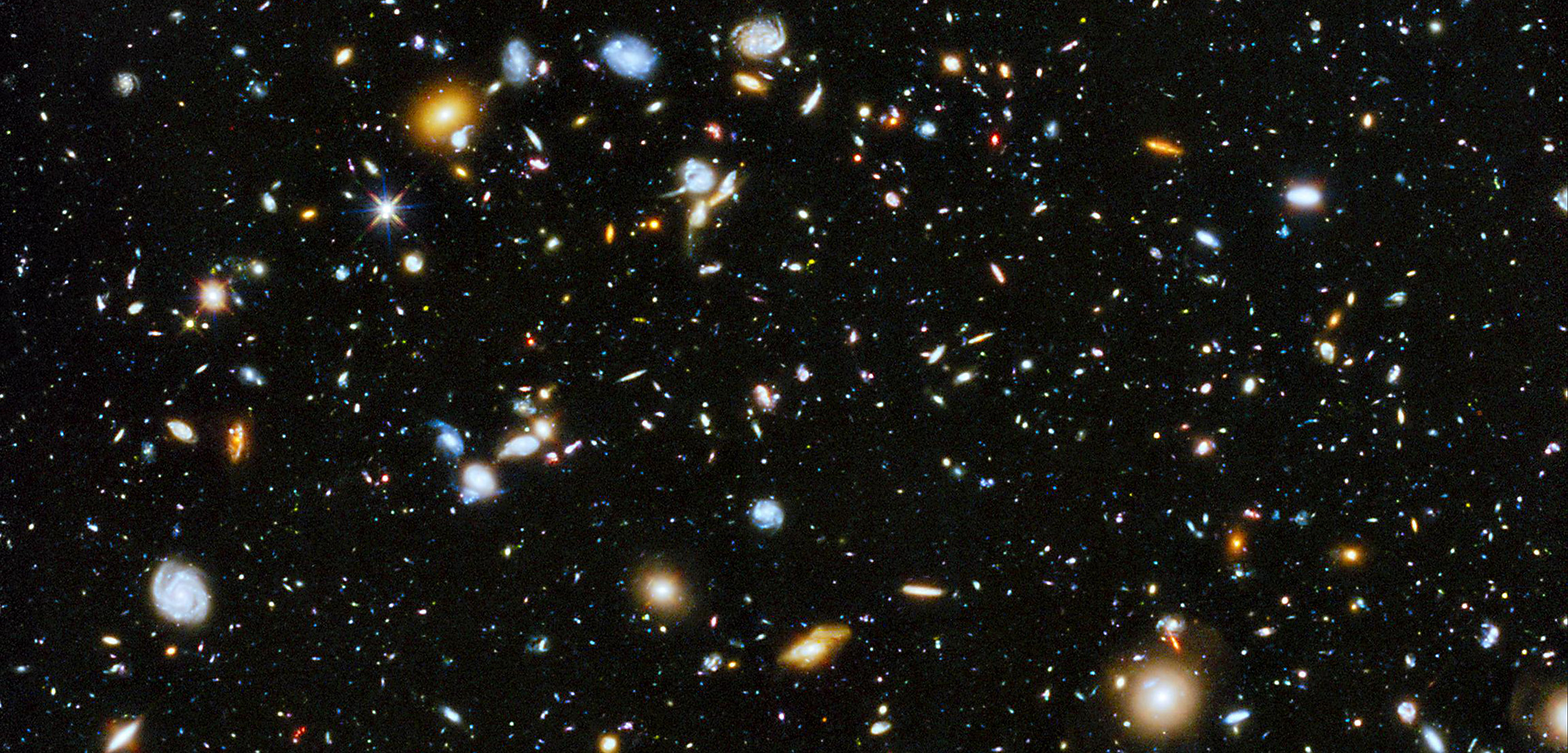
    This portrait of our universe’s history is called the Hubble Ultra Deep Field (or HUDF). It is a minuscule patch of the sky first targeted by the Hubble Space Telescope in 2002 and revisited over and over again since then. This version of the HUDF is extra special, though. It combines observations of the field taken with Hubble’s Advanced Camera for Surveys and the Wide Field Camera 3 from 2002 to 2012, providing one of the farthest views into the universe we’ve ever seen. Plus, it includes light not just from the visible part of the spectrum but from the (invisible) infrared and ultraviolet ranges, too, giving us different details of the story of how galaxies came to be. Image: NASA

    The accepted age of the universe has previously been set at 13.7 billion years – but according to the Max Planck Institute, the universe may be several billion years younger.

    Scientists estimate the age of the universe by measuring how fast it expands, which is determined by the movements of stars. A faster rate of expansion would also mean that the universe has reached its size in less time; it is thus younger.

    Hubble’s law describes how the velocity at which galaxies move away from us is proportional to their distance from the Earth. Based on a Hubble Constant (H0) of 70, the accepted age of the universe has been set at 13.7 billion years. But according to the new calculations made by researchers at the Max Planck Institute, the universe may, in fact, be several billion years younger.

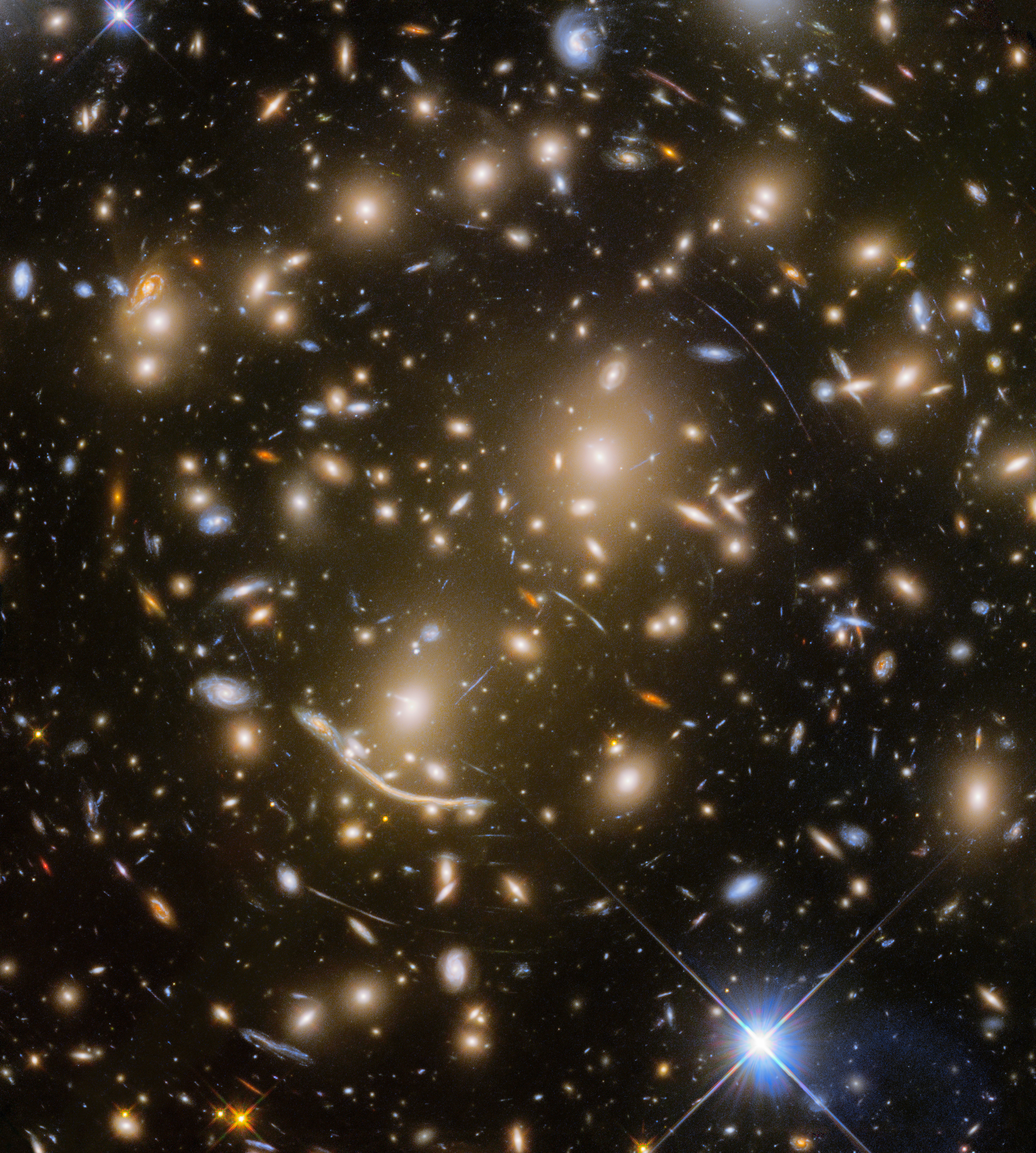
    The Max Planck research team calculated a Hubble constant of 82.4, which would make the universe about 11.4 billion years old. The researchers looked at gravitational lensing, where the light is deflected by a gravitational lens consisting of a distribution of matter – for example, a galaxy cluster. The effect can distort and enlarge the light source. The Max Planck Institute team measured differences in the brightness of different distant objects.
    NASA
    The gravity in this galaxy cluster, called Abell 370, acts as a huge lens in space, magnifying and stretching images of background galaxies like a funhouse mirror. This is called gravitational lensing and was a method astronomers used to refine the age of the universe in the new study. Image: NASA

    However, the institute points out that there is room for large margins of error in the study, not least when the researchers only used two gravitational lenses, so the universe could even turn out to be older.

    In 2013, a team looking at the cosmic background radiation arrived at a different rate of expansion and a Hubble constant equal to 67 – while Nobel Prize-winning astrophysicist Nobel laureate Adam Riess, at the Space Telescope Science Institute, with the help of NASA’s telescope, put the number at 74. Earlier this year, a team calculated the number 73.3.

    In 2013, a team of European scientists looked at leftover radiation from the Big Bang and pronounced the expansion rate a slower 67, while earlier this year, Nobel Prize-winning astrophysicist Adam Riess of the Space Telescope Science Institute used NASA’s super telescope and came up with a number of 74. And another team earlier this year came up with 73.3.

    According to the new study’s abstract, different techniques “lead to inconsistent estimates” of the measurement.

    “Observations of Type Ia supernovae (SNe) can be used to measure H0, but this requires an external calibrator to convert relative distances to absolute ones,”

    “We use the angular diameter distance to strong gravitational lenses as a suitable calibrator, which is only weakly sensitive to cosmological assumptions.”

    – The abstract reads.

    Reference:

    Jee el al., “A measurement of the Hubble constant from angular diameter distances to two gravitational lenses,” Science (2019). science.sciencemag.org/cgi/doi … 1126/science.aat7371
    Share. Facebook Twitter Pinterest LinkedIn Tumblr Email Copy Link

    Related Posts

    The James Webb Space Telescope DeliversThe Deepest Image of the Universe (yet)

    July 13, 2022

    There Is Now Rigorous Evidence for Water on the Moon

    November 2, 2020

    The Dwarf Planet Ceres Might Be Home to an Underground Ocean of Water

    August 12, 2020

    Mysterious Repeating Fast Radio Burst Traced to Nearby Galaxy

    January 13, 2020

    Mercury Transit 2019 4K UHD

    November 12, 2019

    A Second Interstellar Visitor Detected in Our Solar System

    September 20, 2019
    Recent Posts
    • Oil Shocks, Policy Mistakes, and the Risk of a Second Inflation Wave (Part II)
    • Oil Shocks, Policy Mistakes, and the Risk of a Second Inflation Wave (Part I)
    • Microsoft Stored a Movie on Glass — And It Could Last Centuries
    • AI, Automatic Stabilizers & Inflation
    • Largest Battles in History: Cannae — Rome’s Darkest Day
    • The Day the Alliance Died
    • Evaluating Heart Disease: How Cumulative Diet Choices Compound Your Risk
    • What Would Happen If China Attacked Taiwan?
    • Geopoliticisation as a Structural Tailwind for Commodity Prices
    • America’s Economic Remodel: Who’s Really Paying the Bill?
    © 2025 Illustrated Curiosity

    Type above and press Enter to search. Press Esc to cancel.