Close Menu
Illustrated Curiosity | Economics, History, Science, Space, Technology, Health, Physics, Earth
    Facebook X (Twitter) Instagram YouTube
    Illustrated Curiosity | Economics, History, Science, Space, Technology, Health, Physics, Earth
    • Earth
    • Economics
    • Environment
      • Environmental Tech
      • Pollution
      • Wildlife
    • Health
      • Health Tech
      • Medicine
      • Nutrition
      • Exercise
    • History
      • Prehistory
      • Ancient History
      • Postclassical Era
      • Modern History
    • Humans
      • Human Brain
      • Psychology
    • Life
      • Animals & Plants
      • Genetics
      • Paleontology
      • Evolution
      • Genetic Engineering
    • Physics
    • Space
      • Astrobiology
      • Astronomy
      • Extrasolar Planets
      • Space Tech
      • Spaceflight
    • Technology
      • Artificial Intelligence
      • Energy
      • Engineering
      • Materials
      • Robotics
      • Vehicles
    Illustrated Curiosity | Economics, History, Science, Space, Technology, Health, Physics, Earth
    Home » Scientists Have Discovered 300,000 New Galaxies
    Astronomy

    Scientists Have Discovered 300,000 New Galaxies

    March 12, 20193 Mins Read
    Image: NASA, Public Domain
    Share
    Facebook Twitter LinkedIn Pinterest Email
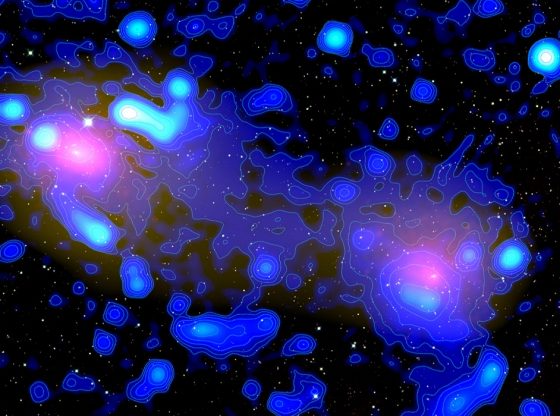
    This handout, released by Paris Observatory — PSL on Tuesday, shows an image taken with the Low-Frequency Array (LOFAR) radio telescope of diffuse emissions of material in a galaxy cluster. Image: NASA, Public Domain

    The universe just got considerably bigger after astronomers discovered almost 300,000 previously undetected galaxies.

    More than 200 astronomers from 18 countries worked together on the new Low-Frequency Array (LOFAR) telescope in the Netherlands to complete the findings. LOFAR scans the sky for low-frequency radio waves, which can detect even a slight glimmer of emissions from a galaxy.

    LOFAR is an incredibly sensitive radio survey, mapping the sky with fine detail. It’s operated by ASTRON, the Netherlands Institute for Radio Astronomy.

    Last week, the journal Astronomy & Astrophysics published a special edition dedicated to 26 research papers produced from LOFAR’s first space survey.

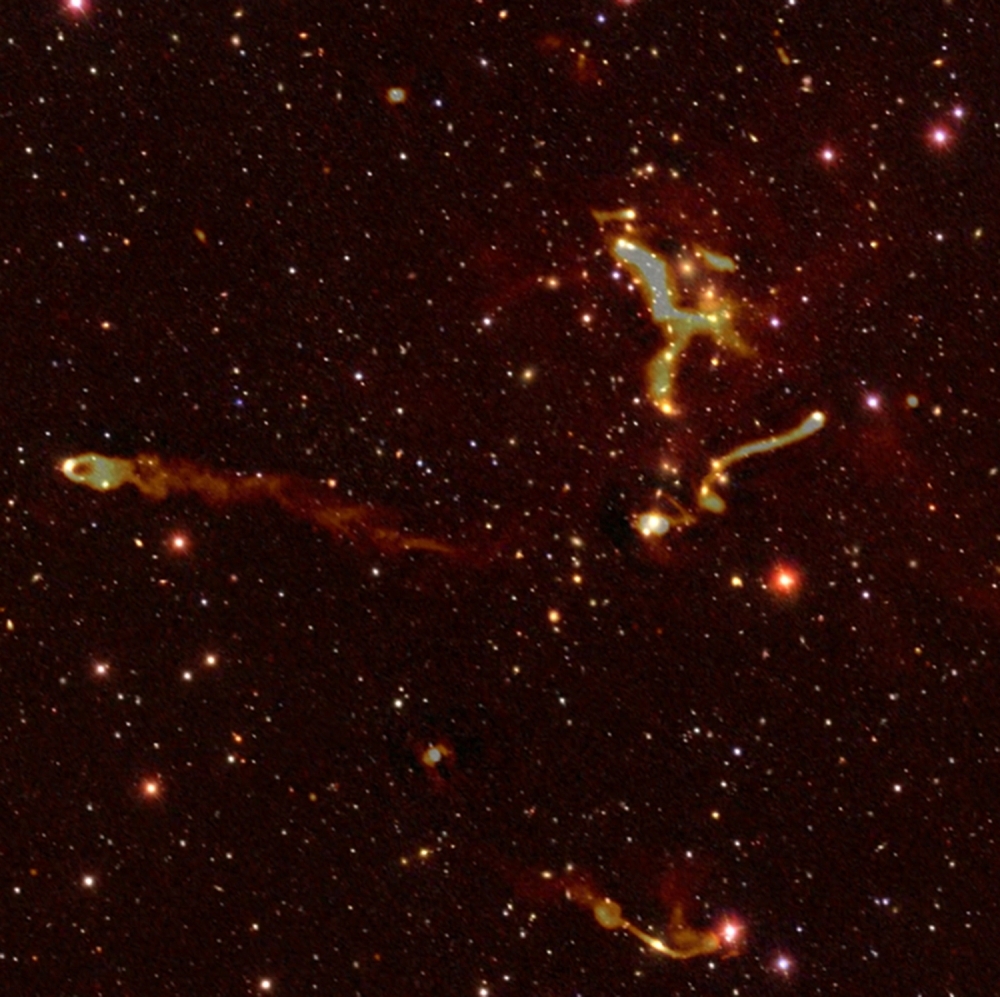
    Radio astronomy is another way of revealing the secrets of the universe that optical light can’t. Radio astronomy reveals processes in the universe that cannot be seen with optical instruments. The LOFAR telescope works by pick up traces, or “jets,” of ancient radiation produced when galaxies merge. These jets can extend over millions of light years.

    Big sky survey by @LOFAR has detected hundreds of thousands of previously undetected galaxies, shedding new light on black holes & how clusters of galaxies evolve. The first 26 articles have just been published in @AandA_journal https://t.co/CjsG9silrJ pic.twitter.com/9qWvGLV3tK

    — Low Frequency Array (@LOFAR) 19 februari 2019

    In this first part of the sky survey, LOFAR observed a quarter of the northern hemisphere at low radio frequencies. At this point, approximately 10 percent of that data has been released to the public. It maps 300,000 sources, almost all of which are galaxies in the distant universe; their radio signals have traveled billions of light years to reach Earth.

    “LOFAR has a remarkable sensitivity and that allows us to see that these jets are present in all of the most massive galaxies, which means that their black holes never stop eating,”

    – Philip Best, one of the study authors and a professor at the University of Edinburgh’s School of Physics and Astronomy, in a statement.

    The 26 papers published this week only encompass the first 2% of the sky survey. Eventually, the team hopes to have images of the entire northern sky, which would contain 15 million radio sources.

    Reference:

    LOFAR Surveys: a new window on the Universe

    Share. Facebook Twitter Pinterest LinkedIn Tumblr Email Copy Link

    Related Posts

    The James Webb Space Telescope DeliversThe Deepest Image of the Universe (yet)

    July 13, 2022

    There Is Now Rigorous Evidence for Water on the Moon

    November 2, 2020

    The Dwarf Planet Ceres Might Be Home to an Underground Ocean of Water

    August 12, 2020

    Mysterious Repeating Fast Radio Burst Traced to Nearby Galaxy

    January 13, 2020

    Mercury Transit 2019 4K UHD

    November 12, 2019

    A Second Interstellar Visitor Detected in Our Solar System

    September 20, 2019
    Recent Posts
    • Largest Battles in History: Cannae — Rome’s Darkest Day
    • The Day the Alliance Died
    • Evaluating Heart Disease: How Cumulative Diet Choices Compound Your Risk
    • What Would Happen If China Attacked Taiwan?
    • Geopoliticisation as a Structural Tailwind for Commodity Prices
    • America’s Economic Remodel: Who’s Really Paying the Bill?
    • Why Inflation May Be Preparing for a Second Act
    • How the End of Bretton Woods Reshaped Our Economies — and Our Politics
    • Can the U.S. Really Handle 250% Debt-to-GDP? Why Jackson Hole’s Daring Paper Is Wrong
    • Japan’s Fiscal Trap: What Happens If Austerity Is No Longer an Option?
    © 2025 Illustrated Curiosity

    Type above and press Enter to search. Press Esc to cancel.