Close Menu
Illustrated Curiosity | Economics, History, Science, Space, Technology, Health, Physics, Earth
    Facebook X (Twitter) Instagram YouTube
    Illustrated Curiosity | Economics, History, Science, Space, Technology, Health, Physics, Earth
    • Earth
    • Economics
    • Environment
      • Environmental Tech
      • Pollution
      • Wildlife
    • Health
      • Health Tech
      • Medicine
      • Nutrition
      • Exercise
    • History
      • Prehistory
      • Ancient History
      • Postclassical Era
      • Modern History
    • Humans
      • Human Brain
      • Psychology
    • Life
      • Animals & Plants
      • Genetics
      • Paleontology
      • Evolution
      • Genetic Engineering
    • Physics
    • Space
      • Astrobiology
      • Astronomy
      • Extrasolar Planets
      • Space Tech
      • Spaceflight
    • Technology
      • Artificial Intelligence
      • Energy
      • Engineering
      • Materials
      • Robotics
      • Vehicles
    Illustrated Curiosity | Economics, History, Science, Space, Technology, Health, Physics, Earth
    Home » Mysterious Repeating Fast Radio Burst Traced to Nearby Galaxy
    Astronomy

    Mysterious Repeating Fast Radio Burst Traced to Nearby Galaxy

    January 13, 20204 Mins Read
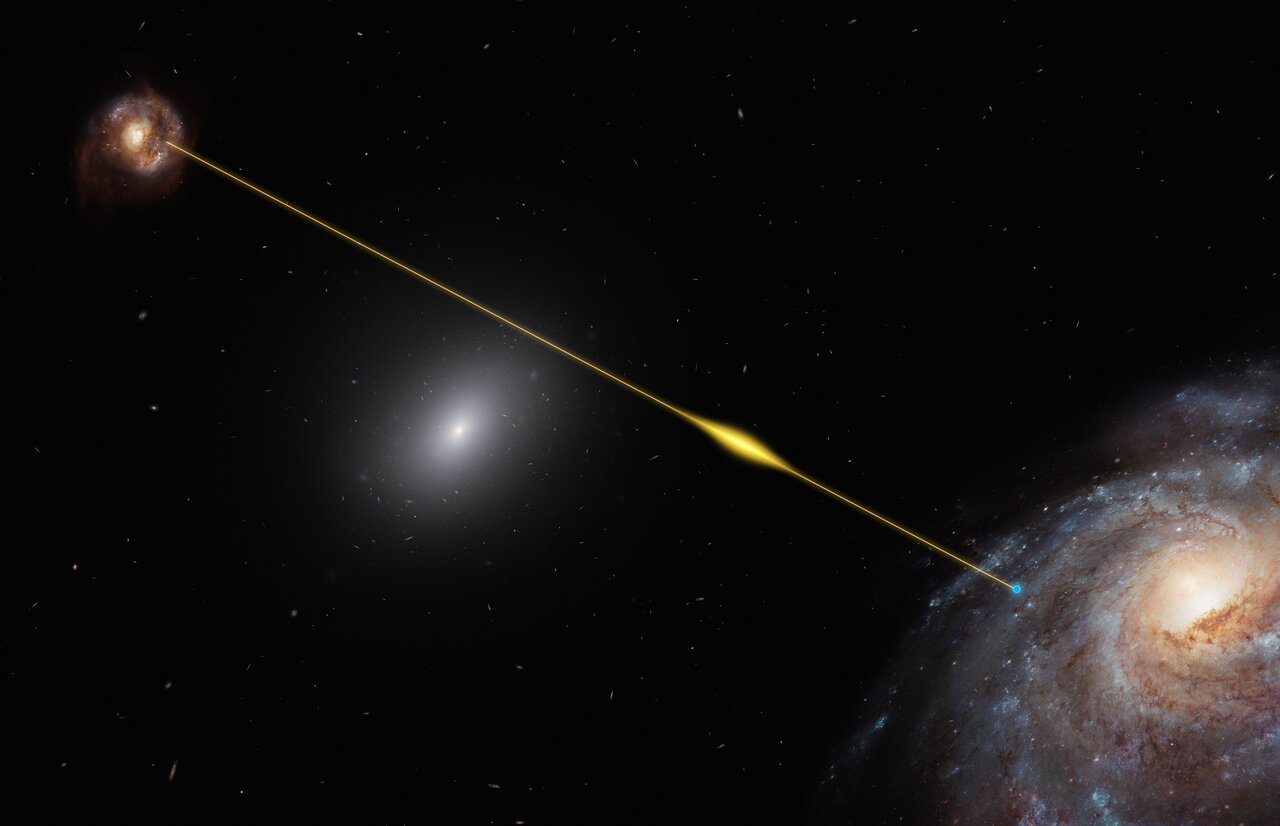
    This artist’s impression represents the path of the fast radio burst FRB 181112 traveling from a distant host galaxy to reach the Earth. FRB 181112 was pinpointed by the Australian Square Kilometre Array Pathfinder (ASKAP) radio telescope. Follow-up observations with ESO’s Very Large Telescope (VLT) revealed that the radio pulses have passed through the halo of a massive galaxy on their way toward Earth. This finding allowed astronomers to analyse the radio signal for clues about the nature of the halo gas. Image: NASA
    Share
    Facebook Twitter LinkedIn Pinterest Email
    Image credit: ESO
    This artist’s impression represents the path of the fast radio burst FRB 181112 traveling from a distant host galaxy to reach the Earth. FRB 181112 was pinpointed by the Australian Square Kilometre Array Pathfinder (ASKAP) radio telescope. Follow-up observations with ESO’s Very Large Telescope (VLT) revealed that the radio pulses have passed through the halo of a massive galaxy on their way toward Earth. This finding allowed astronomers to analyze the radio signal for clues about the nature of the halo gas. Image: NASA

    For more than a decade, astronomers across the globe have wrestled with the perplexities of fast radio bursts (FRB), intense, unexplained cosmic flashes of energy, light years away, that pop for mere milliseconds.

    These mysterious ultra-fast pinpricks of radio energy light up the night sky and nobody knows why. A newly discovered example of this fleeting phenomenon has been traced to its place of origin in a nearby spiral galaxy.

    This is the second time astronomers have traced the origin of an FRB, the first time in 2016 when a repeating FBR was traced back to a dwarf galaxy with a high rate of star formation 3 billion light-years away.

    According to a new study published in the journal Nature, the origin of this newly discovered repeating signal, known as 180916.J0158+65, is a spiral galaxy located 500 million light-years from Earth.

    The source of the FSB is seven times closer than the other repeating radio burst and more than 10 times closer than non-repeating FRBs that have been traced.

    Fast radio bursts, or FRBs, are millisecond-long bursts of radio waves in space. Individual radio bursts emit once and don’t repeat. Repeating fast radio bursts is known to send out short energetic radio waves multiple times.

    These signals are challenging to track because they had been distorted by something called the Faraday effect, which occurs when electromagnetic radiation interacts with a magnetic field.

    FRB 180916 was not nearly as distorted by the Faraday effect comparted to the 2016 FRB 121102, which indicates that its place of origin was not as magnetic, and it was found pretty far from its galaxy’s center.

    The burst was first detected by a team of researchers working at the Canadian Hydrogen Intensity Mapping Experiment, and a global effort of eight ground-based telescopes using a technique known as Very Long Baseline Interferometry managed to track the FSB to its origins.

    The team achieved a level of resolution high enough to localize the burst to a region approximately seven light-years across – a feat comparable to an individual on Earth being able to distinguish a person on the moon, according to CHIME.

    “The FRB is among the closest yet seen, and we even speculated that it could be a more conventional object in the outskirts of our own galaxy,”

    “However, the observation proved that it’s in a relatively nearby galaxy, making it still a puzzling FRB but close enough to now study using many other telescopes.”

    – Mohit Bhardwaj, study co-author and McGill University doctoral student.

    The scientists hope that further studies will reveal the conditions that result in the production of these mysterious transient radio pulses, and address some of the many unanswered questions they pose.

    “We have a new chance to perhaps detect emissions at other wavelengths — X-ray or visible light, for instance. And if we did, that would be hugely constraining of the models,”

    – Dr. Victoria Kaspi, an astrophysicist at McGill University and a leading member of the CHIME/FRB Collaboration.

    “Our aim is to precisely localize more FRBs and, ultimately, understand their origin,”

    – Dr. Jason Hessels, an astronomer at the Netherlands Institute for Radio Astronomy (ASTRON) and the University of Amsterdam

    CHIME/FRB is a collaboration of over 50 scientists led by the University of British Columbia, McGill University, the University of Toronto, the Perimeter Institute for Theoretical Physics, and the National Research Council of Canada (NRC).

    Reference:

    B. Marcote, K. Nimmo et al. A repeating fast radio burst source localized to a nearby spiral galaxy Nature volume 577, pages190–194(2020)
    Share. Facebook Twitter Pinterest LinkedIn Tumblr Email Copy Link

    Related Posts

    The James Webb Space Telescope DeliversThe Deepest Image of the Universe (yet)

    July 13, 2022

    There Is Now Rigorous Evidence for Water on the Moon

    November 2, 2020

    The Dwarf Planet Ceres Might Be Home to an Underground Ocean of Water

    August 12, 2020

    Mercury Transit 2019 4K UHD

    November 12, 2019

    A Second Interstellar Visitor Detected in Our Solar System

    September 20, 2019

    The Universe May Be Billions of Years Younger Than We Thought

    September 16, 2019
    Recent Posts
    • Largest Battles in History: Cannae — Rome’s Darkest Day
    • The Day the Alliance Died
    • Evaluating Heart Disease: How Cumulative Diet Choices Compound Your Risk
    • What Would Happen If China Attacked Taiwan?
    • Geopoliticisation as a Structural Tailwind for Commodity Prices
    • America’s Economic Remodel: Who’s Really Paying the Bill?
    • Why Inflation May Be Preparing for a Second Act
    • How the End of Bretton Woods Reshaped Our Economies — and Our Politics
    • Can the U.S. Really Handle 250% Debt-to-GDP? Why Jackson Hole’s Daring Paper Is Wrong
    • Japan’s Fiscal Trap: What Happens If Austerity Is No Longer an Option?
    © 2025 Illustrated Curiosity

    Type above and press Enter to search. Press Esc to cancel.