Close Menu
Illustrated Curiosity
    Facebook X (Twitter) Instagram YouTube
    Illustrated Curiosity
    • Earth
    • Economics
    • Environment
      • Climate
      • Environmental Tech
      • Pollution
      • Wildlife
    • Health
      • Health Tech
      • Medicine
      • Nutrition
      • Exercise
    • History
      • Prehistory
      • Ancient History
      • Postclassical Era
      • Modern History
    • Humans
      • Human Brain
      • Psychology
    • Life
      • Animals & Plants
      • Genetics
      • Paleontology
      • Evolution
      • Genetic Engineering
    • Physics
    • Space
      • Astrobiology
      • Astronomy
      • Extrasolar Planets
      • Space Tech
      • Spaceflight
    • Technology
      • Artificial Intelligence
      • Energy
      • Engineering
      • Materials
      • Robotics
      • Vehicles
    Illustrated Curiosity
    Home » A Huge Crack Provides More Evidence That Africa Is Slowly Splitting into Two
    Earth

    A Huge Crack Provides More Evidence That Africa Is Slowly Splitting into Two

    April 9, 20183 Mins Read
    Share
    Facebook Twitter LinkedIn Pinterest Email
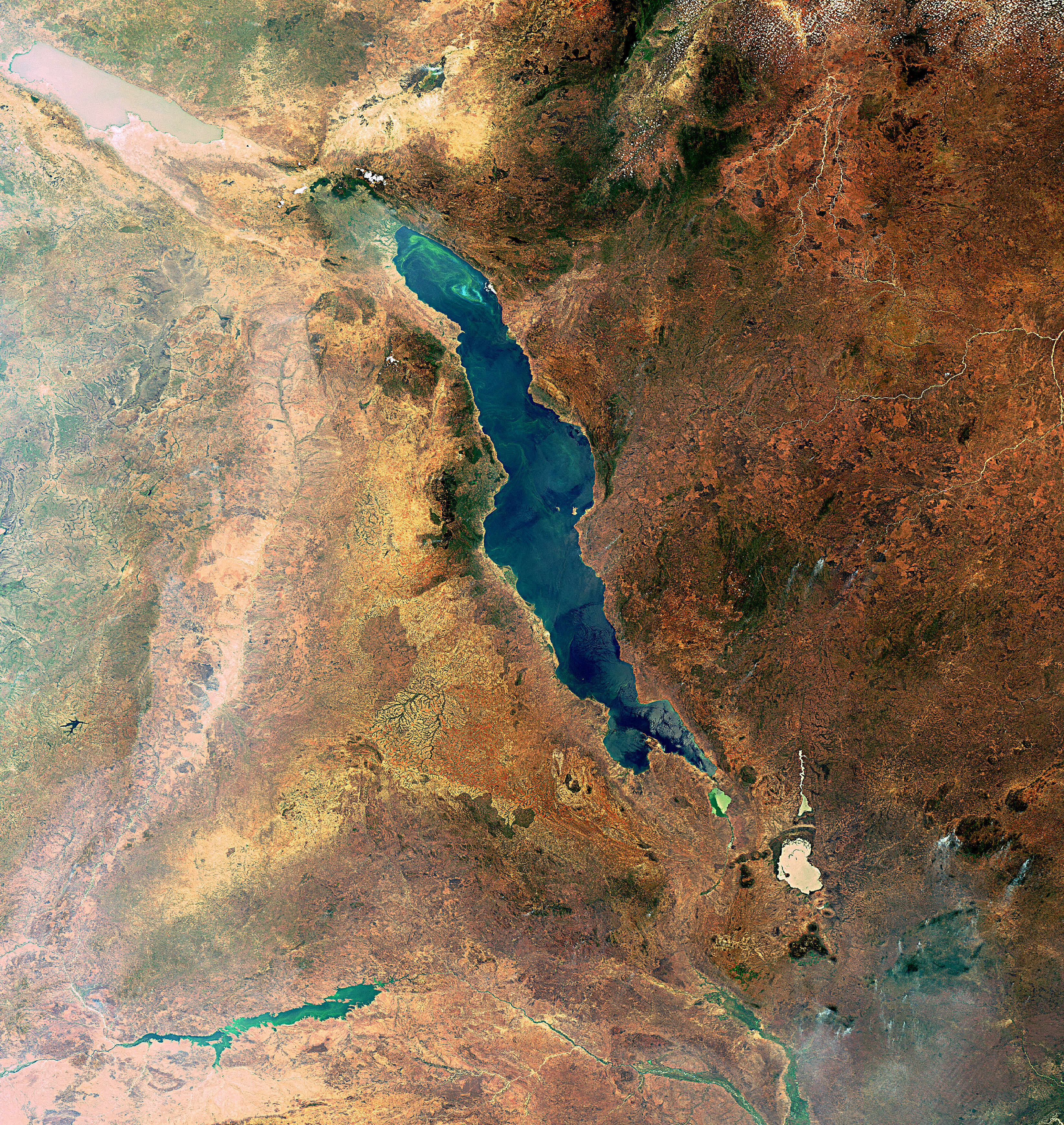
    This Envisat image features Lake Malawi in the Eastern Rift of the Great Rift Valley, a geological fault system of Southwest Asia and East Africa. The series of lakes in and around the Great Rift Valley is referred to as the ‘Great Lakes of Africa’.

    A long crack recently that dramatically emerged in the Kenyan countryside has given scientists yet more evidence that the African continent is slowly breaking apart.

    Suddenly the ground opened in zigzag. Eliud Njoroge Mbuga noticed how the crack emerged along the cement floor in his home. He managed to pick up some personal belongings and head out before the house collapsed.

    The crack spread to several kilometers in length, about 15 meters deep and up to 20 meters wide at some places.

    The triggering factor was heavy rain, but scientist now firmly believes that Africa is splitting into two parts.

    The process is going to be extremely slow, so there is little reason for locals to worry about it.

    Cracks occur from the so-called Rift Valley, a foul that extends from northern Ethiopia south to Zimbabwe. But with several other cracks occurring along northeastern Africa.
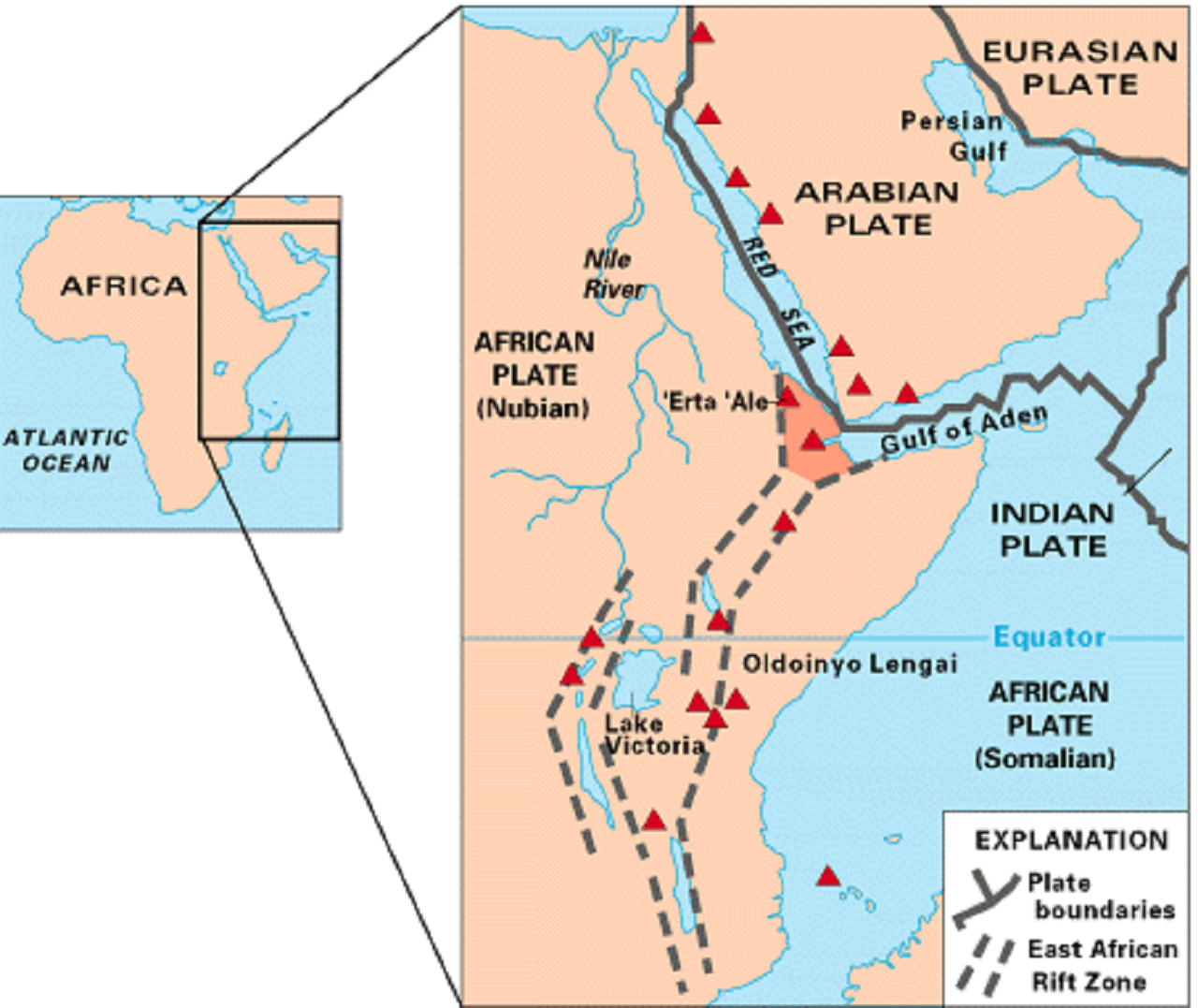
    Map of East Africa showing some of the historically active volcanoes(red triangles) and the Afar Triangle (shaded, center) — a so-called triple junction (or triple point), where three plates are pulling away from one another: the Arabian Plate, and the two parts of the African Plate (the Nubian and the Somalian) splitting along the East African Rift Zone. The red triangles show historically active volcanoes. Image source: USGS

    The geological activity along the eastern edge of the Rift Valley became apparent when the Earth suddenly opened on the Kenyan countryside, according to Lucia Perez Diaz, a researcher in dismissal dynamics at Royal Holloway University in Great Britain.

    Besides earthquakes, the African continent splitting into two parts will also take on other characteristics. Along the Rift Valley, there are several volcanoes, of which several belong to Africa’s highest peaks.

    The East African Rift Zone includes a number of active as well as dormant volcanoes, among them: Mount Kilimanjaro, Mount Kenya, Mount Longonot, Menengai Crater, Mount Karisimbi, Mount Nyiragongo, Mount Meru and Mount Elgon, as well as the Crater Highlands in Tanzania. Active volcanos include Erta Ale, DallaFilla, and Ol Doinyo Lengai, the former of which is a continuously active basaltic shield volcano in the Afar Region of northeastern Ethiopia.

    The earthquakes resulting from the split are usually modest since the tectonic plates that are being formed are moving apart from each other, the most powerful earthquakes occur where the plates “collide” with each other.

    But East African Rift is the largest seismically active rift system on Earth today. The majority of earthquakes occur near the Afar Depression, with the largest earthquakes typically occurring along or near major border faults.[11] Seismic events in the past century are estimated to have reached a maximum moment magnitude of 7.0. The seismicity trends parallel to the rift system, with a shallow focal depth of 12–15 km (7.5–9.3 mi) beneath the rift axis.

    The Rift Valley started to form 30 million years ago near the Red Sea and the eastern plate appears to work itself southward at a rate of 2.5 to 5 centimeters per year.


    In a couple of millions of years, the sea will flow north along the rejection zone, and parts of what is Ethiopia, Somalia, Kenya, Tanzania, and Mozambique will eventually end up on a new plate and leave the rest of Africa behind.
    Share. Facebook Twitter Pinterest LinkedIn Tumblr Email Copy Link

    Related Posts

    The Looming Giant: Grindavik’s Potential Volcanic Eruption and its Global Implications

    November 13, 2023

    Small Warning Signs Can Reveal Volcano Eruption – before the Disaster

    October 3, 2019

    Massive Crater under Greenland’s Ice Points to Climate-Altering Impact in the Time of Humans

    November 19, 2018

    Earth’s Core Is Actually Solid According to New Research

    October 22, 2018

    Tree Ring Dating Confirms Historical Accounts of ‘Blood Aurora’ as Extreme Cosmic Radiation

    October 18, 2018

    Scientists Offer Clues to What Caused the Mass Extinction 250 Million Years Ago

    October 12, 2018
    Recent Posts
    • America’s Quiet Shift Into Fiscal Dominance: Why Inflation May Be Preparing for a Second Act
    • How the End of Bretton Woods Reshaped Our Economies — and Our Politics
    • Can the U.S. Really Handle 250% Debt-to-GDP? Why Jackson Hole’s Daring Paper Is Wrong
    • Japan’s Fiscal Trap: What Happens If Austerity Is No Longer an Option?
    • The Rise of Range Extended Electric Vehicles (REEVs): A New Era of Hybrid Mobility
    • The Great Capital Rotation: A Shift from U.S. Treasuries to Gold and Real Assets
    • The Hidden Risks of Short-Term Debt: A Balancing Act in U.S. Fiscal Policy
    • The Looming U.S. Debt Spiral: Understanding the Risks
    • The Looming Recession: Seven Economic Indicators Flashing Red for 2025
    • Europa Clipper: NASA’s Mission to Unlock the Secrets of Jupiter’s Icy Moon
    © 2025 Illustrated Curiosity

    Type above and press Enter to search. Press Esc to cancel.

    This website uses cookies to improve your experience. We'll assume you're ok with this, but you can opt-out if you wish.Accept Reject Read More
    Privacy & Cookies Policy

    Privacy Overview

    This website uses cookies to improve your experience while you navigate through the website. Out of these, the cookies that are categorized as necessary are stored on your browser as they are essential for the working of basic functionalities of the website. We also use third-party cookies that help us analyze and understand how you use this website. These cookies will be stored in your browser only with your consent. You also have the option to opt-out of these cookies. But opting out of some of these cookies may affect your browsing experience.
    Necessary
    Always Enabled
    Necessary cookies are absolutely essential for the website to function properly. This category only includes cookies that ensures basic functionalities and security features of the website. These cookies do not store any personal information.
    Non-necessary
    Any cookies that may not be particularly necessary for the website to function and is used specifically to collect user personal data via analytics, ads, other embedded contents are termed as non-necessary cookies. It is mandatory to procure user consent prior to running these cookies on your website.
    SAVE & ACCEPT