Close Menu
Illustrated Curiosity
    Facebook X (Twitter) Instagram YouTube
    Illustrated Curiosity
    • Earth
    • Economics
    • Environment
      • Climate
      • Environmental Tech
      • Pollution
      • Wildlife
    • Health
      • Health Tech
      • Medicine
      • Nutrition
      • Exercise
    • History
      • Prehistory
      • Ancient History
      • Postclassical Era
      • Modern History
    • Humans
      • Human Brain
      • Psychology
    • Life
      • Animals & Plants
      • Genetics
      • Paleontology
      • Evolution
      • Genetic Engineering
    • Physics
    • Space
      • Astrobiology
      • Astronomy
      • Extrasolar Planets
      • Space Tech
      • Spaceflight
    • Technology
      • Artificial Intelligence
      • Energy
      • Engineering
      • Materials
      • Robotics
      • Vehicles
    Illustrated Curiosity
    Home » Earth’s Largest Known Crater Found in Greenland
    Earth

    Earth’s Largest Known Crater Found in Greenland

    July 1, 2012No Comments3 Mins Read
    Share
    Facebook Twitter LinkedIn Pinterest Email
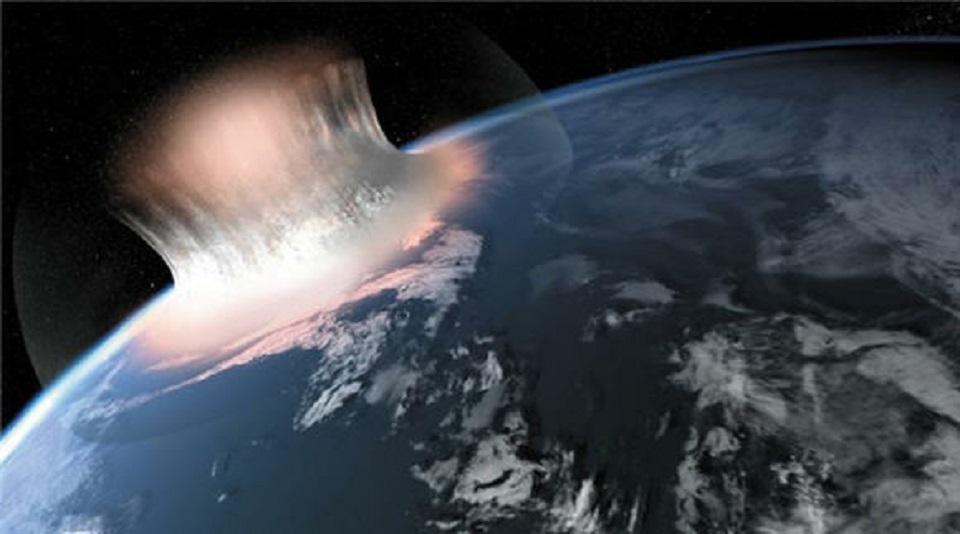
    Artist depiction of a catastrophic scenario. Image credit: NASA.


    Researchers from Denmark, Sweden and Wales have found what is the largest known meteorite crater on Earth.

    This, according to a study published this week in the journal Earth and Planetary Science Letters.

    The crater was found just nearby the town of Maniitsoq. And was probably created by a meteorite that struck the Earth about 3 billion years ago.
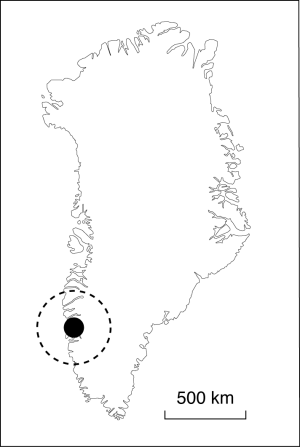
    Location of the Greenland crater

    Largest Known

    The crater has a diameter of 600 kilometers (373 miles). It is indeed huge, compared to the 177 kilometers (110 miles) Chicxulub crater that is thought to have made the dinosaurs go extinct about 65 million years ago.

    And also compared to the former “largest” crater in the history of Earth, the 300 kilometers wide Vredefort crater in South Africa. This created is what made South Africa to the gold exporter it today, with the largest known gold deposits.
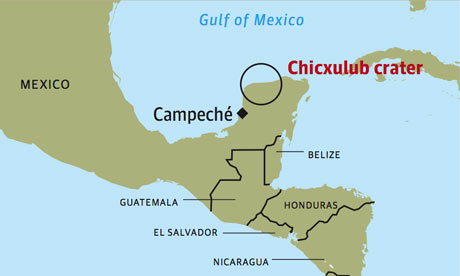
    The Chicxulub crater in Mexico. Believed to be the creation of an asteroid that made the Dinosaurs go extinct.

    Meteorite

    The Greenland meteorite had a diameter of at least 30 kilometers and struck the surface of the earth at a rate of about 20,000 meters per second.

    Scientists believe that the meteorite must have created an enormous tsunami that was well over 30 meters (100 feet) tall and traveled around the whole globe to eventually meet itself on the opposite side of Earth.

    A Scenario

    If something similar would occur on present Earth, it would likely spell the end of all higher lifeforms on our planet. Meteorites have struck the Earth on regular basis during its history of about 4,5 billion years.

    These space rocks have been fundamental for Earth as we now know it, the Earth that came to be and the life that now thrives upon it. Making this precious life almost go extinct on several occasions, but giving new life forms a chance. Life would arise and spawn new organisms from different and unique evolutionary processes. Organisms such as mammals, that was given a chance to prove themselves successful after the extinction of the dinosaurs.

    One hypothesis among scientist contributes icy comets as the origin of Earths water. Another hypothesis concern the possibility of life on Earth brought here via comets, instead of being created on the planet itself.

    NASA scientists have recently replicated the impact of a comet and demonstrated that amino acids, the building block of life, could actually have survived the intense heat and shock resulting from a collision. Meaning that life could perhaps have hitched hiked on space rocks ended up on Earth.

    Space Rock Lingo

    Asteroid – A small, irregularly shaped rocky body that orbits the Sun.
    Breccia – A coarse-grained rock composed of angular, broken rock fragments held together by a mineral cement.
    Comet – An icy extraterrestrial object that glows when it approaches the Sun, producing a long, wispy tail that points away from the Sun.
    Meteor – A glowing fragment of extraterrestrial material passing through Earth’s atmosphere.
    Meteorite – A fragment of extraterrestrial material that strikes the surface of Earth.
    Meteoroid – A small solid body floating in space.
    Shock wave – A wave of increased temperature and pressure formed by the sudden compression of the medium through which the wave moves.

    ______________
    http://www.nasa.gov/mission_pages/stardust/news/stardust_amino_acid.html
    http://www.geus.dk/geuspage-uk.htm
    ____________________________
    Comet Crater Greenland Meteor Meteorite
    Share. Facebook Twitter Pinterest LinkedIn Tumblr Email Copy Link

    Related Posts

    The Looming Giant: Grindavik’s Potential Volcanic Eruption and its Global Implications

    November 13, 2023

    Small Warning Signs Can Reveal Volcano Eruption – before the Disaster

    October 3, 2019

    Massive Crater under Greenland’s Ice Points to Climate-Altering Impact in the Time of Humans

    November 19, 2018

    Earth’s Core Is Actually Solid According to New Research

    October 22, 2018

    Tree Ring Dating Confirms Historical Accounts of ‘Blood Aurora’ as Extreme Cosmic Radiation

    October 18, 2018

    Scientists Offer Clues to What Caused the Mass Extinction 250 Million Years Ago

    October 12, 2018
    Recent Posts
    • How the End of Bretton Woods Reshaped Our Economies — and Our Politics
    • Can the U.S. Really Handle 250% Debt-to-GDP? Why Jackson Hole’s Daring Paper Is Wrong
    • Japan’s Fiscal Trap: What Happens If Austerity Is No Longer an Option?
    • The Rise of Range Extended Electric Vehicles (REEVs): A New Era of Hybrid Mobility
    • The Great Capital Rotation: A Shift from U.S. Treasuries to Gold and Real Assets
    • The Hidden Risks of Short-Term Debt: A Balancing Act in U.S. Fiscal Policy
    • The Looming U.S. Debt Spiral: Understanding the Risks
    • The Looming Recession: Seven Economic Indicators Flashing Red for 2025
    • Europa Clipper: NASA’s Mission to Unlock the Secrets of Jupiter’s Icy Moon
    • Could Hedge Funds Cause Chaos in the U.S. Treasury Market? And What About Inflation?
    © 2025 Illustrated Curiosity

    Type above and press Enter to search. Press Esc to cancel.

    This website uses cookies to improve your experience. We'll assume you're ok with this, but you can opt-out if you wish.Accept Reject Read More
    Privacy & Cookies Policy

    Privacy Overview

    This website uses cookies to improve your experience while you navigate through the website. Out of these, the cookies that are categorized as necessary are stored on your browser as they are essential for the working of basic functionalities of the website. We also use third-party cookies that help us analyze and understand how you use this website. These cookies will be stored in your browser only with your consent. You also have the option to opt-out of these cookies. But opting out of some of these cookies may affect your browsing experience.
    Necessary
    Always Enabled
    Necessary cookies are absolutely essential for the website to function properly. This category only includes cookies that ensures basic functionalities and security features of the website. These cookies do not store any personal information.
    Non-necessary
    Any cookies that may not be particularly necessary for the website to function and is used specifically to collect user personal data via analytics, ads, other embedded contents are termed as non-necessary cookies. It is mandatory to procure user consent prior to running these cookies on your website.
    SAVE & ACCEPT