Close Menu
Illustrated Curiosity
    Facebook X (Twitter) Instagram YouTube
    Illustrated Curiosity
    • Earth
    • Economics
    • Environment
      • Climate
      • Environmental Tech
      • Pollution
      • Wildlife
    • Health
      • Health Tech
      • Medicine
      • Nutrition
      • Exercise
    • History
      • Prehistory
      • Ancient History
      • Postclassical Era
      • Modern History
    • Humans
      • Human Brain
      • Psychology
    • Life
      • Animals & Plants
      • Genetics
      • Paleontology
      • Evolution
      • Genetic Engineering
    • Physics
    • Space
      • Astrobiology
      • Astronomy
      • Extrasolar Planets
      • Space Tech
      • Spaceflight
    • Technology
      • Artificial Intelligence
      • Energy
      • Engineering
      • Materials
      • Robotics
      • Vehicles
    Illustrated Curiosity
    Home » Researchers Find ‘off Switch’ for Gene Editing Tool CRISPR
    Genetic Engineering

    Researchers Find ‘off Switch’ for Gene Editing Tool CRISPR

    December 25, 20162 Mins Read
    Share
    Facebook Twitter LinkedIn Pinterest Email

    There is now a way to stop the CRISPR gene editing tool from snipping out of control.
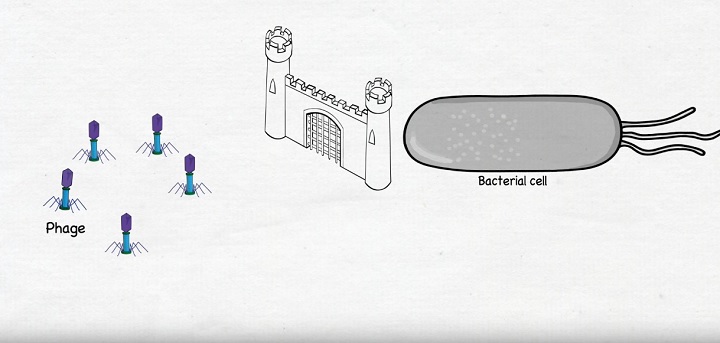
    Scientists have found several proteins that stop the Cas9 enzyme from cutting DNA.

    The breakthrough genetic tool CRISPR-Cas9 is a way to effectively genetically modify complete populations of plants, animals and hold great promise for humans. Because of this effectiveness, however, it has sparked debate, being inherited it is able to make changes in complete populations with unforeseen consequences as a result.

    Until now, there were no “off switches” to prevent Cas9 from making cuts in the wrong places or to stop gene drives using the enzyme from running amok.

    Scientists at the University of Massachusetts Medical School in Worcester and the University of Toronto in Canada present a potential ‘off-switch’. The ‘switch’ enables researchers to stop the activity of CRISPR from modifying certain cells.

    The CRISPR tool originates in how bacteria defend themselves against viruses, so it was also expected that there would be a way for viruses to counterattack.

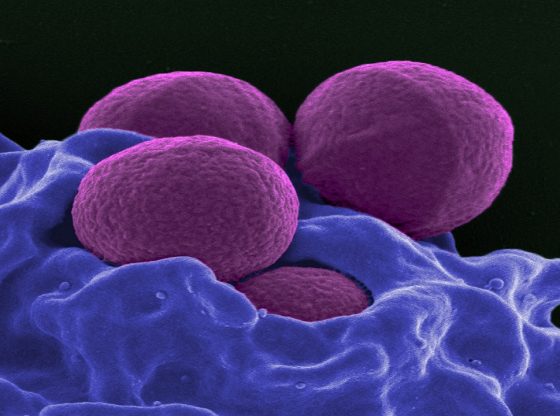
    The researchers discovered that three proteins in Neisseria meningitides inhibit a version of Cas9, an enzyme that some CRISPR systems employ to cut the DNA (N. meningitides is a bacterium that causes a form of meningitis in humans.) These anti-Cas9 proteins offer a nature-driven approach to controlling Cas9.

    If it is desirable for some genetic modification to not be inherited by offspring, the scientists can prevent the CRISPR-Cas9 activity in the germ cells by providing the cells with the ‘switch’.

    CRISPR research really took off in 2016 with various efforts launched. Among other things, the first study in humans was initiated by scientists in China, who will investigate its effectiveness in gene therapy of a difficult but common lung disease.

    References:

    April Pawluk et al “Naturally Occurring Off Switches for crispr-Cas9” December 15 Cell, DOI: http://dx.doi.org/10.1016/j.cell.2016.11.017


    CRISPR
    Share. Facebook Twitter Pinterest LinkedIn Tumblr Email Copy Link

    Related Posts

    U.S. Researchers Plan to Treat Cancer Patients Using Crispr

    January 23, 2018

    The Rise of Citizen Bioengineering

    January 8, 2018

    CRISPR Treatment Prevents Hearing Loss in Mice

    December 28, 2017

    Semi-Synthetic Life Form Lets Cells Produce Novel Proteins

    December 5, 2017

    Boy Was given New Skin Thanks to Gene Therapy

    November 14, 2017

    CRISPR 2.0 is Here With Breakthroughs in Base Editing

    October 28, 2017
    Recent Posts
    • America’s Quiet Shift Into Fiscal Dominance: Why Inflation May Be Preparing for a Second Act
    • How the End of Bretton Woods Reshaped Our Economies — and Our Politics
    • Can the U.S. Really Handle 250% Debt-to-GDP? Why Jackson Hole’s Daring Paper Is Wrong
    • Japan’s Fiscal Trap: What Happens If Austerity Is No Longer an Option?
    • The Rise of Range Extended Electric Vehicles (REEVs): A New Era of Hybrid Mobility
    • The Great Capital Rotation: A Shift from U.S. Treasuries to Gold and Real Assets
    • The Hidden Risks of Short-Term Debt: A Balancing Act in U.S. Fiscal Policy
    • The Looming U.S. Debt Spiral: Understanding the Risks
    • The Looming Recession: Seven Economic Indicators Flashing Red for 2025
    • Europa Clipper: NASA’s Mission to Unlock the Secrets of Jupiter’s Icy Moon
    © 2025 Illustrated Curiosity

    Type above and press Enter to search. Press Esc to cancel.

    This website uses cookies to improve your experience. We'll assume you're ok with this, but you can opt-out if you wish.Accept Reject Read More
    Privacy & Cookies Policy

    Privacy Overview

    This website uses cookies to improve your experience while you navigate through the website. Out of these, the cookies that are categorized as necessary are stored on your browser as they are essential for the working of basic functionalities of the website. We also use third-party cookies that help us analyze and understand how you use this website. These cookies will be stored in your browser only with your consent. You also have the option to opt-out of these cookies. But opting out of some of these cookies may affect your browsing experience.
    Necessary
    Always Enabled
    Necessary cookies are absolutely essential for the website to function properly. This category only includes cookies that ensures basic functionalities and security features of the website. These cookies do not store any personal information.
    Non-necessary
    Any cookies that may not be particularly necessary for the website to function and is used specifically to collect user personal data via analytics, ads, other embedded contents are termed as non-necessary cookies. It is mandatory to procure user consent prior to running these cookies on your website.
    SAVE & ACCEPT