
Close Menu
Illustrated Curiosity
    Facebook X (Twitter) Instagram YouTube
    Illustrated Curiosity
    • Earth
    • Economics
    • Environment
      • Climate
      • Environmental Tech
      • Pollution
      • Wildlife
    • Health
      • Health Tech
      • Medicine
      • Nutrition
      • Exercise
    • History
      • Prehistory
      • Ancient History
      • Postclassical Era
      • Modern History
    • Humans
      • Human Brain
      • Psychology
    • Life
      • Animals & Plants
      • Genetics
      • Paleontology
      • Evolution
      • Genetic Engineering
    • Physics
    • Space
      • Astrobiology
      • Astronomy
      • Extrasolar Planets
      • Space Tech
      • Spaceflight
    • Technology
      • Artificial Intelligence
      • Energy
      • Engineering
      • Materials
      • Robotics
      • Vehicles
    Illustrated Curiosity
    Home » Remarkably Preserved Fossil Sea Reptile Still Has Skin and Blubber
    Paleontology

    Remarkably Preserved Fossil Sea Reptile Still Has Skin and Blubber

    December 10, 2018No Comments3 Mins Read
    Share
    Facebook Twitter LinkedIn Pinterest Email
    Creator: Dmitry Bogdanov
    Artistic restoration of the Ichthyosaur Platypterygius kiprijanovi.

    The remains of a 180 million-year-old ichthyosaur (literally ‘fish-lizard’) have been analyzed, and the fossil is so well-preserved that its soft-tissues retain some of their original pliability.

    The dolphin-like marine reptile resembles its distant relative in more than appearance, according to an international team of researchers that includes scientists from North Carolina State University and Sweden’s Lund University.
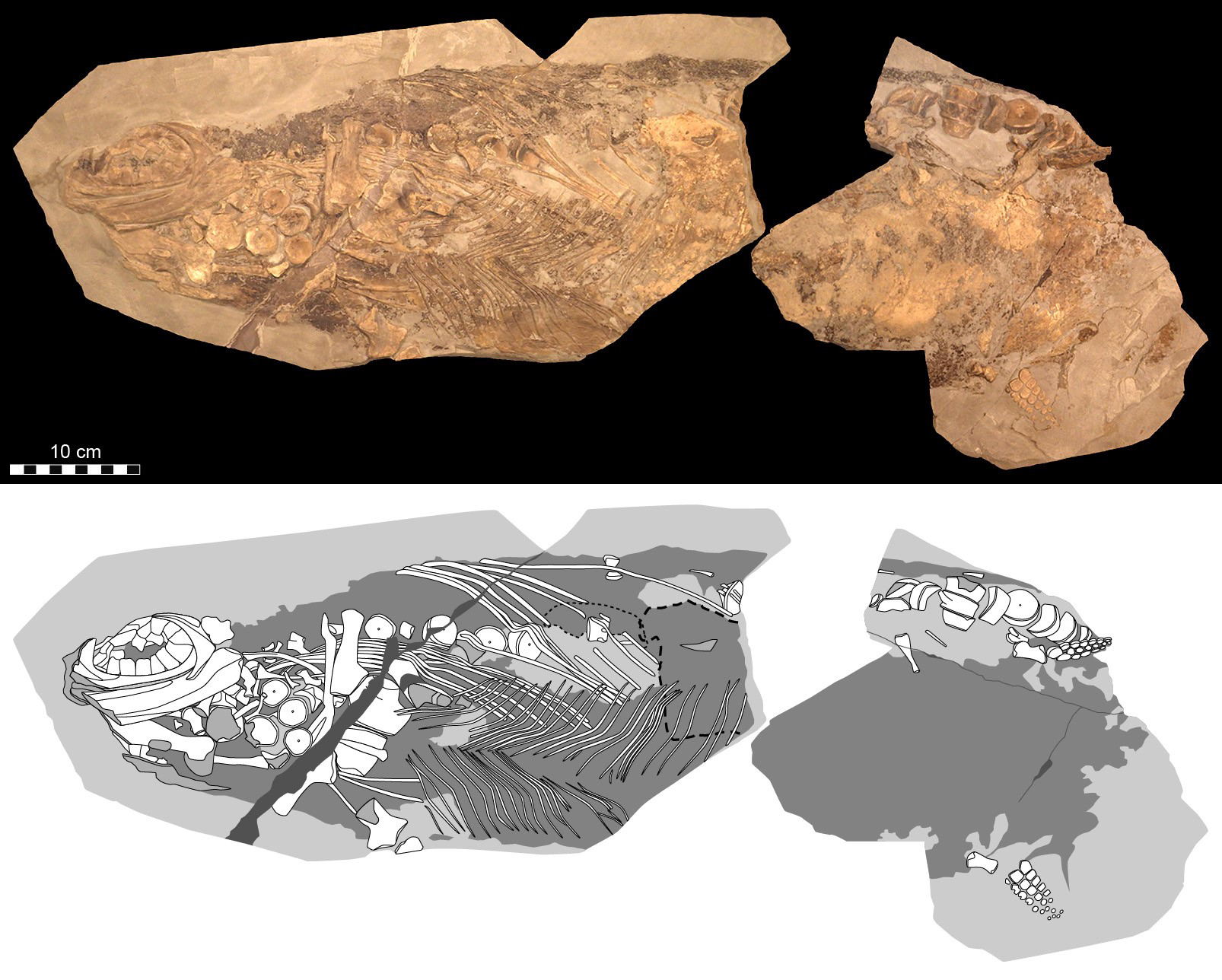
    An 180-million-year-old ichthyosaur (literally ‘fish-lizard’) fossil has been discovered. Photographic (top) and diagrammatic (bottom) representation of the 85-cm-long fossil.

    The 180-million-year-old ichthyosaur fossil, found in southwest Germany, provides the best evidence yet that Stenopterygius ichthyosaur were warm-blooded creatures and suggests the Jurassic-era “fish lizard” had more in common with modern whales and dolphins than we thought.

    “You can clearly see both the body outline and remains of internal organs,”

    “We can even distinguish the different cellular layers within the skin.”

    – lead researcher Johan Lindgren, of Lund University in Sweden, said in a statement.

    Johan Lindgren, associate professor at Sweden’s Lund University and lead author of a paper describing the work, put together an international team to analyze an approximately 180 million-year-old Stenopterygius fossil from the Holzmaden quarry in Germany.
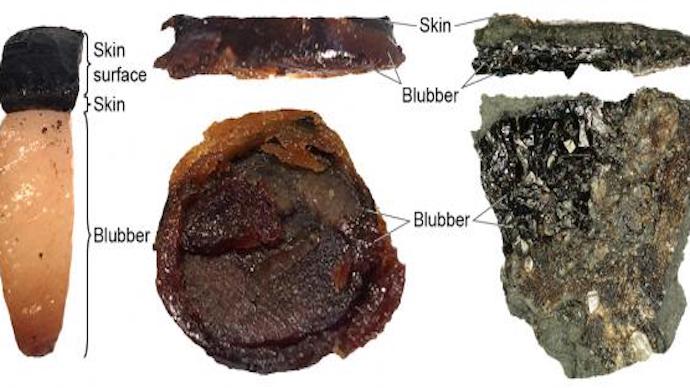
    Comparison between artificially matured modern porpoise integument (left and center) and fossil ichthyosaur blubber (right) (via Johan Lindgren & Martin Jarenmark)

    The researchers found pigment cells concentrated on the dorsal side of the creature’s body. Molecular and microstructural analysis of these cells reveals that these animals were most likely warm-blooded, had insulating blubber and used their coloration as camouflage from predators. The Jurassic-era ichthyosaur, therefore, appears to have shared qualities of both a mammal and a reptile.

    The research team then used high-powered spectroscopes and x-rays, scanned the fossil for melanin and reconstructed the melanophores in 3-D. Among other things, the team found that, like many marine animals today, the ichthyosaur’s back was darker in color than its belly. This form of coloration, called countershading, would have helped the animal disguise itself in the water and regulate its body temperature.

    The researchers argue that the new findings offer valuable additions and insight into the concept of convergent evolution; whereby organisms not closely related independently evolve similar traits as a result of having to adapt to similar environments or ecological niches.

    Ichthyosaurs thrived during much of the Mesozoic era; based on fossil evidence, they first appeared around 250 million years ago and at least one species survived until about 90 million years ago, into the Late Cretaceous.

    Reference:

    Johan Lindgren et al. Soft-tissue evidence for homeothermy and crypsis in a Jurassic ichthyosaur DOI https://doi.org/10.1038/s41586-018-0775-x


    Share. Facebook Twitter Pinterest LinkedIn Tumblr Email Copy Link

    Related Posts

    All Dogs Are Descended from the Same Wolf

    November 30, 2020

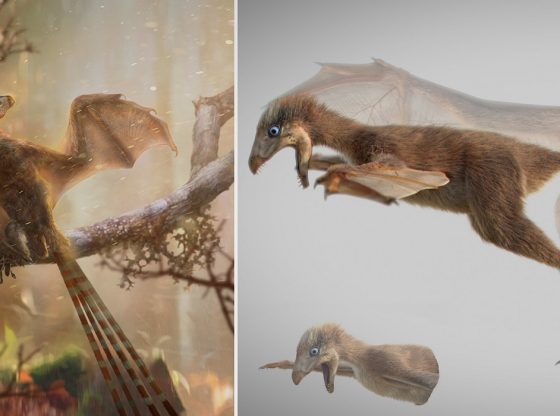
    A Newly Identified Raptor Hunted With The Terrifying Agility of a Cheetah

    June 16, 2020

    European Neanderthals Feasted on Fresh Seafood, Boosting Their Brain

    March 30, 2020

    Fishing in the Sahara? Yes – 10 000 Years Ago

    March 2, 2020

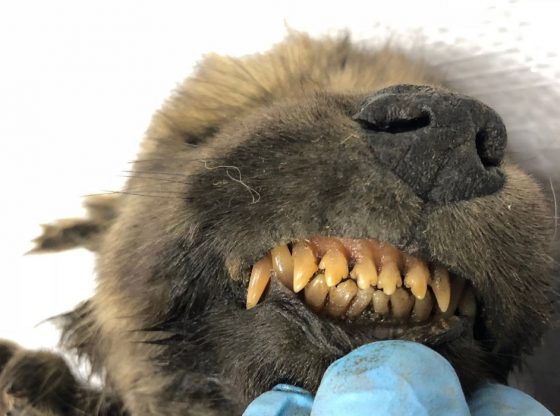
    18,000-Year-Old Frozen Puppy Found Perfectly Preserved in Siberian Permafrost

    December 9, 2019

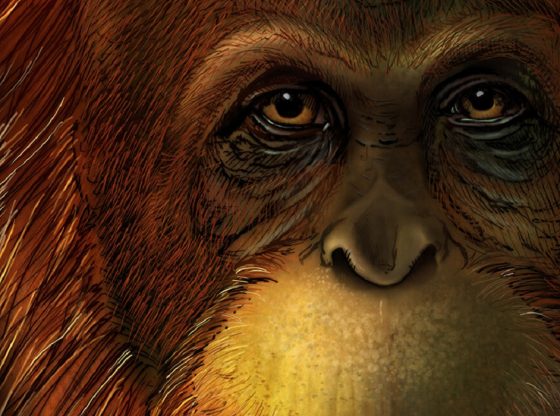
    Huge mysterious ape Gigantopithecus was a distant cousin of orangutans

    November 25, 2019
    Recent Posts
    • How the End of Bretton Woods Reshaped Our Economies — and Our Politics
    • Can the U.S. Really Handle 250% Debt-to-GDP? Why Jackson Hole’s Daring Paper Is Wrong
    • Japan’s Fiscal Trap: What Happens If Austerity Is No Longer an Option?
    • The Rise of Range Extended Electric Vehicles (REEVs): A New Era of Hybrid Mobility
    • The Great Capital Rotation: A Shift from U.S. Treasuries to Gold and Real Assets
    • The Hidden Risks of Short-Term Debt: A Balancing Act in U.S. Fiscal Policy
    • The Looming U.S. Debt Spiral: Understanding the Risks
    • The Looming Recession: Seven Economic Indicators Flashing Red for 2025
    • Europa Clipper: NASA’s Mission to Unlock the Secrets of Jupiter’s Icy Moon
    • Could Hedge Funds Cause Chaos in the U.S. Treasury Market? And What About Inflation?
    © 2025 Illustrated Curiosity

    Type above and press Enter to search. Press Esc to cancel.

    This website uses cookies to improve your experience. We'll assume you're ok with this, but you can opt-out if you wish.Accept Reject Read More
    Privacy & Cookies Policy

    Privacy Overview

    This website uses cookies to improve your experience while you navigate through the website. Out of these, the cookies that are categorized as necessary are stored on your browser as they are essential for the working of basic functionalities of the website. We also use third-party cookies that help us analyze and understand how you use this website. These cookies will be stored in your browser only with your consent. You also have the option to opt-out of these cookies. But opting out of some of these cookies may affect your browsing experience.
    Necessary
    Always Enabled
    Necessary cookies are absolutely essential for the website to function properly. This category only includes cookies that ensures basic functionalities and security features of the website. These cookies do not store any personal information.
    Non-necessary
    Any cookies that may not be particularly necessary for the website to function and is used specifically to collect user personal data via analytics, ads, other embedded contents are termed as non-necessary cookies. It is mandatory to procure user consent prior to running these cookies on your website.
    SAVE & ACCEPT