Close Menu
Illustrated Curiosity
    Facebook X (Twitter) Instagram YouTube
    Illustrated Curiosity
    • Earth
    • Economics
    • Environment
      • Climate
      • Environmental Tech
      • Pollution
      • Wildlife
    • Health
      • Health Tech
      • Medicine
      • Nutrition
      • Exercise
    • History
      • Prehistory
      • Ancient History
      • Postclassical Era
      • Modern History
    • Humans
      • Human Brain
      • Psychology
    • Life
      • Animals & Plants
      • Genetics
      • Paleontology
      • Evolution
      • Genetic Engineering
    • Physics
    • Space
      • Astrobiology
      • Astronomy
      • Extrasolar Planets
      • Space Tech
      • Spaceflight
    • Technology
      • Artificial Intelligence
      • Energy
      • Engineering
      • Materials
      • Robotics
      • Vehicles
    Illustrated Curiosity
    Home » Early Earth’s Air Weighed Less than Half of Today’s Atmosphere
    Earth

    Early Earth’s Air Weighed Less than Half of Today’s Atmosphere

    May 13, 20162 Mins Read
    Share
    Facebook Twitter LinkedIn Pinterest Email
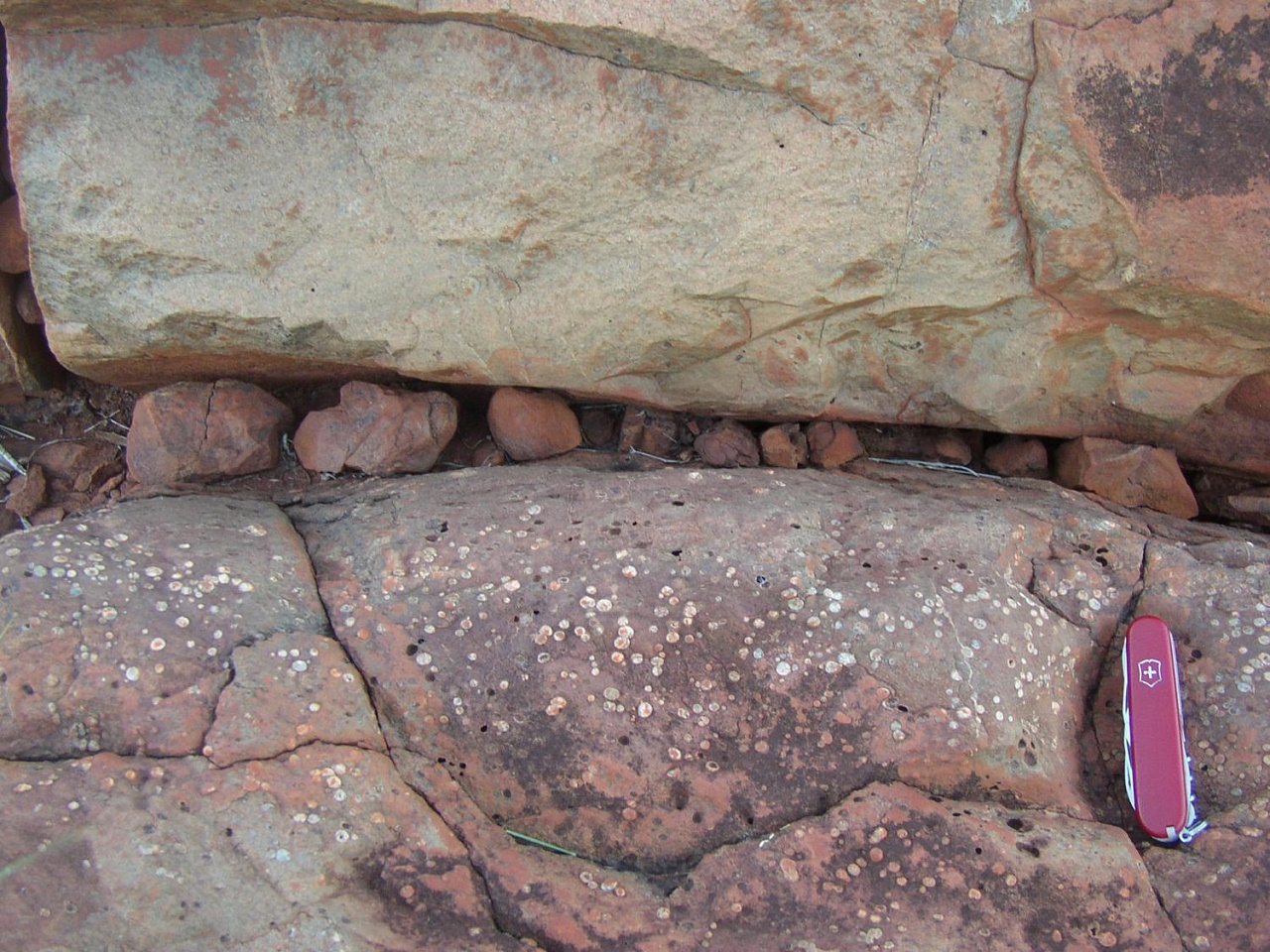
    One of the lava flows analyzed in the study, here the shore of Australia’s Beasley River. Gas bubbles that formed as the lava cooled, 2.7 billion years ago, have since filled with calcite and other minerals. The bubbles now look like white spots. Researchers compared bubble sizes from the top and bottom of the lava flows to measure the ancient air pressure. Credit: Sanjoy Som/University of Washington

    The air pressure on Earth 2.7 billion years ago was no more than half of what it is today.

    This, according to new research which has analyzed air bubbles that once formed in lava in what is now Australia. The researchers can make his conclusion as there is a direct correlation between the size of the bubble and the air pressure. Simply put the larger the bubble, the lower the air pressure.

    Previous research suggests that the Sun was much cooler at this time than it is now. Therefore, it has been a bit of a paradox how the Earth could be kept warm enough and be favorable for life.

    “For the longest time, people have been thinking the atmospheric pressure might have been higher back then because the sun was fainter,” said lead author Sanjoy Som, who did the work as part of his UW doctorate in Earth and space sciences. “Our result is the opposite of what we were expecting.”

    These new findings appear to confirm the hypothesis that there must have been considerable amounts of greenhouse gasses on the planet at this time, such as methane. The methane as a very potent greenhouse gas would be effective at keeping the heat trapped in the atmosphere of the Earth.

    This ramped up greenhouse effect would enable life to survive and indeed prosper despite the thin atmosphere. The research is another step to better understand the evolution of life before Earth got an atmosphere with oxygen.

    The researchers will next look for other suitable rocks to confirm the findings and learn how atmospheric pressure might have varied through time.

    ________________

    Earth’s air pressure 2.7 billion years ago constrained to less than half of modern levels. Nature Geoscience
    ________________________________

    Evolution of Life Greenhouse Effect Prehistoric Earth
    Share. Facebook Twitter Pinterest LinkedIn Tumblr Email Copy Link

    Related Posts

    The Looming Giant: Grindavik’s Potential Volcanic Eruption and its Global Implications

    November 13, 2023

    Small Warning Signs Can Reveal Volcano Eruption – before the Disaster

    October 3, 2019

    Massive Crater under Greenland’s Ice Points to Climate-Altering Impact in the Time of Humans

    November 19, 2018

    Earth’s Core Is Actually Solid According to New Research

    October 22, 2018

    Tree Ring Dating Confirms Historical Accounts of ‘Blood Aurora’ as Extreme Cosmic Radiation

    October 18, 2018

    Scientists Offer Clues to What Caused the Mass Extinction 250 Million Years Ago

    October 12, 2018
    Recent Posts
    • America’s Quiet Shift Into Fiscal Dominance: Why Inflation May Be Preparing for a Second Act
    • How the End of Bretton Woods Reshaped Our Economies — and Our Politics
    • Can the U.S. Really Handle 250% Debt-to-GDP? Why Jackson Hole’s Daring Paper Is Wrong
    • Japan’s Fiscal Trap: What Happens If Austerity Is No Longer an Option?
    • The Rise of Range Extended Electric Vehicles (REEVs): A New Era of Hybrid Mobility
    • The Great Capital Rotation: A Shift from U.S. Treasuries to Gold and Real Assets
    • The Hidden Risks of Short-Term Debt: A Balancing Act in U.S. Fiscal Policy
    • The Looming U.S. Debt Spiral: Understanding the Risks
    • The Looming Recession: Seven Economic Indicators Flashing Red for 2025
    • Europa Clipper: NASA’s Mission to Unlock the Secrets of Jupiter’s Icy Moon
    © 2025 Illustrated Curiosity

    Type above and press Enter to search. Press Esc to cancel.

    This website uses cookies to improve your experience. We'll assume you're ok with this, but you can opt-out if you wish.Accept Reject Read More
    Privacy & Cookies Policy

    Privacy Overview

    This website uses cookies to improve your experience while you navigate through the website. Out of these, the cookies that are categorized as necessary are stored on your browser as they are essential for the working of basic functionalities of the website. We also use third-party cookies that help us analyze and understand how you use this website. These cookies will be stored in your browser only with your consent. You also have the option to opt-out of these cookies. But opting out of some of these cookies may affect your browsing experience.
    Necessary
    Always Enabled
    Necessary cookies are absolutely essential for the website to function properly. This category only includes cookies that ensures basic functionalities and security features of the website. These cookies do not store any personal information.
    Non-necessary
    Any cookies that may not be particularly necessary for the website to function and is used specifically to collect user personal data via analytics, ads, other embedded contents are termed as non-necessary cookies. It is mandatory to procure user consent prior to running these cookies on your website.
    SAVE & ACCEPT