
Close Menu
Illustrated Curiosity
    Facebook X (Twitter) Instagram YouTube
    Illustrated Curiosity
    • Earth
    • Economics
    • Environment
      • Climate
      • Environmental Tech
      • Pollution
      • Wildlife
    • Health
      • Health Tech
      • Medicine
      • Nutrition
      • Exercise
    • History
      • Prehistory
      • Ancient History
      • Postclassical Era
      • Modern History
    • Humans
      • Human Brain
      • Psychology
    • Life
      • Animals & Plants
      • Genetics
      • Paleontology
      • Evolution
      • Genetic Engineering
    • Physics
    • Space
      • Astrobiology
      • Astronomy
      • Extrasolar Planets
      • Space Tech
      • Spaceflight
    • Technology
      • Artificial Intelligence
      • Energy
      • Engineering
      • Materials
      • Robotics
      • Vehicles
    Illustrated Curiosity
    Home » The Fading American Dream: Economic Mobility has Nearly Halved Since 1940
    Economics

    The Fading American Dream: Economic Mobility has Nearly Halved Since 1940

    April 28, 2017No Comments3 Mins Read
    Share
    Facebook Twitter LinkedIn Pinterest Email

    The American dream is getting harder to achieve, according to a new report published in this week’s issue of Science.
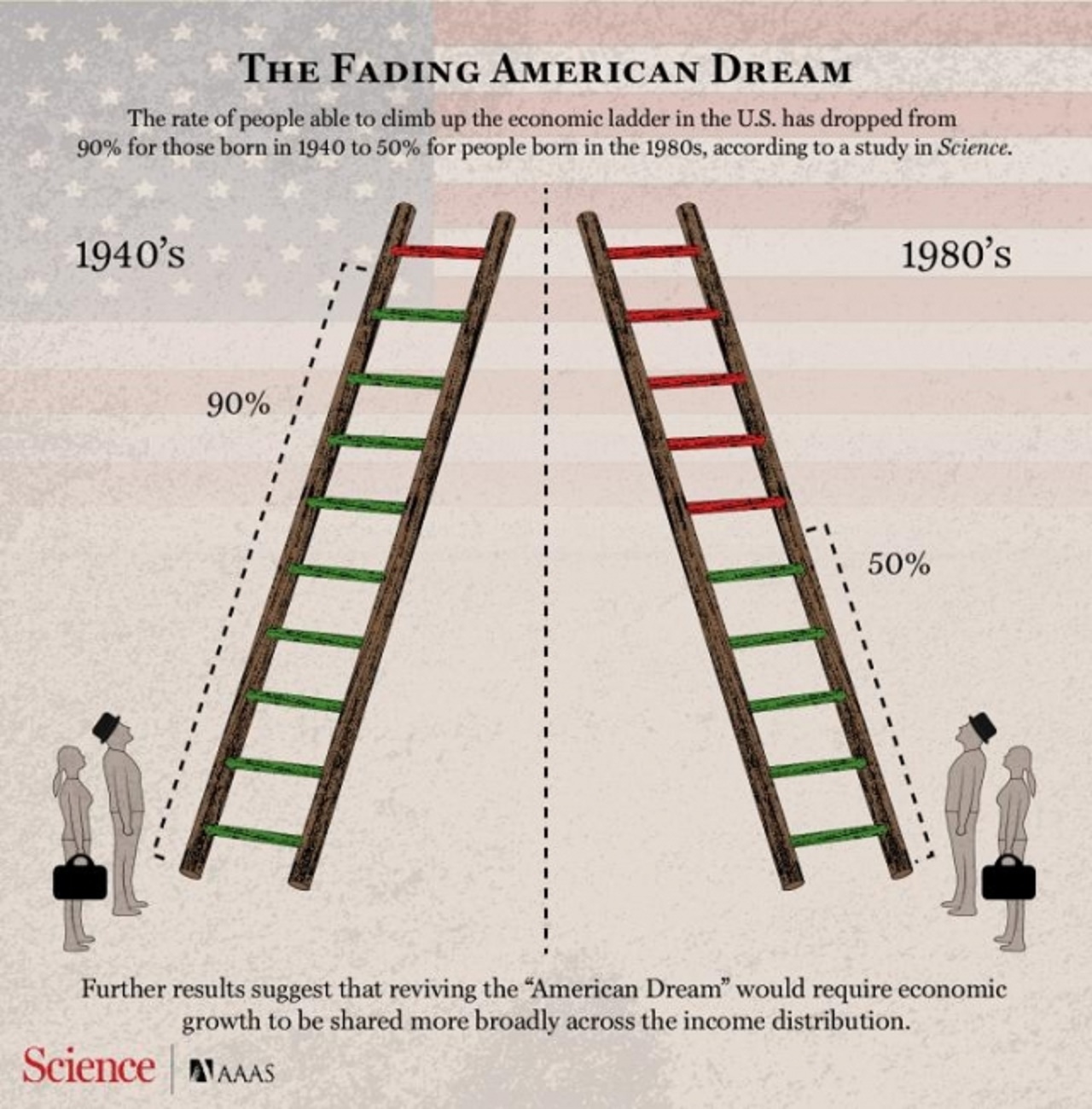
    Infographic with results by Chetty et al., revealing that the probability for children to attain a higher income than their parents has dropped dramatically – from more than 90 percent for children born in 1940 to 50 percent for children born in the 1980s. Reserach paper published the 28th of April 2017, issue of Science, published by AAAS. Image and caption: Carla Schaffer/AAAS/Science)

    Children in the United States are less likely to attain a higher income than their parents, according to researchers at Stanford University.

    90 percent of Americans born in the 40s were able to earn more than their parents. But for people born in the 1980s, this prospect has fallen to 50 percent.

    Economic distribution

    The authors write that the decline was particularly acute “in the industrial Midwest,” states like Michigan, and hit the middle class hardest, though they note “that declines in absolute mobility have been a systematic, widespread phenomenon throughout the United States since 1940.”

    According to researchers, the economic growth today is also more unevenly spread over income groups compared to earlier. Those with lower income do not see the same increases as those with higher income.

    The study authors conclude:

    Increasing GDP growth rates alone cannot restore absolute mobility to the rates experienced by children born in the 1940s. However, distributing current GDP growth more equally across income groups as in the 1940 birth cohort would reverse more than 70% of the decline in mobility. These results imply that reviving the “American dream” of high rates of absolute mobility would require economic growth that is shared more broadly across the income distribution.

    The American dream

    The meaning of the “American Dream” has changed over the course of history but is widely regarded as to have the freedom to pursue and the opportunity to make your own life into what you would like it to be. That the opportunity for prosperity and success can be achieved through hard work in a society with few barriers.

    The definition of the American Dream by James Truslow Adams in 1931, “life should be better and richer and fuller for everyone, with opportunity for each according to ability or achievement” regardless of social class or circumstances of birth.

    Reference:

    Chetty R, et al:The fading American dream: Trends in absolute income mobility since 1940, April 28, 2017, Vol 356 issue 6336, Science, doi: 10.1126 / science.aal4617


    U.S. Economy United States of America
    Share. Facebook Twitter Pinterest LinkedIn Tumblr Email Copy Link

    Related Posts

    How the End of Bretton Woods Reshaped Our Economies — and Our Politics

    December 6, 2025

    Can the U.S. Really Handle 250% Debt-to-GDP? Why Jackson Hole’s Daring Paper Is Wrong

    November 6, 2025

    Japan’s Fiscal Trap: What Happens If Austerity Is No Longer an Option?

    May 7, 2025

    The Great Capital Rotation: A Shift from U.S. Treasuries to Gold and Real Assets

    February 6, 2025

    The Hidden Risks of Short-Term Debt: A Balancing Act in U.S. Fiscal Policy

    January 18, 2025

    The Looming U.S. Debt Spiral: Understanding the Risks

    January 3, 2025
    Recent Posts
    • How the End of Bretton Woods Reshaped Our Economies — and Our Politics
    • Can the U.S. Really Handle 250% Debt-to-GDP? Why Jackson Hole’s Daring Paper Is Wrong
    • Japan’s Fiscal Trap: What Happens If Austerity Is No Longer an Option?
    • The Rise of Range Extended Electric Vehicles (REEVs): A New Era of Hybrid Mobility
    • The Great Capital Rotation: A Shift from U.S. Treasuries to Gold and Real Assets
    • The Hidden Risks of Short-Term Debt: A Balancing Act in U.S. Fiscal Policy
    • The Looming U.S. Debt Spiral: Understanding the Risks
    • The Looming Recession: Seven Economic Indicators Flashing Red for 2025
    • Europa Clipper: NASA’s Mission to Unlock the Secrets of Jupiter’s Icy Moon
    • Could Hedge Funds Cause Chaos in the U.S. Treasury Market? And What About Inflation?
    © 2025 Illustrated Curiosity

    Type above and press Enter to search. Press Esc to cancel.

    This website uses cookies to improve your experience. We'll assume you're ok with this, but you can opt-out if you wish.Accept Reject Read More
    Privacy & Cookies Policy

    Privacy Overview

    This website uses cookies to improve your experience while you navigate through the website. Out of these, the cookies that are categorized as necessary are stored on your browser as they are essential for the working of basic functionalities of the website. We also use third-party cookies that help us analyze and understand how you use this website. These cookies will be stored in your browser only with your consent. You also have the option to opt-out of these cookies. But opting out of some of these cookies may affect your browsing experience.
    Necessary
    Always Enabled
    Necessary cookies are absolutely essential for the website to function properly. This category only includes cookies that ensures basic functionalities and security features of the website. These cookies do not store any personal information.
    Non-necessary
    Any cookies that may not be particularly necessary for the website to function and is used specifically to collect user personal data via analytics, ads, other embedded contents are termed as non-necessary cookies. It is mandatory to procure user consent prior to running these cookies on your website.
    SAVE & ACCEPT