Close Menu
Illustrated Curiosity
    Facebook X (Twitter) Instagram YouTube
    Illustrated Curiosity
    • Earth
    • Economics
    • Environment
      • Climate
      • Environmental Tech
      • Pollution
      • Wildlife
    • Health
      • Health Tech
      • Medicine
      • Nutrition
      • Exercise
    • History
      • Prehistory
      • Ancient History
      • Postclassical Era
      • Modern History
    • Humans
      • Human Brain
      • Psychology
    • Life
      • Animals & Plants
      • Genetics
      • Paleontology
      • Evolution
      • Genetic Engineering
    • Physics
    • Space
      • Astrobiology
      • Astronomy
      • Extrasolar Planets
      • Space Tech
      • Spaceflight
    • Technology
      • Artificial Intelligence
      • Energy
      • Engineering
      • Materials
      • Robotics
      • Vehicles
    Illustrated Curiosity
    Home » The Liquidity Trap: The Japanese Experience and a U.S. Comparison
    Economics

    The Liquidity Trap: The Japanese Experience and a U.S. Comparison

    March 15, 2014No Comments5 Mins Read
    Share
    Facebook Twitter LinkedIn Pinterest Email
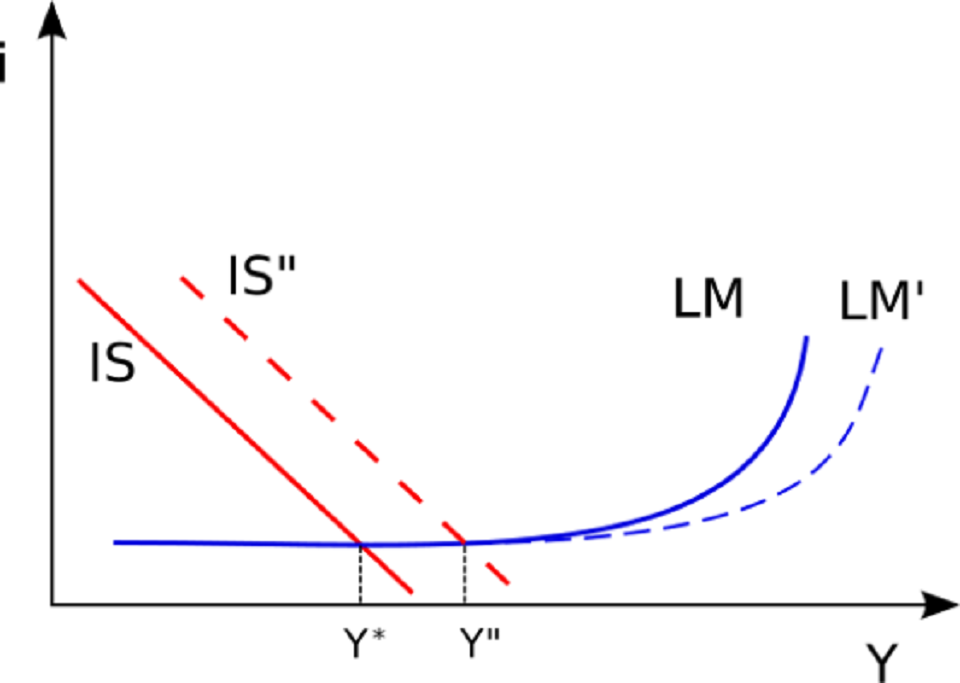
    The demand for money is perfectly elastic and a monetary expansion (the shift from LM to LM’) has no effect on equilibrium interest rates or output. A fiscal expansion (the shift from IS to IS”) leads to a higher level of output with no change in interest rates. Credit: Bkwillwm.

    The situation described as a “liquidity trap is an ever more relevant economic concept today, with many European economies and the United States struggling with low inflation rates or even deflation accompanied with low economic growth and very low to even negative base interest rates.

    Growth and Deflation

    When conventional monetary policies have become impotent and nominal interest rates are at or near zero with no effect; we have what economists call a liquidity trap.

    This was true in Japan during the 1990s and the United States in the 1930s. When interest rates had reached very low levels but with little to no effect on economic inflation or growth. U.S. interest rates were close to zero during the second half of the 1930s and the same was true in Japan during the second half of the 1990s. In 1999 the Japanese short-term interest rates were only 0,1 percent.

    Expansionary monetary policy relies on the logic of when reducing interest rates, this would stimulate investment spendings. But when interest rates are at a very low level already, close to zero, then any further aggressive monetary policy would be less effective, naturally. Making it difficult for central banks to have any impact on monetary policy, a situation that several economies are facing today, again.

    As expansionary monetary policy raises the supply of money, this raising liquidity levels, but since interest rates cannot fall any further, this liquidity has no effect – thereby aggregate demand, production, and employment are “trapped” at low levels.

    In the Wake of Financial Crisis

    After the financial collapse of 2007,  the United States and Europe faced short-term policy rates close to zero. The U.S. Central Bank, The Federal Reserve (FED), responded to the financial crisis to stabilize the economy and the financial system. They reduced the level of short-term interest rates to near zero and also longer-term interest rates.
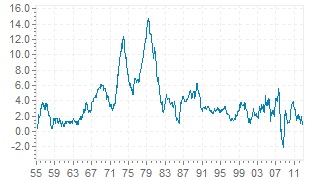
    Inflation United States – consumer price index (CPI). Source: The Federal Reserve via Global-rates.com.

    The FED also began purchasing large quantities of longer-term Treasury securities and longer-term securities issued or guaranteed by agencies such as Fannie Mae or Freddie Mac.

    A situation emerged that looked very much like a liquidity trap and some economists, among those Paul Krugman who has studied the economics of the Great Depression meticulously, argued and warned repeatedly that the U.S. was heading in the direction of a dangerous liquidity trap.

    Indeed, a tripling of the U.S. monetary base between 2008 and 2011 failed to produce any significant effect on U.S. domestic price indices.

    The situation in the U.S. today still resembles a liquidity trap. Since at present time the FED interest rates are very close to zero with a very low inflation rate (1 percent in January 2014).

    This is also true for several other countries in Europe. And Japan is still one of those struggling with very low inflation levels, despite the many attempts by the Bank of Japan to stimulate the economy. Inflation levels for the Japanese economy have remained around zero for long periods, with little effect on inflation, with even intermediate deflation.
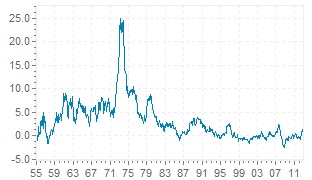
    Inflation Japan – consumer price index (CPI). Source: The Bank of Japan via Global-rates.com.

    Deflation was true for some periods during 2013 but the inflation rate has recently begun to accelerate – probably due to the recently elected Prime Minister Shinzo Abe’s campaign aiming to end two decades of low economic growth and stagnation. It remains to be seen if the economic policies implemented by Abe, called ‘Abenomics’, will be successful in the long run.

    How to Escape the Trap?

    In economics, the rationale is that expectations affect behavior and thereby real economic factors in the economy. Nominal rates are confined to the zero level, but not real rates. And since expansionary monetary policy might raise inflation expectation, the mere fact that announced stimulus, could lower real interest rates below zero and thereby stimulate the economy and raise investment spending.

    Another response to monetary expansion is that of causing deliberate currency depreciation and making the nation’s goods cheaper and more attractive abroad – thereby increasing exports, raising incomes and stimulating the economy.

    In the wake of the financial crises, many central banks have responded to the situation with a somewhat unconventional monetary policy called quantitative easing, in which to stimulate the economy, the banks start buying specified amounts of financial assets from commercial banks and other private institutions. Thereby increasing the monetary base on those financial assets. It is an experiment and remains unclear at the moment, if this will, in fact, have any effect on the economy.

    _______________
    Inflation United States – consumer price index (CPI)
    FED Federal Funds Rate, American central bank’s interest rate

    ______________________________

    2007 Financial Crisis Economic Growth Inflation Japanese Economy Liquidity Trap U.S. Economy
    Share. Facebook Twitter Pinterest LinkedIn Tumblr Email Copy Link

    Related Posts

    How the End of Bretton Woods Reshaped Our Economies — and Our Politics

    December 6, 2025

    Can the U.S. Really Handle 250% Debt-to-GDP? Why Jackson Hole’s Daring Paper Is Wrong

    November 6, 2025

    Japan’s Fiscal Trap: What Happens If Austerity Is No Longer an Option?

    May 7, 2025

    The Great Capital Rotation: A Shift from U.S. Treasuries to Gold and Real Assets

    February 6, 2025

    The Hidden Risks of Short-Term Debt: A Balancing Act in U.S. Fiscal Policy

    January 18, 2025

    The Looming U.S. Debt Spiral: Understanding the Risks

    January 3, 2025
    Recent Posts
    • How the End of Bretton Woods Reshaped Our Economies — and Our Politics
    • Can the U.S. Really Handle 250% Debt-to-GDP? Why Jackson Hole’s Daring Paper Is Wrong
    • Japan’s Fiscal Trap: What Happens If Austerity Is No Longer an Option?
    • The Rise of Range Extended Electric Vehicles (REEVs): A New Era of Hybrid Mobility
    • The Great Capital Rotation: A Shift from U.S. Treasuries to Gold and Real Assets
    • The Hidden Risks of Short-Term Debt: A Balancing Act in U.S. Fiscal Policy
    • The Looming U.S. Debt Spiral: Understanding the Risks
    • The Looming Recession: Seven Economic Indicators Flashing Red for 2025
    • Europa Clipper: NASA’s Mission to Unlock the Secrets of Jupiter’s Icy Moon
    • Could Hedge Funds Cause Chaos in the U.S. Treasury Market? And What About Inflation?
    © 2025 Illustrated Curiosity

    Type above and press Enter to search. Press Esc to cancel.

    This website uses cookies to improve your experience. We'll assume you're ok with this, but you can opt-out if you wish.Accept Reject Read More
    Privacy & Cookies Policy

    Privacy Overview

    This website uses cookies to improve your experience while you navigate through the website. Out of these, the cookies that are categorized as necessary are stored on your browser as they are essential for the working of basic functionalities of the website. We also use third-party cookies that help us analyze and understand how you use this website. These cookies will be stored in your browser only with your consent. You also have the option to opt-out of these cookies. But opting out of some of these cookies may affect your browsing experience.
    Necessary
    Always Enabled
    Necessary cookies are absolutely essential for the website to function properly. This category only includes cookies that ensures basic functionalities and security features of the website. These cookies do not store any personal information.
    Non-necessary
    Any cookies that may not be particularly necessary for the website to function and is used specifically to collect user personal data via analytics, ads, other embedded contents are termed as non-necessary cookies. It is mandatory to procure user consent prior to running these cookies on your website.
    SAVE & ACCEPT