Close Menu
Illustrated Curiosity | Economics, History, Science, Space, Technology, Health, Physics, Earth
    Facebook X (Twitter) Instagram YouTube
    Illustrated Curiosity | Economics, History, Science, Space, Technology, Health, Physics, Earth
    • Earth
    • Economics
    • Environment
      • Environmental Tech
      • Pollution
      • Wildlife
    • Health
      • Health Tech
      • Medicine
      • Nutrition
      • Exercise
    • History
      • Prehistory
      • Ancient History
      • Postclassical Era
      • Modern History
    • Humans
      • Human Brain
      • Psychology
    • Life
      • Animals & Plants
      • Genetics
      • Paleontology
      • Evolution
      • Genetic Engineering
    • Physics
    • Space
      • Astrobiology
      • Astronomy
      • Extrasolar Planets
      • Space Tech
      • Spaceflight
    • Technology
      • Artificial Intelligence
      • Energy
      • Engineering
      • Materials
      • Robotics
      • Vehicles
    Illustrated Curiosity | Economics, History, Science, Space, Technology, Health, Physics, Earth
    Home » Newly Discovered T-cell Receptor May Lead to More ‘Universal’ Cancer Therapy, Study Suggests
    Medicine

    Newly Discovered T-cell Receptor May Lead to More ‘Universal’ Cancer Therapy, Study Suggests

    February 3, 20203 Mins Read
    Share
    Facebook Twitter LinkedIn Pinterest Email
    Pixabay License
    Cancer is basically a disease of uncontrolled cell division. Its development and progression are usually linked to a series of changes in the activity of cell cycle regulators. For example, inhibitors of the cell cycle keep cells from dividing when conditions aren’t right, so too little activity of these inhibitors can promote cancer. Similarly, positive regulators of cell division can lead to cancer if they are too active. In most cases, these changes in activity are due to mutations in the genes that encode cell cycle regulator proteins.

    A team of British researchers has devised a new method that they believe has “tremendous potential” in treating all types of cancer.

    The researchers have manipulated the body’s own defense against tumors with gene editing using the so-called Crispr-Cas9, and in this way managed to teach T-cells to attack most cancers, leaving healthy cells unharmed.

    T-cells (lymphocytes T) use a receptor protein called a T cell receptor (TCR), which essentially “looks” at the proteins being produced by a cell, and if those proteins are abnormal — e.g., if the cell is cancerous or infected with a virus — the T-cell can become activated to kill the abnormal cell.

    Improving the efficacy of this process is the goal of many cancer immunotherapies. A drawback is a reliance on a group of protein molecules called ‘major histocompatability complex’ (MHC), whose sequence varies greatly from person to person. MHC is required in the process of T-cell activation.

    The new discovery, which comes from scientists based at Cardiff University, researchers have identified a kind of T-cell with a novel TCR that doesn’t act through MHC, but through a different protein called MR1 (major histocompatibility complex class I-related gene protein).
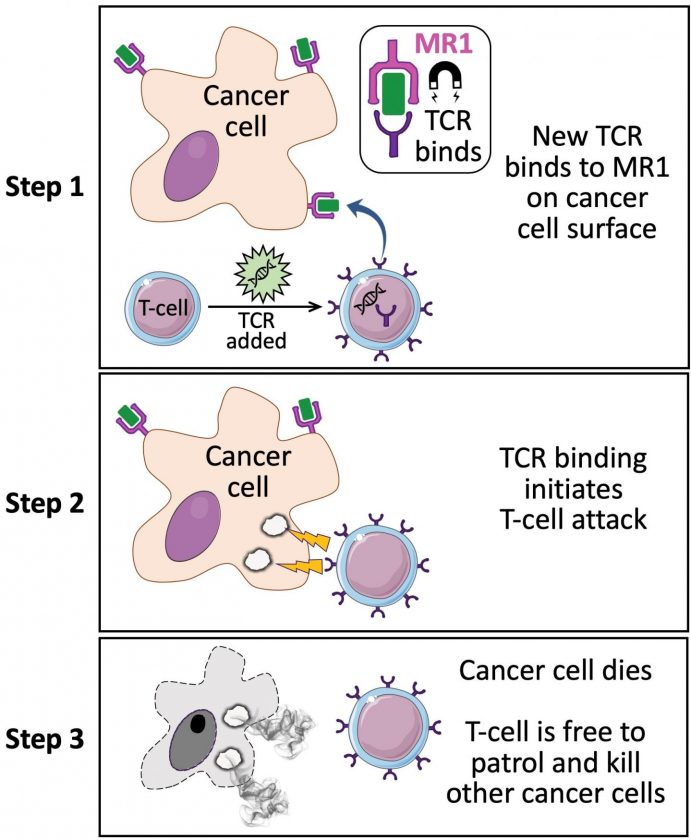
    Unlike MHC, MR1 does not vary in the human population and is thus a hugely attractive new target for immunotherapies.

    “Cancer-targeting via MR1-restricted T cells is an exciting new frontier—it raises the prospect of a ‘one size fits all’ cancer treatment, a single type of T cell that could destroy many different types of cancers across the population.”

    – Cardiff’s Andrew Sewell, Ph.D., a professor of infection and immunity.

    T cells equipped with the new TCR (MR1) were shown, in the lab, to kill lung, skin, blood, colon, breast, bone, prostate, ovarian, kidney, and cervical cancer cells, while ignoring healthy cells. To test the therapeutic potential of these cells in vivo, the researchers injected T cells able to recognize MR1 into mice bearing human cancer and with a human immune system.

    “An MR1-restricted T cell clone mediated in vivo regression of leukemia and conferred enhanced survival of NSG mice,”

    “TCR transfer to T cells of patients enabled killing of autologous and nonautologous melanoma. These findings offer opportunities for HLA-independent, pan-cancer, pan-population immunotherapies.”

    – The article’s authors wrote.

    The Cardiff group hopes to trial this new approach in patients toward the end of this year, following further safety testing. The study, “Genome-wide CRISPR–Cas9 screening reveals ubiquitous T cell cancer-targeting via the monomorphic MHC class I-related protein MR1,” was published in Nature Immunology.

    Reference:

    Michael D. Crowther et al Genome-wide CRISPR–Cas9 screening reveals ubiquitous Tcell cancer targeting via the monomorphic MHC class I-related protein MR1 | VOL 21 | FEBRUARY 2020 | 178–185 | DOI: https://doi.org/10.1038/s41590-019-0578-8

    Cancer Cancer Treatment
    Share. Facebook Twitter Pinterest LinkedIn Tumblr Email Copy Link

    Related Posts

    Groundbreaking Breakthrough: A Potential Cure for Cancer Targets Proliferating Cell Nuclear Antigen (PCNA)

    August 3, 2023

    Data Modeling Can Predict How COVID-19 Will Spread in a Big City

    November 13, 2020

    Air Pollution May Be a Contributing Factor behind High Death Rates in COVID-19

    June 8, 2020

    Evidence of Stray Dogs as Possible Intermediate Host of COVID-19 Pandemic

    April 28, 2020

    Promising Progress on Urine Tests for Prostate Cancer

    March 23, 2020

    Machine Learning Found Surprising Potential New Antibiotics to Combat Resistant Bacteria

    February 25, 2020
    Recent Posts
    • Largest Battles in History: Cannae — Rome’s Darkest Day
    • The Day the Alliance Died
    • Evaluating Heart Disease: How Cumulative Diet Choices Compound Your Risk
    • What Would Happen If China Attacked Taiwan?
    • Geopoliticisation as a Structural Tailwind for Commodity Prices
    • America’s Economic Remodel: Who’s Really Paying the Bill?
    • Why Inflation May Be Preparing for a Second Act
    • How the End of Bretton Woods Reshaped Our Economies — and Our Politics
    • Can the U.S. Really Handle 250% Debt-to-GDP? Why Jackson Hole’s Daring Paper Is Wrong
    • Japan’s Fiscal Trap: What Happens If Austerity Is No Longer an Option?
    © 2025 Illustrated Curiosity

    Type above and press Enter to search. Press Esc to cancel.