
The Taiping Rebellion took place during the 18th century (1851-1864). A time when China was experiencing many circumstances that made the period very precarious and potentially dangerous.
Foreign influence in China was strong, the British Empire hegemony at sea made itself apparent during the Opium War, which was settled at gunpoint in 1842 after a spectacular and easy victory for British superior warship technology. The resulting treaty forced the opening of trading ports, a fixed tariff on imported goods at 5 percent, imposed indemnity of 21 million ounces of silver to cover Britain’s war expenses and the ceding of the island of Hong Kong to Britain. The “most favored nation” clause implied that whenever one nation extracted a new privilege from China, it was extended automatically to Britain.
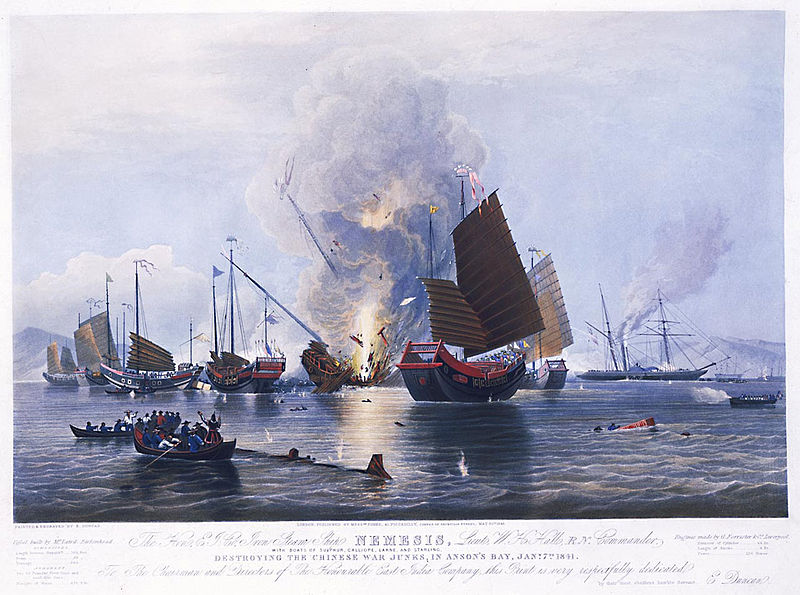
Chinese and western hostilities continued even after the treaty. With renewed hostilities between 1856 and 1860, Britain and French troops occupied Beijing and set the emperor’s summer palace on fire.
Then the Chinese situation was worsened by several domestic aspects. China was the world’s most populous country with over 400 million people. And with a continuing growing population, farm size shrank, forests were remade into farming land, and surplus labor pushed down wages. Conflicts due to rights over water and tenancy increased.
There was high female infanticide as families felt that they could not afford more than two or three children and sons were more important for the family’s business. The following shortage of women resulted in many young men. Some of these young men became bandits.
And with an extensive opium problem, the combination of these aspects led to some of the most destructive rebellions in Chinese and indeed human history.
The Heavenly Kingdom: The rise
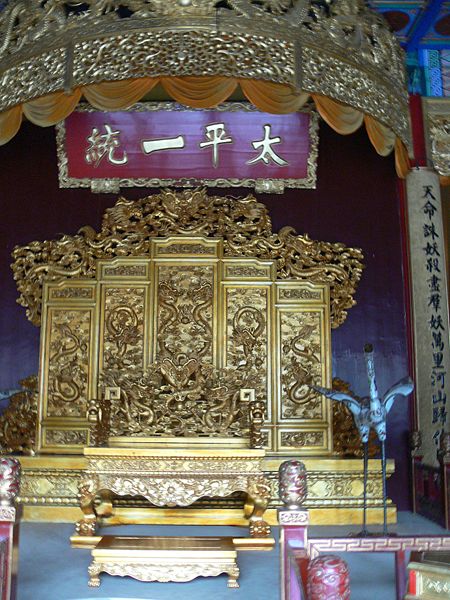
A total of 20 million people died during the Taiping Rebellion. Making it one of the bloodiest wars in human history. It was initiated by a man named Hong Xiuquan (1814-1864). Hong Xiuquan came from Southern China but after failing his civil service examinations he had begun a career as a religious leader instead. He then had visions of a golden bearded old man and a middle-aged man who addressed him as his younger brother and set him on a quest to annihilate devils. He later read a Christian tract and inspired by Christian ideas he interpreted his vision as to mean that he was Jesus’ younger brother.
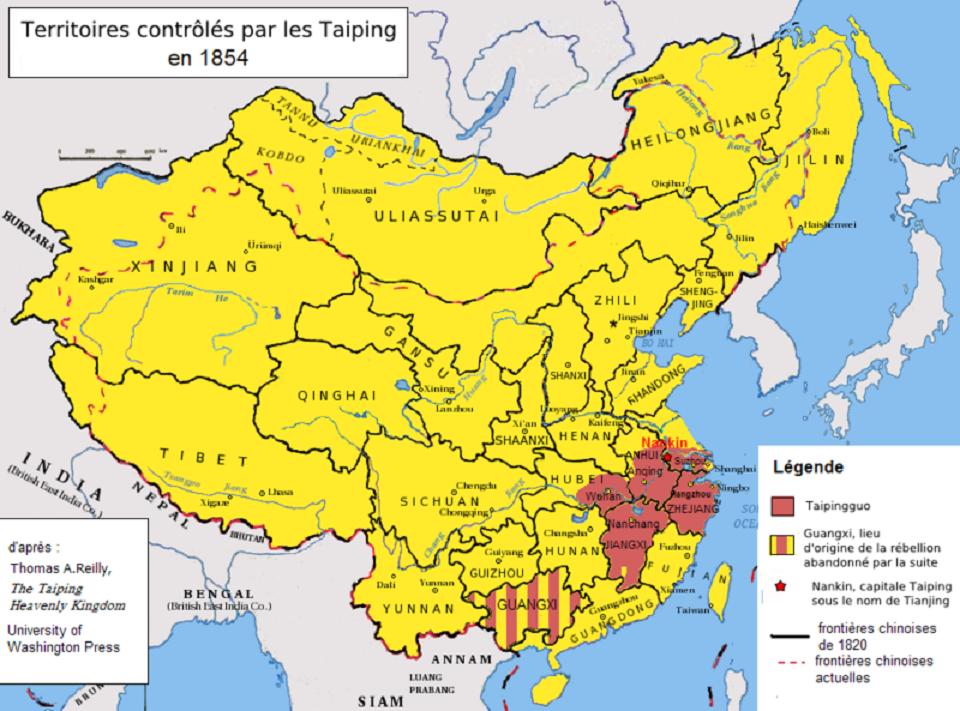
He began gathering followers and instructed them to destroy idols, temples, give up opium and alcohol. He declared himself king of the Heavenly Kingdom of Great Peace in 1851. This Kingdom moved north and established their capital at Nanjing. From here they set about to create a Utopian society. A society of equal landholdings and equality between men and woman. Christian missionaries were not willing to help them, they instead deemed them heretical. The Kingdom expanded greatly and were to control large parts of southern China, though. At its height, they were ruling over about 30 million people.
Their army was marked by a high level of discipline and fanaticism. The soldiers wore red jackets with blue trousers and grew their hair long. There were therefore given the nickname “Longhairs”. They were equipped With rudimentary weaponry and were lacking heavy weapons such as artillery. Instead, their hand to hand combat was most often very bloody and extremely brutal. Modern estimates of the overall size of the Taiping Heavenly Army put it at about 500,000 soldiers.
The rebels held on to Nanjing for more than a decade. With the Kingdom of Manchu who had conquered northern China, several centuries earlier were proven to be powerless in the face of a rebellion of this size. And with the threat being both domestic and foreign, the Chinese Empire under the Qing dynasty began raising and modernizing the army under the slogan “self-strengthening”. They set about to modernize along Western lines with envoys sent abroad to collect information.
The Heavenly Kingdom: The fall
The Heavenly Kingdom attempted to expand its borders to include Shanghai in August 1860, but the attempt was repelled by Chinese imperial troops under the leadership of European officers, and the command of Fredrick Townsend Ward. The imperial reconquest now began in earnest. And by early 1864 imperial control in most areas was re-established. Chinese forces began massing on Nanjing.
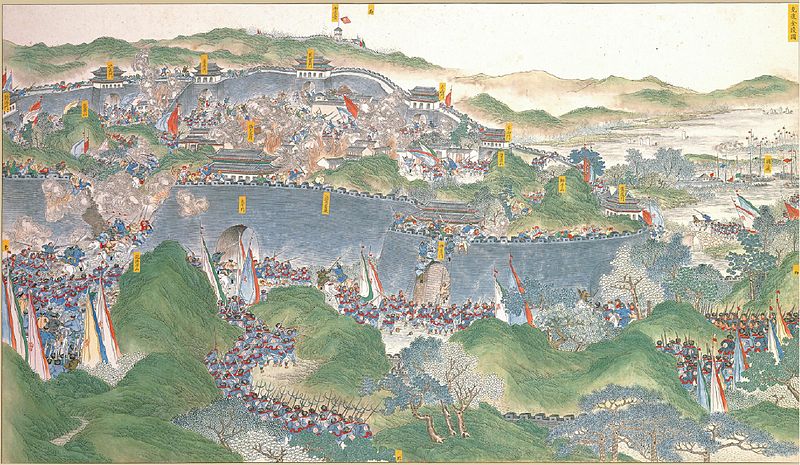
Hong Xiuquan declared that God would defend Nanjing. But the city was under siege and after a while, the city began to run low on the supply of food. As a probable consequence of this, Hong Xiuquan died of food poisoning from eating wild vegetables. The Kingdom continued under the leadership of his young son. But the city was finally stormed by Chinese imperial troops. This attack led to bloody street-by-street fighting and high costs on both sides (an estimated 100,000 deaths in three days). The city then finally fell in July 1864.
With still more than a quarter of a million Taiping rebels fighting in the border regions of Jiangxi and Fujian, the war wasn’t over until August 1871 when the last rebellion commander and his army was completely wiped out by imperial forces at the border region of Hunan, Guizhou, and Guangxi.
Estimates of the total number of dead are based on projections. The most widely cited source put the total number of deaths accumulated during the 15 years of rebellion at about 20 to 30 million civilians and soldiers. With most of these deaths attributed to plague and famine in the wake of war.
Many ideas of Hong Xiuquan would inspire Sun Yat-sen during the 20th century, as the founder of the Chinese Nationalist Party, also Mao Zedong glorified the Taiping rebels as early heroic revolutionaries against a corrupt feudal system.