
Human Origins Program, Smithsonian
Our own kind Homo sapiens developed a great deal of our technical and social skills when under pressure from difficult environmental circumstances, according to several new research studies by researchers that have been working at archaeological sites in East Africa for several years.
Extreme climate conditions that varied between very wet and dry – the living conditions of our distant relatives that lived in what is now southern Kenya more than 320,000 years ago was very tough.
The challenges that this unpredictable climate meant with varying access to different types of food may have helped to spur the innovation forced changes in social habits that increased the survival chances of our early relatives.
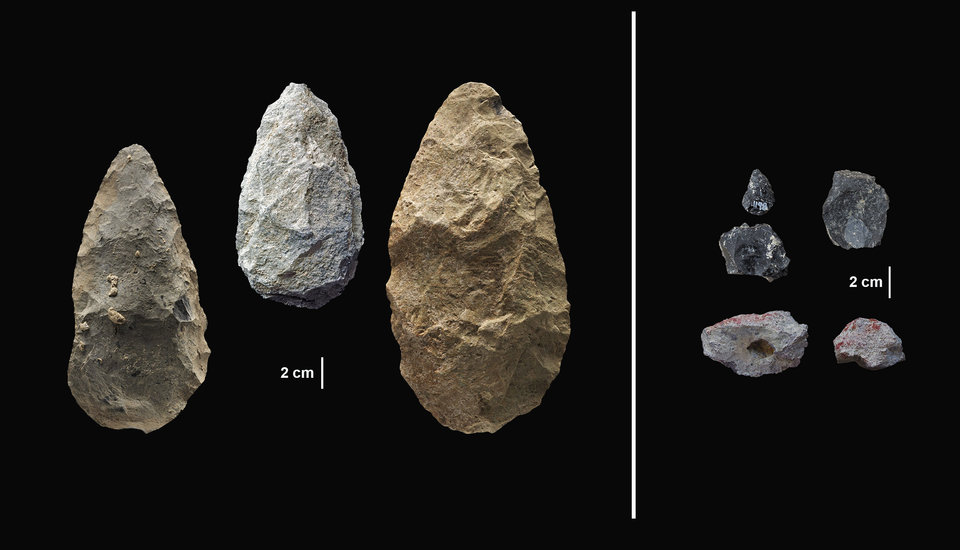
New findings reveal that some of the earliest members of our species, Homo sapiens, engaged in surprisingly sophisticated behaviors including using color pigments.
The discovery of processed obsidian, a type of glasslike volcanic rock that produces ultra-sharp cutting edges, is 320,000 years old and pushes back our understanding of the development of early humans, showing them engaged in some of the behaviors that would mark out our species to this day.
The researchers behind the newly published study also describe ochre pigment that produced a bright-red color, which could have been used for body painting or other symbolic expressions.
The researchers from the American Smithsonian Natural History Museum publishes three scientific articles in the journal Science resulting from a broad collaboration with an international group of archaeologists.
The findings indicate advances in technology and social structures unexpected so early in our species’ history, they said.
“My view is that these newly evolved mental and social abilities — including awareness of distant groups, use of pigments and innovative technologies including projectile points — were at the foundation of our species’ origin,”
– Paleoanthropologist Rick Potts, director of the Smithsonian National Museum of Natural History’s Human Origins Program.
The findings counter a popular theory about human evolution, which holds that our species gradually changed in response to environmental pressures caused by expanding, arid grasslands in Africa. The so-called savanna hypothesis suggests that human bipedalism evolved as a direct result of human ancestors transition from an arboreal lifestyle to one on the savannas.
The first of the three new studies, the researchers report that the Olorgesailie Basin — where hominids lived starting by at least 1.2 million years ago — was mostly floodplains until around 800,000 years ago. An increasing pace of environmental change is seen in the geological record, for the next several thousand years.
Some animals did not survive the period of instability and hominids could no longer stay in one place for a long time. A technological shift appears to have occurred in East Africa by at least 320,000 years ago. About 42 percent of the more refined tools were crafted from obsidian. Replacing the previous big and clunky Acheulean toolkit of stone tools.
The second study provides more detail on the human-made artifacts excavated from the Olorgesailie Basin at the Eastern Rift Valley in southern Kenya. It shows that there is no local source there for obsidian, which means individuals must have traveled from around 26 to over 100 kilometers to obtain this material. The researchers, therefore, believe that they must have made distant contacts, with whom they might have engaged in trade.
It isn’t certain that these hominids where homo sapiens, the researchers believe that before around 320,000 years ago, these populations Homo heidelbergens that once also lived in not only Africa but also in Europe and western Asia.
Fossils for Homo sapiens start to appear in Morocco around 315,000 years ago, Earliest fossil evidence of Homo sapiens found in Morocco.
The third study provides detailed dating of sites within the Olorgesailie Basin, based on argon and uranium dating methods, it helps to elucidate the critical transition between the Acheulean period and the Middle Stone Age.
Put together, these findings could further strengthen East Africa as an important place for modern human development, although the oldest known fossil of actual Homo sapiens remains are from Morocco in North Africa.
Reference:
Richard Potts et al. Environmental dynamics during the onset of the Middle Stone Age in eastern Africa DOI: 10.1126/science.aao2200
Alison S. Brooks et al. Long-distance stone transport and pigment use in the earliest Middle Stone Age DOI: 10.1126/science.aao2646
Alan L. Deino et al. Chronology of the Acheulean to Middle Stone Age transition in eastern Africa DOI: 10.1126/science.aao2216