Close Menu
Illustrated Curiosity
    Facebook X (Twitter) Instagram YouTube
    Illustrated Curiosity
    • Earth
    • Economics
    • Environment
      • Climate
      • Environmental Tech
      • Pollution
      • Wildlife
    • Health
      • Health Tech
      • Medicine
      • Nutrition
      • Exercise
    • History
      • Prehistory
      • Ancient History
      • Postclassical Era
      • Modern History
    • Humans
      • Human Brain
      • Psychology
    • Life
      • Animals & Plants
      • Genetics
      • Paleontology
      • Evolution
      • Genetic Engineering
    • Physics
    • Space
      • Astrobiology
      • Astronomy
      • Extrasolar Planets
      • Space Tech
      • Spaceflight
    • Technology
      • Artificial Intelligence
      • Energy
      • Engineering
      • Materials
      • Robotics
      • Vehicles
    Illustrated Curiosity
    Home » Earliest fossil evidence of Homo sapiens found in Morocco
    Evolution

    Earliest fossil evidence of Homo sapiens found in Morocco

    June 10, 2017No Comments4 Mins Read
    Share
    Facebook Twitter LinkedIn Pinterest Email

    Fossil findings in Morocco show that Homo sapiens may have walked the Earth 300,000 years ago already, significantly earlier than previously assumed. The findings also show that the development of our species was not limited to sub-Saharan Africa.
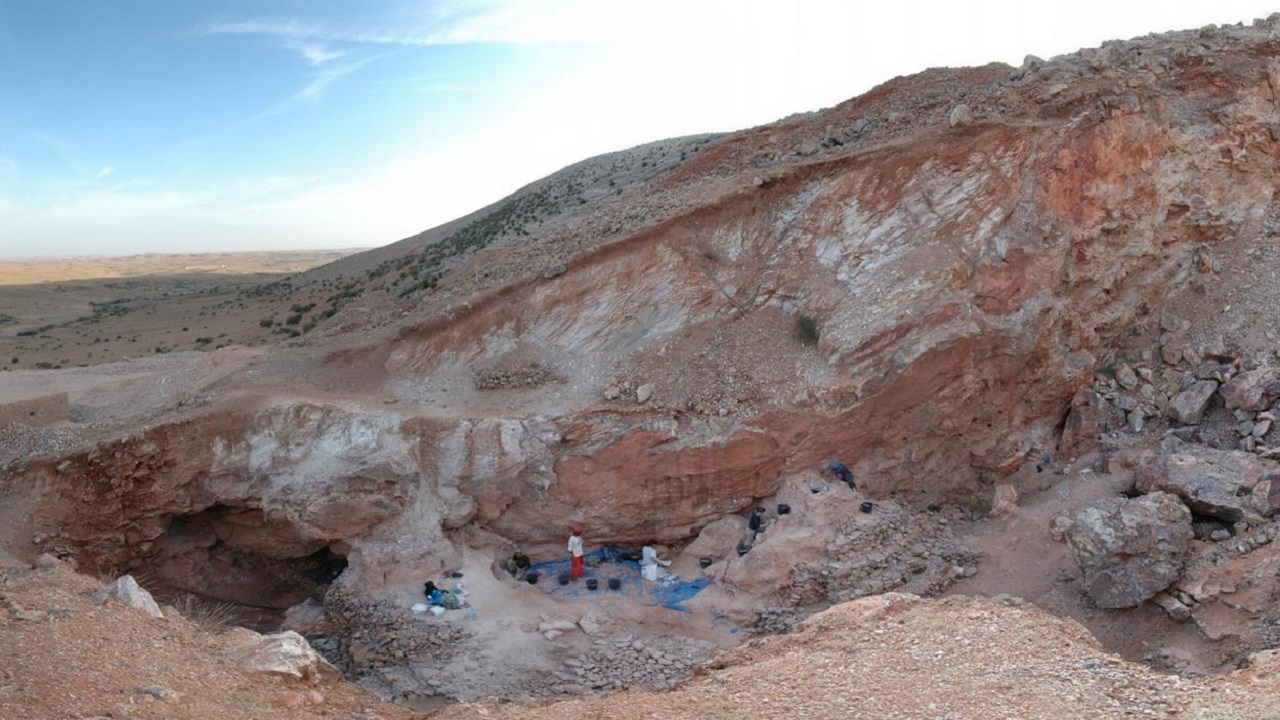
    The Jebel Irhoud site in Morocco. Credit Shannon McPherron/Max Planck Institute for Evolutionary Anthropology

    A great and surprising discovery has been made in the search for the human origin in the form of the oldest fossils so far of our own kind. The new fossil findings point out that our species Homo sapiens is significantly older than we have found evidence for before.

    So far, it has been assumed that Homo sapiens occurred in sub-Saharan Africa about 200,000 years ago. The oldest known findings were, before this new discovery, was a number of fossils from Ethiopia with an age of 195,000 years.

    Now, however, the whole story has to be rewritten, since the newfound Moroccan fossils have been dated to approximately 315,000 years. This probably means that our species first occurred even earlier.
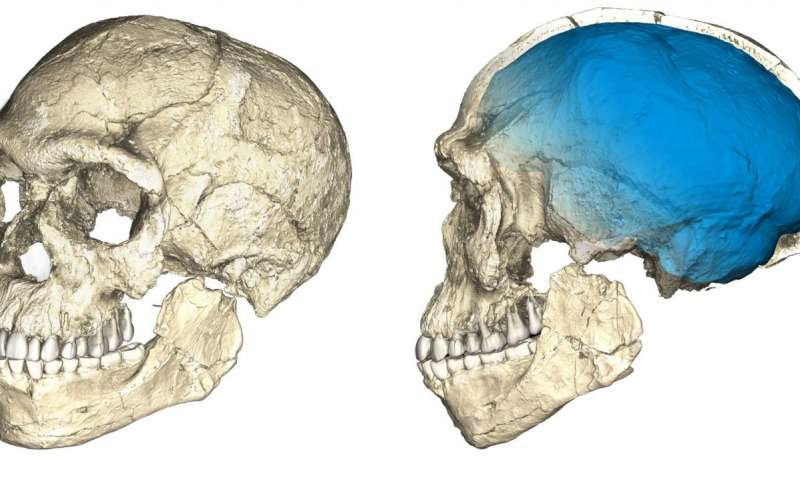
    Two views of a composite reconstruction of the earliest known Homo sapiens fossils from Jebel Irhoud (Morocco) based on micro computed tomographic scans of multiple original fossils. Dated to 300 thousand years ago these early Homo sapiens already have a modern-looking face that falls within the variation of humans living today. However, the archaic-looking virtual imprint of the braincase (blue) indicates that brain shape, and possibly brain function, evolved within the Homo sapiens lineage.
    © Philipp Gunz, MPI EVA Leipzig (License: CC-BY-SA 2.0)

    The fossils were found at a place called Jebel Irhoud in Morocco, close to Marrakesh, and consist of remains from at least five individuals, including parts of a skull and a lower jaw.

    The analysis suggests that these individuals are closer to Homo sapiens than any other contemporary human species, such as the Neanderthals and Homo heidelbergensis. This is, therefore, the earliest finding of the specific homo genus that developed into Homo Sapiens.
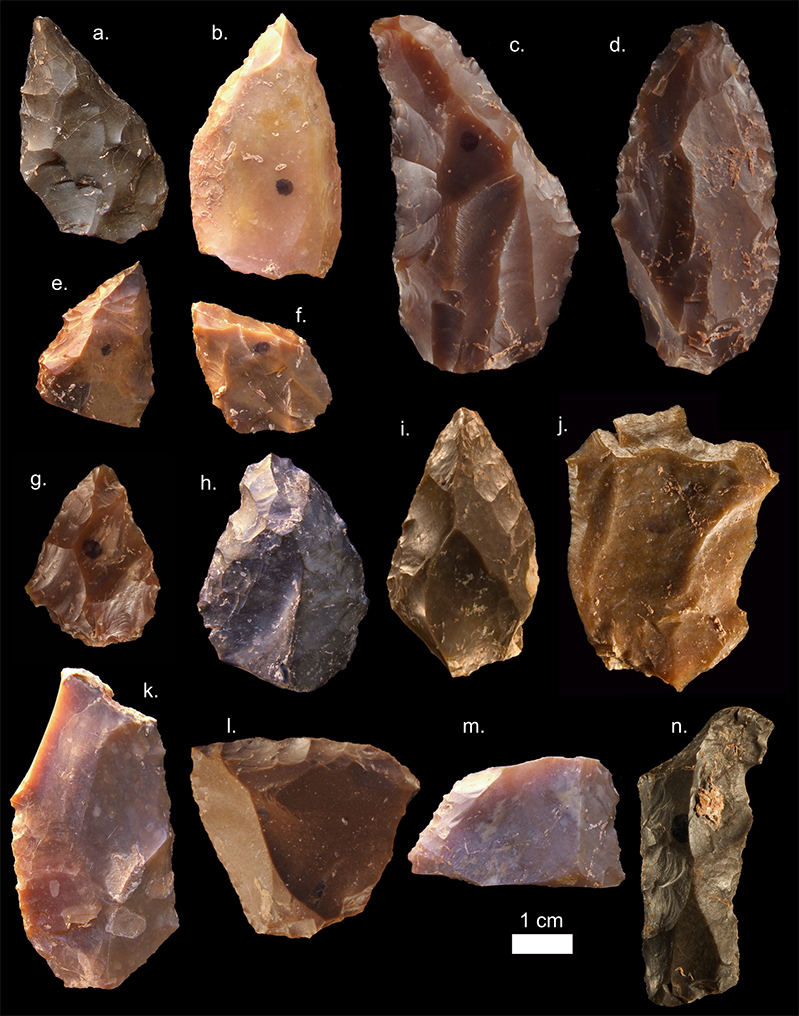
    Some of the Middle Stone Age stone tools from Jebel Irhoud (Morocco). Pointed forms such as a-i are common in the assemblage. Also characteristic are the Levellois prepared core flakes (j-k).
    © Mohammed Kamal, MPI EVA Leipzig (License: CC-BY-SA 2.0)

    According to the team of researchers led by the paleoanthropologist Jean-Jacques Hublin at the Max Planck Institute in Leipzig, the face shape of the people of Jebel Irhoud is quite similar to our own and they wouldn’t stand out today. They have a small and gracile face, and globular braincase, typical for modern humans. The shape of the brain case, on the other hand, has some more archaic features. These features are what could be expected from the very earliest representatives of our own kind.

    The findings could help researchers to seriously begin assessing the boundaries between different homo species, to define the emergence of Homo sapiens. These boundaries are certainly fuzzy around 300,000 years ago, with several species involved and with fully developed Homo sapiens possibly first emerging circa 70,000 years ago.

    The age of the new findings are remarkable, but so is also the location of the findings. It has been assumed that humans fully evolved south of the Sahara. Now, North Africa must be included when talking about the evolution of our species.

    According to the Max Planck researchers, the Jebel Irhoud fossils corroborate the interpretation of an enigmatic partial cranium from Florisbad, South Africa, as an early representative of Homo sapiens.

    The earliest Homo sapiens fossils are found across the entire African continent: Jebel Irhoud, Morocco (300 thousand years), Florisbad, South Africa (260 thousand years), and Omo Kibish, Ethiopia (195 thousand years). This indicates a complex evolutionary history of our species, possibly involving the whole African continent.

    Clearly, Homo sapiens developed gradually over a long period of time and our own kind did not suddenly arise 200,000 years ago.

    Reference:

    Jean-Jacques Hublin et al. New fossils from Jebel Irhoud, Morocco and the pan-African origin of Homo sapiens. Nature 7 may 2017: DOI: 10.1038/nature22336

    Daniel Richter et al. The age of the hominin fossils from Jebel Irhoud, Morocco, and the origins of the Middle Stone Age. Nature 7 may 2017: DOI: 10.1038/nature22335

    Human Evolution
    Share. Facebook Twitter Pinterest LinkedIn Tumblr Email Copy Link

    Related Posts

    Use of Evolution to Design Molecules Nets Nobel Prize in Chemistry for 3 Scientists

    October 4, 2018

    This Is How the Bottlenose Dolphin Avoids Divers’ Disease

    August 14, 2018

    Indonesian Divers Have Evolved Bigger Spleens to Hunt Underwater

    May 7, 2018

    These Skates Are Made for Walking

    February 23, 2018

    Modern Humans have Even more Neanderthal DNA than we thought

    October 6, 2017

    Homo sapiens emerged more than 300,000 years ago, according to new study

    September 29, 2017
    Recent Posts
    • How the End of Bretton Woods Reshaped Our Economies — and Our Politics
    • Can the U.S. Really Handle 250% Debt-to-GDP? Why Jackson Hole’s Daring Paper Is Wrong
    • Japan’s Fiscal Trap: What Happens If Austerity Is No Longer an Option?
    • The Rise of Range Extended Electric Vehicles (REEVs): A New Era of Hybrid Mobility
    • The Great Capital Rotation: A Shift from U.S. Treasuries to Gold and Real Assets
    • The Hidden Risks of Short-Term Debt: A Balancing Act in U.S. Fiscal Policy
    • The Looming U.S. Debt Spiral: Understanding the Risks
    • The Looming Recession: Seven Economic Indicators Flashing Red for 2025
    • Europa Clipper: NASA’s Mission to Unlock the Secrets of Jupiter’s Icy Moon
    • Could Hedge Funds Cause Chaos in the U.S. Treasury Market? And What About Inflation?
    © 2025 Illustrated Curiosity

    Type above and press Enter to search. Press Esc to cancel.

    This website uses cookies to improve your experience. We'll assume you're ok with this, but you can opt-out if you wish.Accept Reject Read More
    Privacy & Cookies Policy

    Privacy Overview

    This website uses cookies to improve your experience while you navigate through the website. Out of these, the cookies that are categorized as necessary are stored on your browser as they are essential for the working of basic functionalities of the website. We also use third-party cookies that help us analyze and understand how you use this website. These cookies will be stored in your browser only with your consent. You also have the option to opt-out of these cookies. But opting out of some of these cookies may affect your browsing experience.
    Necessary
    Always Enabled
    Necessary cookies are absolutely essential for the website to function properly. This category only includes cookies that ensures basic functionalities and security features of the website. These cookies do not store any personal information.
    Non-necessary
    Any cookies that may not be particularly necessary for the website to function and is used specifically to collect user personal data via analytics, ads, other embedded contents are termed as non-necessary cookies. It is mandatory to procure user consent prior to running these cookies on your website.
    SAVE & ACCEPT