Close Menu
Illustrated Curiosity
    Facebook X (Twitter) Instagram YouTube
    Illustrated Curiosity
    • Earth
    • Economics
    • Environment
      • Climate
      • Environmental Tech
      • Pollution
      • Wildlife
    • Health
      • Health Tech
      • Medicine
      • Nutrition
      • Exercise
    • History
      • Prehistory
      • Ancient History
      • Postclassical Era
      • Modern History
    • Humans
      • Human Brain
      • Psychology
    • Life
      • Animals & Plants
      • Genetics
      • Paleontology
      • Evolution
      • Genetic Engineering
    • Physics
    • Space
      • Astrobiology
      • Astronomy
      • Extrasolar Planets
      • Space Tech
      • Spaceflight
    • Technology
      • Artificial Intelligence
      • Energy
      • Engineering
      • Materials
      • Robotics
      • Vehicles
    Illustrated Curiosity
    Home » Environmental Changes, Responsible for the Diversification of Horses
    Evolution

    Environmental Changes, Responsible for the Diversification of Horses

    February 13, 2017No Comments3 Mins Read
    Share
    Facebook Twitter LinkedIn Pinterest Email

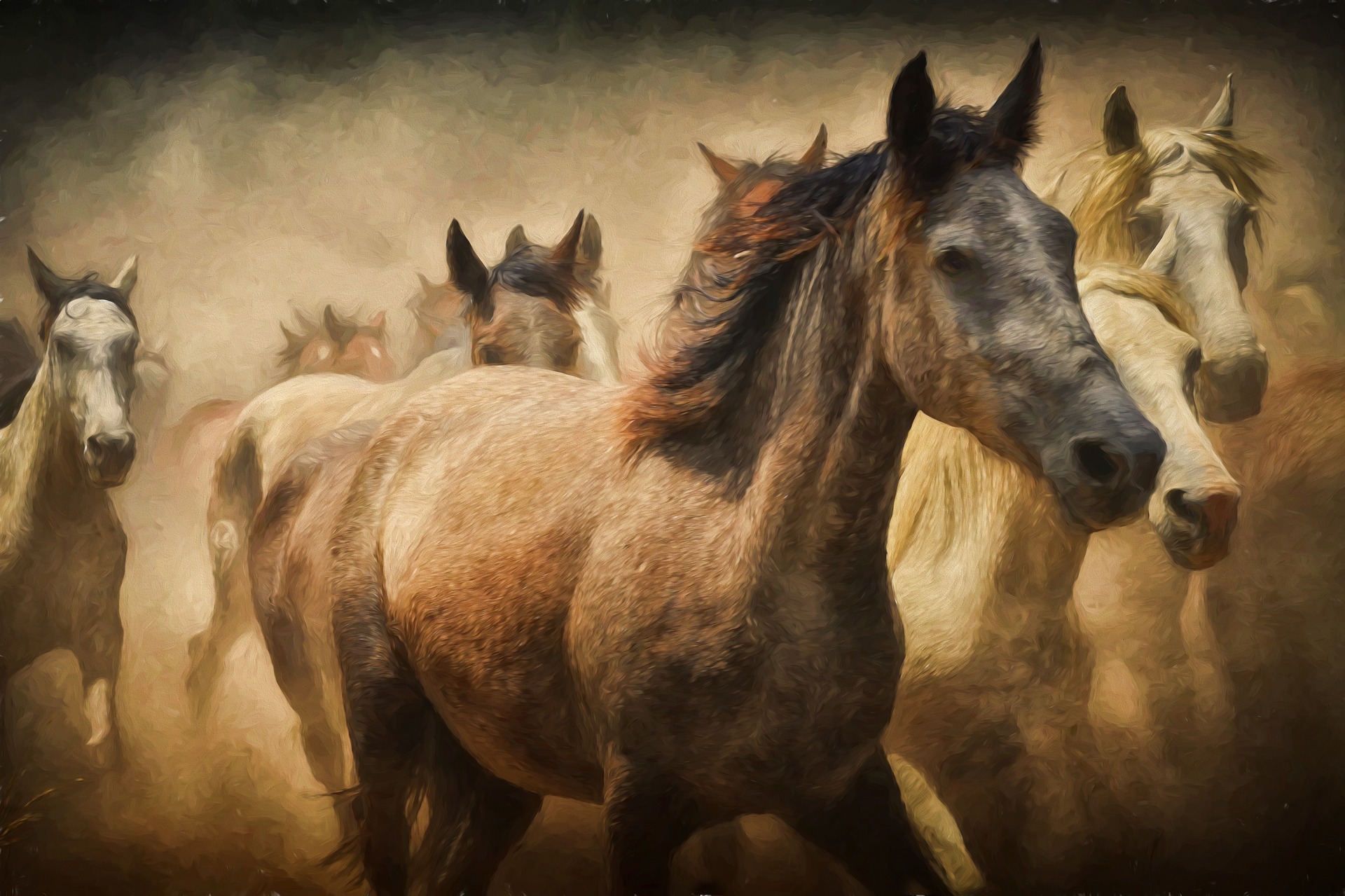
    Fossils of the horse’s ancestors turns our understanding of evolution on its head. The research indicates that it is the environment rather than new genetic traits that primarily pushes evolution forward.
    CC0 Public Domain

    Evolution can go rapidly with many new species demerging from a specific animal genus within a short period of time. But what the actual driving force is behind this rapid speciation has long been discussed.

    The main hypothesis has long been attributed to random specific changes in the genetic material that gives rise to new traits of individual animals and that these traits make it possible for animals to find new niches and colonize new environments.

    But recent fossil records of the horse’s ancestors are pointing to the contrary. These fossils show us how the geographic or ecological isolation of a group of animals can be important.

    The horse is often used as a textbook example of rapid evolutionary development. One example is the horse’s teeth and body size that has changed a lot and rapidly through evolution; from being small as a fox with short teeth, the horse grew both in size and tooth length to adapt to a life as herbivores.
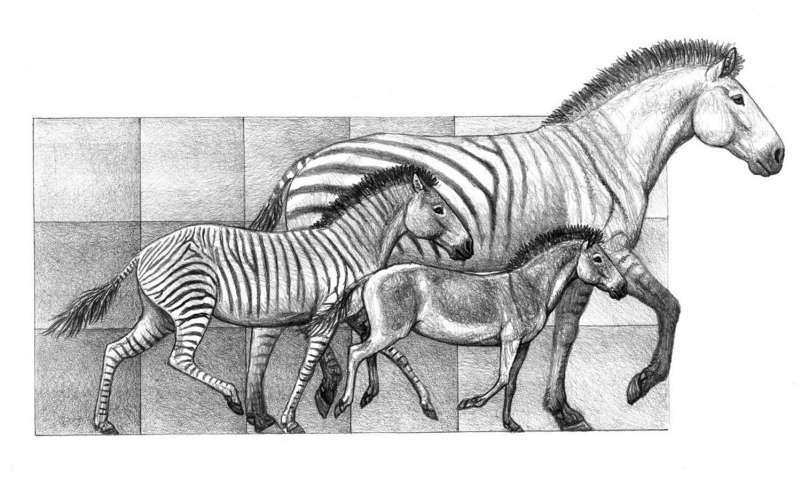
    Three species of Hipparion, that lived in the Iberian peninsula between 9 million years and 5 million years ago. Credit: Mauricio Antón

    The horse genus is also extremely varied, today there are fewer than ten species remaining, but historically there have been over 130 species. The horse species diversity and rapid evolutionary development have been used as a proof that the development of new properties is probably the driving force behind rapid specialization.

    “According to the classic view, horses would have evolved faster in when grasslands appeared, developing teeth that were more resistant to the stronger wear that comes with a grass-dominated diet. They also became bigger to more effectively digest this low-quality food, and as a strategy against predators in these new, open habitats”, lead author Juan L. Cantalapiedra explains, who is a researcher at the Museum für Naturkunde in Berlin, Germany.

    The researchers examined fossils from 138 different horse breeds which together represent an evolutionary branch that extend 18 million years back in time and a comparison of the rate of speciation and development of new properties revealed that a clear link is missing.

    It appears as if the changes in the appearance of the teeth and the horse’s body size is not correlated with the speed at which new species were formed. These newly evolved species of horses were ecologically very similar but the specific evolutionary changes were much slower than previously assumed. Thus, rather than a multiplication of ecological roles, the new results point to external factors, such as increasing environmental heterogeneity, as the main evolutionary force. Suggesting that it is the environment, rather than traits that drive speciation.

    Reference:

    Cantalapiedra et al, 2016. Decoupled ecomorphological evolution and diversification in the Neogene-Quaternary horses. Science. Doi: 10.1126 / science.aag1772

    Horses Mutation
    Share. Facebook Twitter Pinterest LinkedIn Tumblr Email Copy Link

    Related Posts

    Use of Evolution to Design Molecules Nets Nobel Prize in Chemistry for 3 Scientists

    October 4, 2018

    This Is How the Bottlenose Dolphin Avoids Divers’ Disease

    August 14, 2018

    These Skates Are Made for Walking

    February 23, 2018

    Scientists test evolutionary hypophysis for insomnia

    July 14, 2017

    Earliest fossil evidence of Homo sapiens found in Morocco

    June 10, 2017

    European fossils may belong to earliest known human ancestor

    June 5, 2017
    Recent Posts
    • How the End of Bretton Woods Reshaped Our Economies — and Our Politics
    • Can the U.S. Really Handle 250% Debt-to-GDP? Why Jackson Hole’s Daring Paper Is Wrong
    • Japan’s Fiscal Trap: What Happens If Austerity Is No Longer an Option?
    • The Rise of Range Extended Electric Vehicles (REEVs): A New Era of Hybrid Mobility
    • The Great Capital Rotation: A Shift from U.S. Treasuries to Gold and Real Assets
    • The Hidden Risks of Short-Term Debt: A Balancing Act in U.S. Fiscal Policy
    • The Looming U.S. Debt Spiral: Understanding the Risks
    • The Looming Recession: Seven Economic Indicators Flashing Red for 2025
    • Europa Clipper: NASA’s Mission to Unlock the Secrets of Jupiter’s Icy Moon
    • Could Hedge Funds Cause Chaos in the U.S. Treasury Market? And What About Inflation?
    © 2025 Illustrated Curiosity

    Type above and press Enter to search. Press Esc to cancel.

    This website uses cookies to improve your experience. We'll assume you're ok with this, but you can opt-out if you wish.Accept Reject Read More
    Privacy & Cookies Policy

    Privacy Overview

    This website uses cookies to improve your experience while you navigate through the website. Out of these, the cookies that are categorized as necessary are stored on your browser as they are essential for the working of basic functionalities of the website. We also use third-party cookies that help us analyze and understand how you use this website. These cookies will be stored in your browser only with your consent. You also have the option to opt-out of these cookies. But opting out of some of these cookies may affect your browsing experience.
    Necessary
    Always Enabled
    Necessary cookies are absolutely essential for the website to function properly. This category only includes cookies that ensures basic functionalities and security features of the website. These cookies do not store any personal information.
    Non-necessary
    Any cookies that may not be particularly necessary for the website to function and is used specifically to collect user personal data via analytics, ads, other embedded contents are termed as non-necessary cookies. It is mandatory to procure user consent prior to running these cookies on your website.
    SAVE & ACCEPT