Close Menu
Illustrated Curiosity
    Facebook X (Twitter) Instagram YouTube
    Illustrated Curiosity
    • Earth
    • Economics
    • Environment
      • Climate
      • Environmental Tech
      • Pollution
      • Wildlife
    • Health
      • Health Tech
      • Medicine
      • Nutrition
      • Exercise
    • History
      • Prehistory
      • Ancient History
      • Postclassical Era
      • Modern History
    • Humans
      • Human Brain
      • Psychology
    • Life
      • Animals & Plants
      • Genetics
      • Paleontology
      • Evolution
      • Genetic Engineering
    • Physics
    • Space
      • Astrobiology
      • Astronomy
      • Extrasolar Planets
      • Space Tech
      • Spaceflight
    • Technology
      • Artificial Intelligence
      • Energy
      • Engineering
      • Materials
      • Robotics
      • Vehicles
    Illustrated Curiosity
    Home » Four new elements make their mark on the periodic table
    Physics

    Four new elements make their mark on the periodic table

    January 7, 2016No Comments2 Mins Read
    Share
    Facebook Twitter LinkedIn Pinterest Email
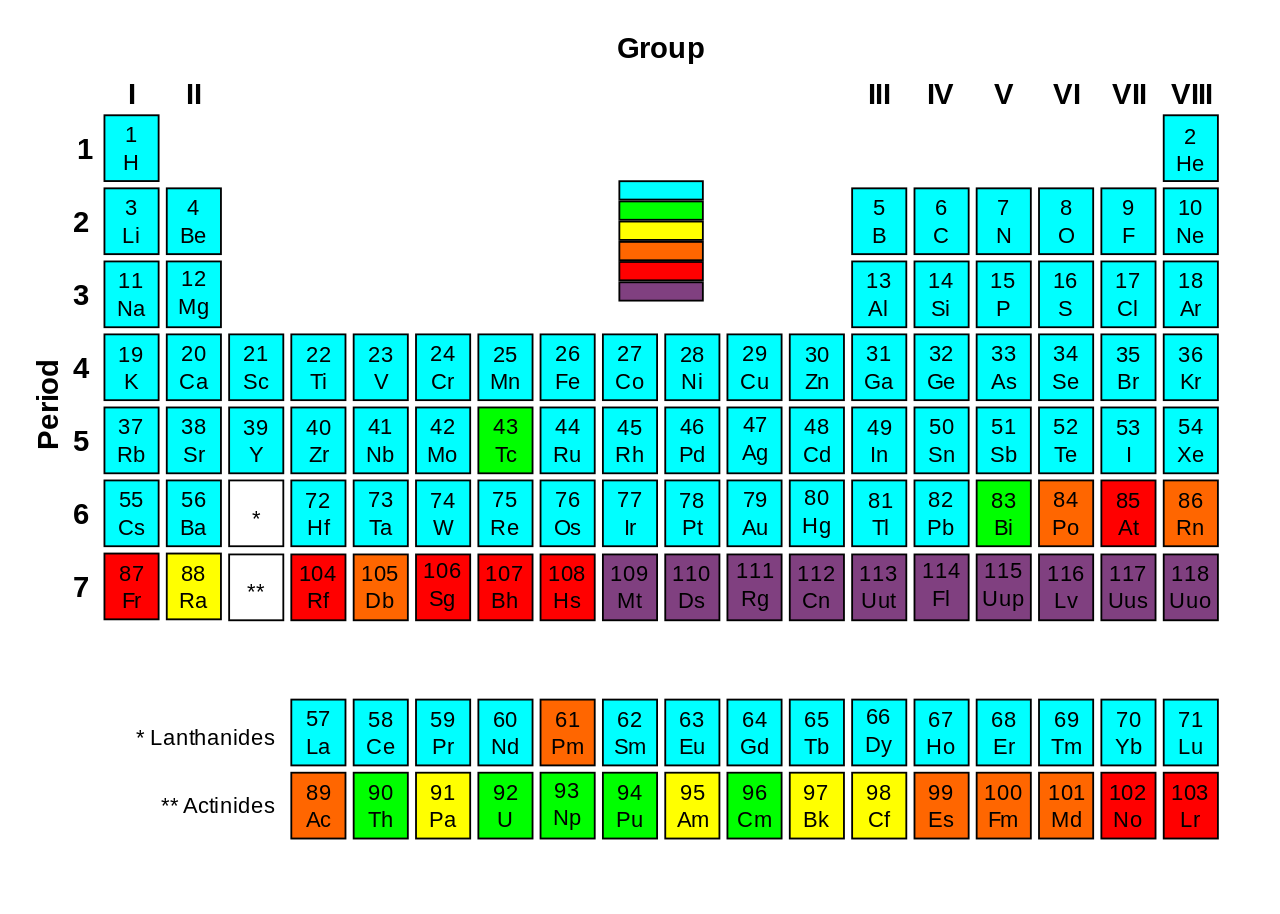
    Periodic table with elements colored according to the half-life of their most stable isotope. All four new elements are extremely radioactive elements: the most stable isotope has a half-life less than several minutes.

    The International Chemistry Union IUPAC have approved four new elements. This approval makes the seventh row of the periodic table complete.

    The elements with atomic numbers 113, 115, 117 and 118 are the heaviest known members of the boron group, the nitrogen group, the halogens and noble gasses.

    All are highly reactive with half-lives of up to half a second. The elements result from research done by teams in Japan, Russia, and the United States.

    The next phase of the process is to name the elements and the scientists behind the discoveries have six months during which they are to suggest names and symbols. These are then to be approved by IUPAC department of inorganic chemistry. Both scientists and the public have a saying on the names before approval by the IUPAC General Assembly in 2017.

    The first report of the synthesis of ununpentium came in August 2003 and was reported on February 2, 2004, in Physical Review C by a team composed of Russian scientists at the Joint Institute for Nuclear Research (JINR) in Dubna, and American scientists at the Lawrence Livermore National Laboratory. The team reported that they bombarded americium-243 with calcium-48 ions to produce four atoms of ununpentium.
    Simulation of an accelerated calcium-48 ion about to collide with an americium-243 target atom.

    They have been given temporary names, though, said Professor Jan Reedijk, President of the Inorganic Chemistry Division of IUPAC. The elements have been temporarily named as ununtrium, (Uut or element 113), ununpentium (Uup, element 115), ununseptium (Uus, element 117), and ununoctium (Uuo, element 118).

    Since the periodic table is systematically built, there have been some gaps in the table and these gaps hint of elements that should exist. The elements are not “natural” in the sense of all being created in a laboratory setting. But with this announcement, all the gaps are now filled.

    _______________
    Discovery and Assignment of Elements with Atomic Numbers 113, 115, 117 and 118
    ______________________________
    Periodic Table of Elements
    Share. Facebook Twitter Pinterest LinkedIn Tumblr Email Copy Link

    Related Posts

    Scientists Race to Test Claimed Room-Temperature Superconductor

    August 3, 2023

    2020 Nobel Prize in Physics Awarded to Trio for Work on Black Hole Formation

    October 6, 2020

    Atomic Clocks So Precise, They Could Detect Space-Time Distortion

    December 4, 2018

    The World Just Redefined the Kilogram

    November 21, 2018

    China Plans to Build a Particle Collider Five Times More Powerful Than the LHC

    November 19, 2018

    Nobel Prize in Physics 2018 Awarded to Scientists Who Put Light to Work

    October 2, 2018
    Recent Posts
    • How the End of Bretton Woods Reshaped Our Economies — and Our Politics
    • Can the U.S. Really Handle 250% Debt-to-GDP? Why Jackson Hole’s Daring Paper Is Wrong
    • Japan’s Fiscal Trap: What Happens If Austerity Is No Longer an Option?
    • The Rise of Range Extended Electric Vehicles (REEVs): A New Era of Hybrid Mobility
    • The Great Capital Rotation: A Shift from U.S. Treasuries to Gold and Real Assets
    • The Hidden Risks of Short-Term Debt: A Balancing Act in U.S. Fiscal Policy
    • The Looming U.S. Debt Spiral: Understanding the Risks
    • The Looming Recession: Seven Economic Indicators Flashing Red for 2025
    • Europa Clipper: NASA’s Mission to Unlock the Secrets of Jupiter’s Icy Moon
    • Could Hedge Funds Cause Chaos in the U.S. Treasury Market? And What About Inflation?
    © 2025 Illustrated Curiosity

    Type above and press Enter to search. Press Esc to cancel.

    This website uses cookies to improve your experience. We'll assume you're ok with this, but you can opt-out if you wish.Accept Reject Read More
    Privacy & Cookies Policy

    Privacy Overview

    This website uses cookies to improve your experience while you navigate through the website. Out of these, the cookies that are categorized as necessary are stored on your browser as they are essential for the working of basic functionalities of the website. We also use third-party cookies that help us analyze and understand how you use this website. These cookies will be stored in your browser only with your consent. You also have the option to opt-out of these cookies. But opting out of some of these cookies may affect your browsing experience.
    Necessary
    Always Enabled
    Necessary cookies are absolutely essential for the website to function properly. This category only includes cookies that ensures basic functionalities and security features of the website. These cookies do not store any personal information.
    Non-necessary
    Any cookies that may not be particularly necessary for the website to function and is used specifically to collect user personal data via analytics, ads, other embedded contents are termed as non-necessary cookies. It is mandatory to procure user consent prior to running these cookies on your website.
    SAVE & ACCEPT