Close Menu
Illustrated Curiosity
    Facebook X (Twitter) Instagram YouTube
    Illustrated Curiosity
    • Earth
    • Economics
    • Environment
      • Climate
      • Environmental Tech
      • Pollution
      • Wildlife
    • Health
      • Health Tech
      • Medicine
      • Nutrition
      • Exercise
    • History
      • Prehistory
      • Ancient History
      • Postclassical Era
      • Modern History
    • Humans
      • Human Brain
      • Psychology
    • Life
      • Animals & Plants
      • Genetics
      • Paleontology
      • Evolution
      • Genetic Engineering
    • Physics
    • Space
      • Astrobiology
      • Astronomy
      • Extrasolar Planets
      • Space Tech
      • Spaceflight
    • Technology
      • Artificial Intelligence
      • Energy
      • Engineering
      • Materials
      • Robotics
      • Vehicles
    Illustrated Curiosity
    Home » Video | LHC animation: The path of the protons
    Physics

    Video | LHC animation: The path of the protons

    June 3, 2015No Comments3 Mins Read
    Share
    Facebook Twitter LinkedIn Pinterest Email
    he Large Hadron Collider (LHC) is the world’s largest and most powerful particle accelerator.

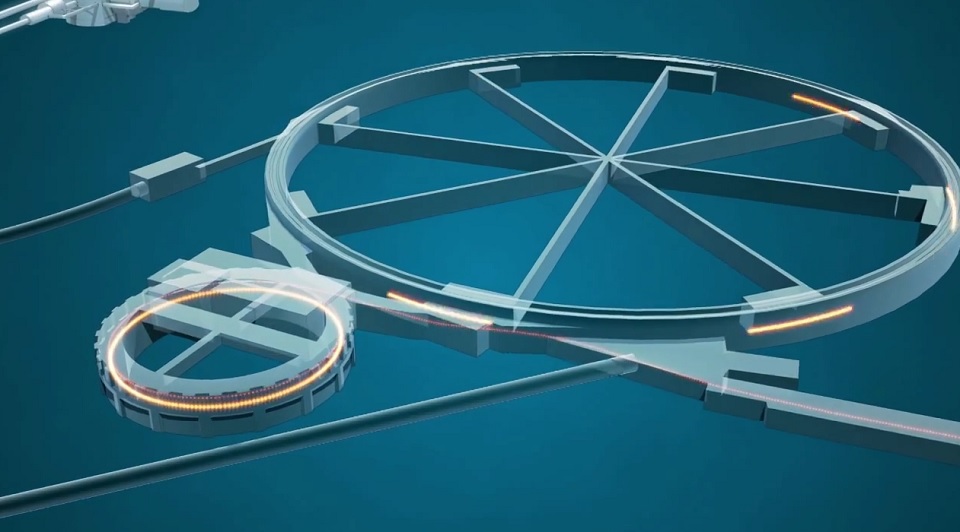
    This animation shows how the Large Hadron Collider (LHC) works.

    The film begins with an aerial view of CERN near Geneva, with outlines of the accelerator complex, including the underground Large Hadron Collider (LHC), 27-km in circumference. The positions of the four largest LHC experiments, ALICE, ATLAS, CMS and LHCb are revealed before we see protons travelling around the LHC ring.

    The proton source is a simple bottle of hydrogen gas. An electric field is used to strip hydrogen atoms of their electrons to yield protons. Linac 2, the first accelerator in the chain, accelerates the protons to the energy of 50 MeV. The beam is then injected into the Proton Synchrotron Booster (PSB), which accelerates the protons to 1.4 GeV, followed by the Proton Synchrotron (PS), which pushes the beam to 25 GeV. Protons are then sent to the Super Proton Synchrotron (SPS) where they are accelerated to 450 GeV.

    The protons are finally transferred to the two beam pipes of the LHC. The beam in one pipe circulates clockwise while the beam in the other pipe circulates anticlockwise, increasing in energy until they reach 6.5 TeV. Beams circulate for many hours inside the LHC beam pipes under normal operating conditions. The two beams are brought into collision inside four detectors – ALICE, ATLAS, CMS and LHCb – where the total energy at the collision point is equal to 13 TeV.

    Collisions occur once every 25 nanoseconds, the trigger level 1 performs ultrafast event selection before data move to trigger levels 2 and 3 at the PC farm. Selected event data are then sent to the CERN data centre that performs initial data reconstruction and makes a copy of the data for long-term storage, while raw and reconstituted data are sent to the Computing Grid. The Worldwide LHC Computing Grid infrastructure includes two “Tier 0” sites, one at CERN and one in Budapest, Hungary, as well as further smaller computing sites located around the world.

    As collision data increases, physicists build up enough statistics to test theoretical predictions, such as the prediction of a Higgs Boson, discovered in the data from the LHC’s first physics run (shown as a bump in the graphs in the animation). The LHC allows physicists to probe the nature of matter. The new higher collision energy of 13 TeV opens up new frontiers in particle physics.

     

    LHC (Large Hadron Collider)
    Share. Facebook Twitter Pinterest LinkedIn Tumblr Email Copy Link

    Related Posts

    Scientists Race to Test Claimed Room-Temperature Superconductor

    August 3, 2023

    2020 Nobel Prize in Physics Awarded to Trio for Work on Black Hole Formation

    October 6, 2020

    Atomic Clocks So Precise, They Could Detect Space-Time Distortion

    December 4, 2018

    The World Just Redefined the Kilogram

    November 21, 2018

    China Plans to Build a Particle Collider Five Times More Powerful Than the LHC

    November 19, 2018

    Nobel Prize in Physics 2018 Awarded to Scientists Who Put Light to Work

    October 2, 2018
    Recent Posts
    • How the End of Bretton Woods Reshaped Our Economies — and Our Politics
    • Can the U.S. Really Handle 250% Debt-to-GDP? Why Jackson Hole’s Daring Paper Is Wrong
    • Japan’s Fiscal Trap: What Happens If Austerity Is No Longer an Option?
    • The Rise of Range Extended Electric Vehicles (REEVs): A New Era of Hybrid Mobility
    • The Great Capital Rotation: A Shift from U.S. Treasuries to Gold and Real Assets
    • The Hidden Risks of Short-Term Debt: A Balancing Act in U.S. Fiscal Policy
    • The Looming U.S. Debt Spiral: Understanding the Risks
    • The Looming Recession: Seven Economic Indicators Flashing Red for 2025
    • Europa Clipper: NASA’s Mission to Unlock the Secrets of Jupiter’s Icy Moon
    • Could Hedge Funds Cause Chaos in the U.S. Treasury Market? And What About Inflation?
    © 2025 Illustrated Curiosity

    Type above and press Enter to search. Press Esc to cancel.

    This website uses cookies to improve your experience. We'll assume you're ok with this, but you can opt-out if you wish.Accept Reject Read More
    Privacy & Cookies Policy

    Privacy Overview

    This website uses cookies to improve your experience while you navigate through the website. Out of these, the cookies that are categorized as necessary are stored on your browser as they are essential for the working of basic functionalities of the website. We also use third-party cookies that help us analyze and understand how you use this website. These cookies will be stored in your browser only with your consent. You also have the option to opt-out of these cookies. But opting out of some of these cookies may affect your browsing experience.
    Necessary
    Always Enabled
    Necessary cookies are absolutely essential for the website to function properly. This category only includes cookies that ensures basic functionalities and security features of the website. These cookies do not store any personal information.
    Non-necessary
    Any cookies that may not be particularly necessary for the website to function and is used specifically to collect user personal data via analytics, ads, other embedded contents are termed as non-necessary cookies. It is mandatory to procure user consent prior to running these cookies on your website.
    SAVE & ACCEPT