Close Menu
Illustrated Curiosity
    Facebook X (Twitter) Instagram YouTube
    Illustrated Curiosity
    • Earth
    • Economics
    • Environment
      • Climate
      • Environmental Tech
      • Pollution
      • Wildlife
    • Health
      • Health Tech
      • Medicine
      • Nutrition
      • Exercise
    • History
      • Prehistory
      • Ancient History
      • Postclassical Era
      • Modern History
    • Humans
      • Human Brain
      • Psychology
    • Life
      • Animals & Plants
      • Genetics
      • Paleontology
      • Evolution
      • Genetic Engineering
    • Physics
    • Space
      • Astrobiology
      • Astronomy
      • Extrasolar Planets
      • Space Tech
      • Spaceflight
    • Technology
      • Artificial Intelligence
      • Energy
      • Engineering
      • Materials
      • Robotics
      • Vehicles
    Illustrated Curiosity
    Home » How Would People React to Finding Alien Life?
    Astrobiology

    How Would People React to Finding Alien Life?

    March 1, 2018No Comments4 Mins Read
    Share
    Facebook Twitter LinkedIn Pinterest Email
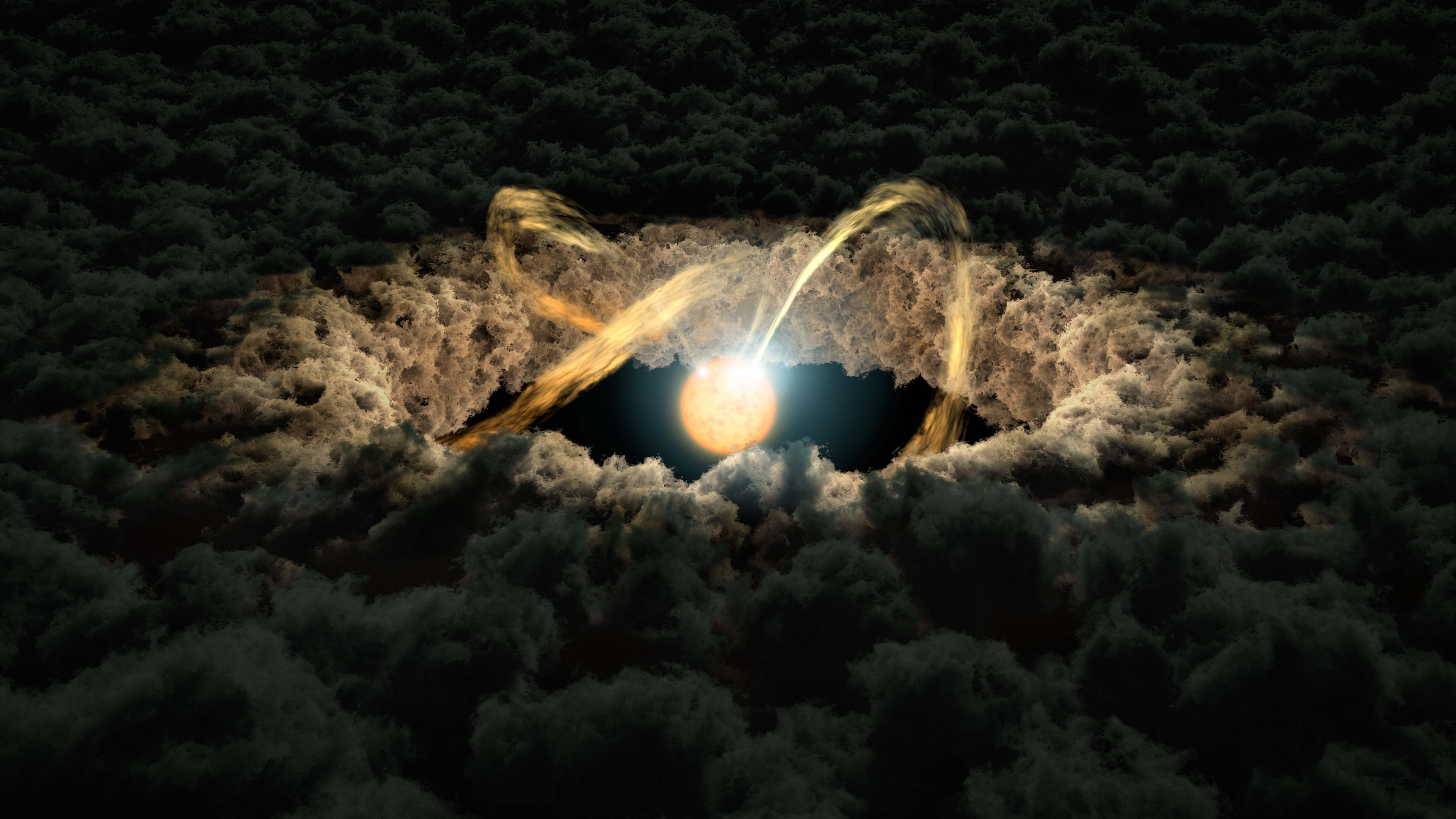
    This illustration shows a star surrounded by a protoplanetary disk. Material from the thick disk flows along the star’s magnetic field lines and is deposited onto the star’s surface. When material hits the star, it lights up brightly.
    Among the stories the team chose covered was the strange behavior of Tabby’s star, which in 2015 was suggested to be the work of orbiting alien megastructures. Credits: NASA/JPL-Caltech

    If we would find extraterrestrial life, people would become more fascinated than scared, according to a new study.

    The search for extraterrestrial life is heating up with more advanced technology available to us, new more powerful instruments with increasing capability and the ever-increasing number of exoplanets discovered. But how would we react if we were told that we are not alone in the universe? This is the question raised by researchers and addressed at the AAAS Austin Science Conference last week.

    This is the first time this type of psychological research has been undertaken on the subject, according to the researchers involved. The team led by Michael Varnum at the Arizona State University examined how the media reported about possible life on other moons and planets.

    “The order and language used is noticeably much more positive than negative,”

    – Study author Michael Varnum of Arizona State University said today during a press briefing at the AAAS meeting.

    Besides probing the media, the researchers also asked more than 500 people to enquire how they considered that they and others would react if astronomers would find traces of life elsewhere in the universe. It turned out that an overwhelming majority of people were more enthusiastic than scared, and they also believed that they themselves would be more positive than humanity at large.

    Finally, the researchers let the participants read one of two articles from the New York Times. One article from 1996 when researchers had discovered what first seemed to be fossils of extraterrestrial microorganisms found in a meteorite from Mars, while the other from 2010, reported that scientists managed to create artificial bacteria.

    Asking whether the words in those stories reflected emotions that were more positive (e.g., “happy,” “nice,” “good”) or more negative (e.g., “worried,” “nervous,” “annoyed”). In both cases, participants reacted more positive, but the article about artificial life gave more negative reactions than the article about life on Mars.

    Nor does it seem that we would be particularly worried if we discovered advanced extraterrestrial civilizations. Michael Varnum also investigated how the media reported about what some presented as a possible construction (a ‘Dyson Sphere’) around Tabbys star, and also more recently when the cigar-shaped Oumuamua asteroid from another solar system passed through our solar system, and some speculated whether it was a spaceship.

    “The reports were consistently positive. So if media reports reflect the reactions of the public, it seems that we should take the news quite well.”

    “If a hostile armada of warships appeared in proximity to the Earth, we would of course not be so happy. But it is much more likely that we will find traces of microorganisms or signals from civilizations very far away and from far back in time,”

    – Michael Varnum.

    The scientific field of astrobiology has become a serious scientific field in recent decades, a field that was almost absurd a couple of decades ago. To suggest that we should search for intelligent extraterrestrial life was probably like saying that we should look for fairies in the 1960s.

    But since then, the pendulum has swung over in the other direction. Today, most researchers believe the universe is full of life. We now know that extrasolar planets are found everywhere, planets are common, we also know that our own solar system is awash in water, water is common, but even if the prerequisites for life appears to be good elsewhere in the universe, we still do not know how common life is.

    The results were presented at the annual science conference AAAS in Austin, Texas, and published in the journal Frontiers in Psychology.

    Reference:

    Jung Yul Kwon, Hannah L. Bercovici, Katja Cunningham and Michael E. W. Varnum How Will We React to the Discovery of Extraterrestrial Life? Front. Psychol., 10 January 2018 | https://doi.org/10.3389/fpsyg.2017.02308
    Alien Civilizations Alien Life Extraterrestrial Intelligence Extraterrestrial Life
    Share. Facebook Twitter Pinterest LinkedIn Tumblr Email Copy Link

    Related Posts

    Europa Clipper: NASA’s Mission to Unlock the Secrets of Jupiter’s Icy Moon

    October 20, 2024

    The Phosphine Discovered in Venus’ Clouds May Be a Big Deal

    September 21, 2020

    There Is Definitely Methane on Mars, Scientists Say. But Is It a Sign of Life?

    April 4, 2019

    NASA Is Working With Billionaire Yuri Milner To Search For Life On Enceladus

    November 12, 2018

    Salty Water Under the Surface of Mars Could Have Enough Oxygen for Life

    November 2, 2018

    Video | Professor Abraham: The Search for Primitive and Intelligent Life on Other Planets

    October 16, 2018
    Recent Posts
    • How the End of Bretton Woods Reshaped Our Economies — and Our Politics
    • Can the U.S. Really Handle 250% Debt-to-GDP? Why Jackson Hole’s Daring Paper Is Wrong
    • Japan’s Fiscal Trap: What Happens If Austerity Is No Longer an Option?
    • The Rise of Range Extended Electric Vehicles (REEVs): A New Era of Hybrid Mobility
    • The Great Capital Rotation: A Shift from U.S. Treasuries to Gold and Real Assets
    • The Hidden Risks of Short-Term Debt: A Balancing Act in U.S. Fiscal Policy
    • The Looming U.S. Debt Spiral: Understanding the Risks
    • The Looming Recession: Seven Economic Indicators Flashing Red for 2025
    • Europa Clipper: NASA’s Mission to Unlock the Secrets of Jupiter’s Icy Moon
    • Could Hedge Funds Cause Chaos in the U.S. Treasury Market? And What About Inflation?
    © 2025 Illustrated Curiosity

    Type above and press Enter to search. Press Esc to cancel.

    This website uses cookies to improve your experience. We'll assume you're ok with this, but you can opt-out if you wish.Accept Reject Read More
    Privacy & Cookies Policy

    Privacy Overview

    This website uses cookies to improve your experience while you navigate through the website. Out of these, the cookies that are categorized as necessary are stored on your browser as they are essential for the working of basic functionalities of the website. We also use third-party cookies that help us analyze and understand how you use this website. These cookies will be stored in your browser only with your consent. You also have the option to opt-out of these cookies. But opting out of some of these cookies may affect your browsing experience.
    Necessary
    Always Enabled
    Necessary cookies are absolutely essential for the website to function properly. This category only includes cookies that ensures basic functionalities and security features of the website. These cookies do not store any personal information.
    Non-necessary
    Any cookies that may not be particularly necessary for the website to function and is used specifically to collect user personal data via analytics, ads, other embedded contents are termed as non-necessary cookies. It is mandatory to procure user consent prior to running these cookies on your website.
    SAVE & ACCEPT