
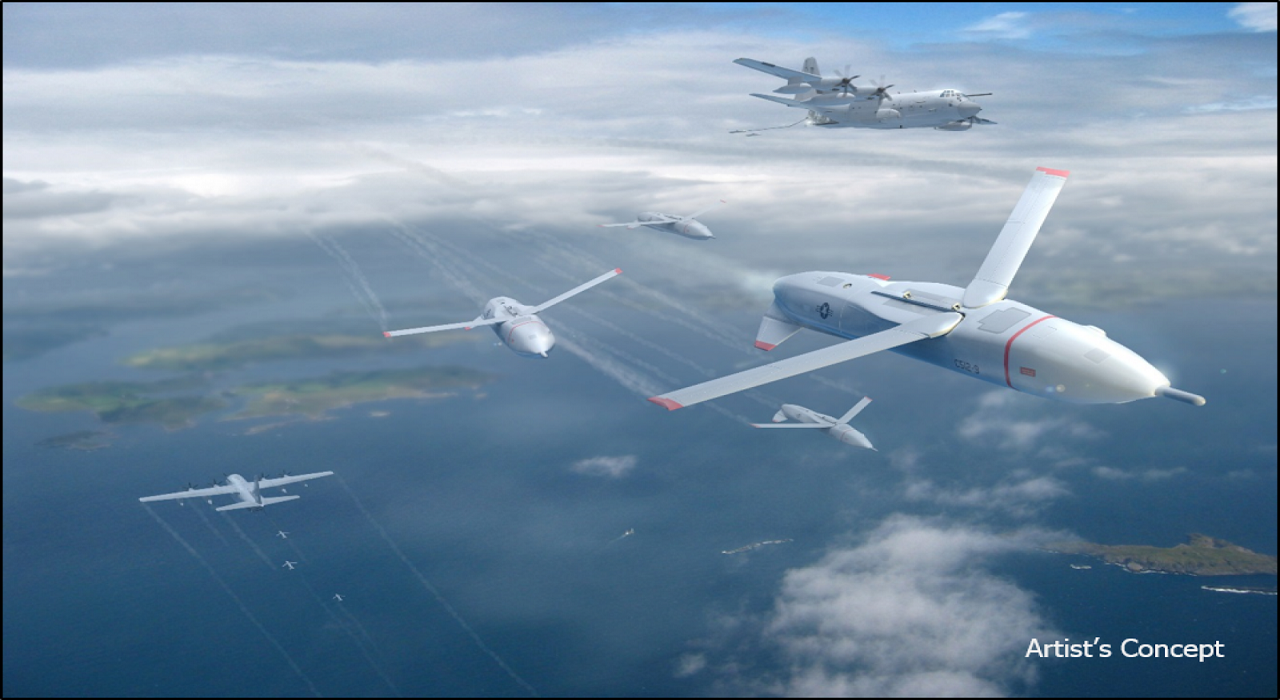
Something akin to The Helicarrier as seen in ‘The Avengers’ and ‘Captain America: Winter Soldier’ is what the U.S. Defense Advanced Research Projects Agency (Darpa) is aiming for.
An equivalent to the aircraft carrier in the sky. That’s what the Defense Advanced Research Projects Agency (DARPA) wants. As they are envisioning swarm technology with attack drones called “Gremlins”.
Obtaining air dominance has long been the ultimate key strategy to victory in war. When the aircraft carrier entered the interwar period, the possibilities of flight expanded, and the areas that could be covered became much bigger. It was then a pivotal military asset in World War 2, and has been during the cold war and indeed, the modern day still.
But how would it be if you could have a flying aircraft carrier? Germany, in a way, tested this when they had aircraft hanging on their zeppelins. But with the Hindenburg crash, and the airship’s following popularity, the concept was abandoned.
Now, these ideas are reemerging. The U.S. defense is very keen on the ability to launch and land drones from their Lockheed C-130 Hercules planes. These drones can be used for almost anything and everything from bombing, surveillance, and recognizance.
Therefore, the Defense Department of Advanced Research Projects Agency (Darpa) has contracted two different companies to design a full-scale system. They aim to develop a fully functional technical system, where multiple drones can be launched and land in a flying C130 Hercules in 2019.
“For decades, U.S. military air operations have relied on increasingly capable multi-function manned aircraft to execute critical combat and non-combat missions. Adversaries’ abilities to detect and engage those aircraft from longer ranges have improved over time as well, however, driving up the costs for vehicle design, operation, and replacement.
An ability to send large numbers of small unmanned air systems (UASs) with coordinated, distributed capabilities could provide U.S. forces with improved operational flexibility at much lower cost than is possible with today’s expensive, all-in-one platforms—especially if those unmanned systems could be retrieved for reuse while airborne.
So far, however, the technology to project volleys of low-cost, reusable systems over great distances and retrieve them in mid-air has remained out of reach.”
– DARPA press release.
Darpa calls the system for the “Gremlin program”, inspired by the fictitious mischievous creature that causes malfunctions in aircraft or other machinery.
Each Gremlin should be able to “load” up to 30 kilograms (66 lbs) and have a range of close to 500 kilometers (310 miles). When deployed, the transport plane to fly near the enemy’s border and send out swarms of autotomized drones that can carry bombs. But the swarms can also photograph, intercept or disturb – completely without risking a human pilot.
Another thing that these gremlins bring about is cost reduction, they are cheap. In times of crisis and war, the enemy will be forced to make the decision whether to use expensive missiles to destroy them. According to the frugal technology documentation released to the public, each drone is expected to have a lifespan of 20 flights.
The Gremlin drones are supposed to be based on a Hercules plan, but it does not necessarily have to be just the mother ship that controls them. This could be done from other levels or from a control unit in a completely different location.
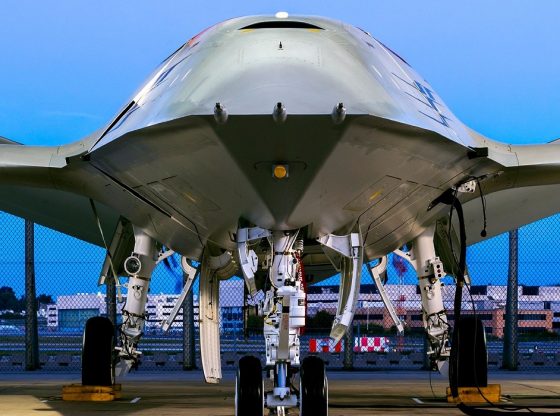
Dynetics and General Atomics (maker of the Predator drone) are currently building competing Gremlins prototypes for DARPA to review in “Phase 2” of the Gremlins project. Phase 3, which has not yet begun, but will see DARPA choose one of the two prototypes to develop into a “full-scale technology demonstration system,” the one that will be test-flown in 2019.
At an estimated unit cost of “under $500,000,” the ultimate value of the Gremlins program to investors will depend largely on how many Gremlins can fit aboard a mothership and how many of these motherships the U.S. Air Force decides it wants to buy. The mothership will probably be a modified Lockheed Martin C130, but other more specialized carriers planes can be expected in the future.