Close Menu
Illustrated Curiosity
    Facebook X (Twitter) Instagram YouTube
    Illustrated Curiosity
    • Earth
    • Economics
    • Environment
      • Climate
      • Environmental Tech
      • Pollution
      • Wildlife
    • Health
      • Health Tech
      • Medicine
      • Nutrition
      • Exercise
    • History
      • Prehistory
      • Ancient History
      • Postclassical Era
      • Modern History
    • Humans
      • Human Brain
      • Psychology
    • Life
      • Animals & Plants
      • Genetics
      • Paleontology
      • Evolution
      • Genetic Engineering
    • Physics
    • Space
      • Astrobiology
      • Astronomy
      • Extrasolar Planets
      • Space Tech
      • Spaceflight
    • Technology
      • Artificial Intelligence
      • Energy
      • Engineering
      • Materials
      • Robotics
      • Vehicles
    Illustrated Curiosity
    Home » NASA puts forward a plan to save Earth from supervolcanos
    Earth

    NASA puts forward a plan to save Earth from supervolcanos

    September 27, 2017No Comments3 Mins Read
    Share
    Facebook Twitter LinkedIn Pinterest Email

    The U.S. Space Agency Nasa has presented a plan to save humanity from supervolcanos by ‘pricking’ the surface.

    Nasa was planning how to best protect our planet from asteroids and comets. They then realized that so-called super-volcanos are a greater threat to life on Earth. This realization prompted NASA to submit to a hypothetical plan to puncture the supervolcano in Yellowstone National Park in the United States. In this way, potentially cool it down.

    Brian Wilson of NASA’s Jet Propulsion Laboratory told the BBC:

    “I was a member of the NASA Advisory Council on Planetary Defense which studied ways for NASA to defend the planet from asteroids and comets,”

    “I came to the conclusion during that study that the supervolcano threat is substantially greater than the asteroid or comet threat.”

    Scientists from the Jet Propulsion Laboratory calculated that the supervolcano would have to be cooled by 35% to avoid an eruption – which could be achieved by ‘pricking’ its surface. The idea is that they drill down 10 kilometers in the volcano and then pump down water. The hot water that emerges could act as a thermal power plant for a vast timescale, which would also serve to finance the project, according to NASA.

    But to cool down the entire volcano will take hundreds or maybe thousands of years. With today’s technology, it is not possible, some scientists say. After NASA released his plan, some researchers criticized the project and called it impossible, while others saw it as visionary. But the risk of doing nothing is a volcanic winter where people could starve to death all over the world.
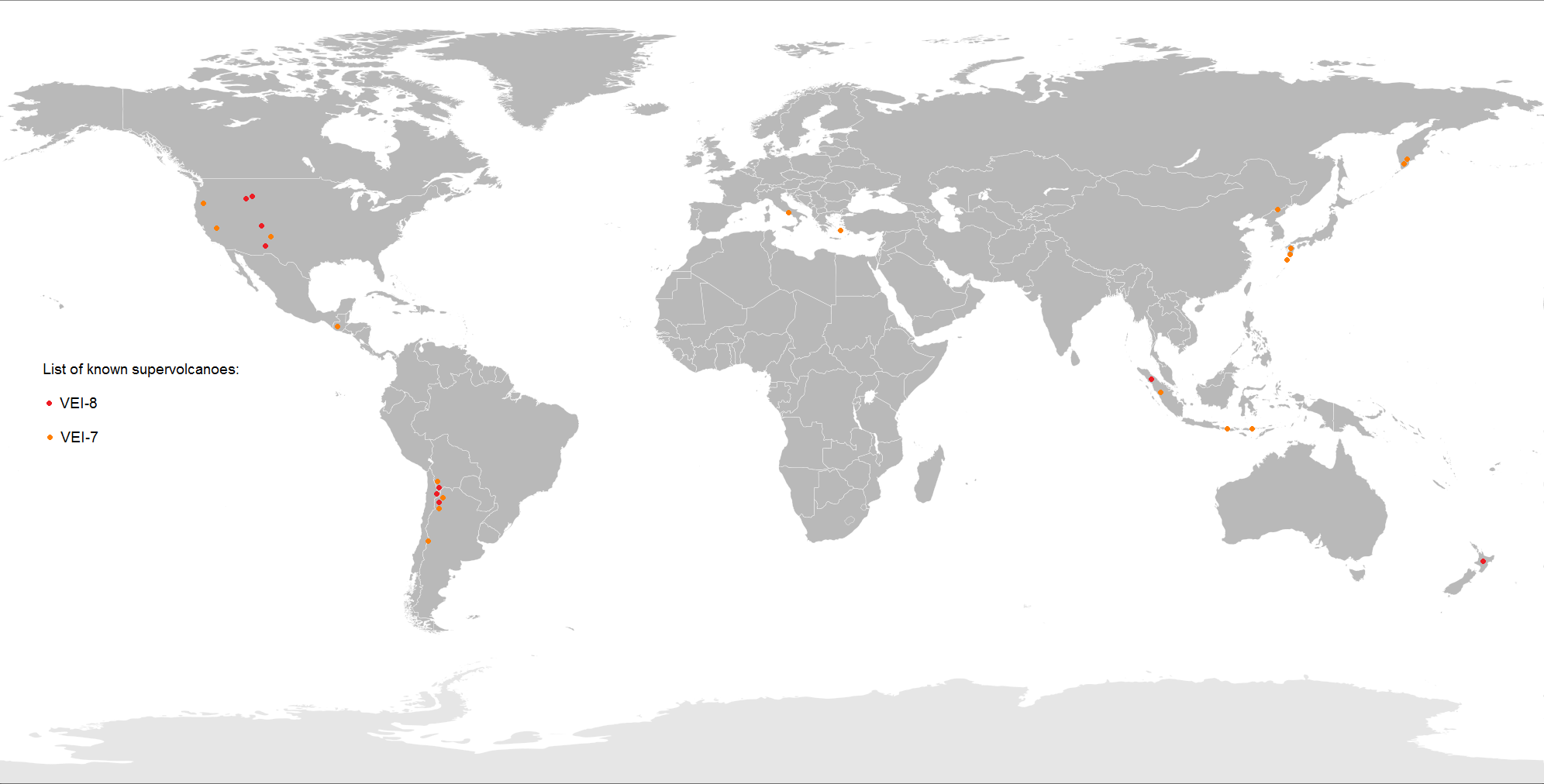
    Credit to Maphobbyist @ Wikipedia
    Map of known supervolcanoes around the World. Volcanic Explosivity Index (VEI) 8 in dark red, Volcanic Explosivity Index (VEI) 7 in orange.

    The United States Geological Survey defines a “supervolcano” as an eruption of magnitude 8 on the Volcano Explosivity Index (VEI), meaning the measured deposits for that eruption is greater than 1,000 cubic kilometers. Supervolcanoes occur when magma in the mantle rises into the crust but is unable to break through it and pressure builds in a large and growing magma pool until the crust is unable to contain the pressure.

    The Oruanui eruption of New Zealand’s Taupo Volcano (about 26,500 years ago) was the world’s most recent supereruption and a VEI-8 eruption. That eruption released enough lava to coat all of Europe in a 5-centimeter thick layer of magma. According to estimation, it took 17,000 years for the climate to return to pre-eruption conditions.

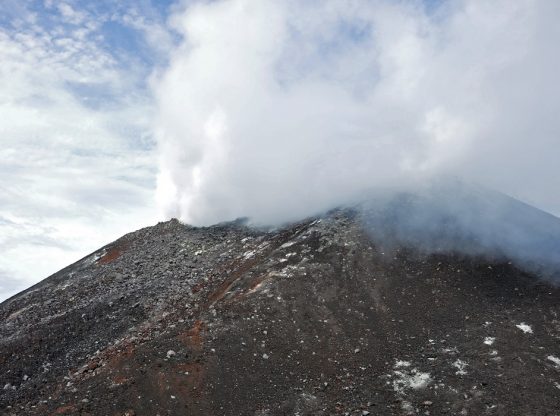
    Supervolcano Vulcano
    Share. Facebook Twitter Pinterest LinkedIn Tumblr Email Copy Link

    Related Posts

    The Looming Giant: Grindavik’s Potential Volcanic Eruption and its Global Implications

    November 13, 2023

    Small Warning Signs Can Reveal Volcano Eruption – before the Disaster

    October 3, 2019

    Massive Crater under Greenland’s Ice Points to Climate-Altering Impact in the Time of Humans

    November 19, 2018

    Earth’s Core Is Actually Solid According to New Research

    October 22, 2018

    Tree Ring Dating Confirms Historical Accounts of ‘Blood Aurora’ as Extreme Cosmic Radiation

    October 18, 2018

    Scientists Offer Clues to What Caused the Mass Extinction 250 Million Years Ago

    October 12, 2018
    Recent Posts
    • How the End of Bretton Woods Reshaped Our Economies — and Our Politics
    • Can the U.S. Really Handle 250% Debt-to-GDP? Why Jackson Hole’s Daring Paper Is Wrong
    • Japan’s Fiscal Trap: What Happens If Austerity Is No Longer an Option?
    • The Rise of Range Extended Electric Vehicles (REEVs): A New Era of Hybrid Mobility
    • The Great Capital Rotation: A Shift from U.S. Treasuries to Gold and Real Assets
    • The Hidden Risks of Short-Term Debt: A Balancing Act in U.S. Fiscal Policy
    • The Looming U.S. Debt Spiral: Understanding the Risks
    • The Looming Recession: Seven Economic Indicators Flashing Red for 2025
    • Europa Clipper: NASA’s Mission to Unlock the Secrets of Jupiter’s Icy Moon
    • Could Hedge Funds Cause Chaos in the U.S. Treasury Market? And What About Inflation?
    © 2025 Illustrated Curiosity

    Type above and press Enter to search. Press Esc to cancel.

    This website uses cookies to improve your experience. We'll assume you're ok with this, but you can opt-out if you wish.Accept Reject Read More
    Privacy & Cookies Policy

    Privacy Overview

    This website uses cookies to improve your experience while you navigate through the website. Out of these, the cookies that are categorized as necessary are stored on your browser as they are essential for the working of basic functionalities of the website. We also use third-party cookies that help us analyze and understand how you use this website. These cookies will be stored in your browser only with your consent. You also have the option to opt-out of these cookies. But opting out of some of these cookies may affect your browsing experience.
    Necessary
    Always Enabled
    Necessary cookies are absolutely essential for the website to function properly. This category only includes cookies that ensures basic functionalities and security features of the website. These cookies do not store any personal information.
    Non-necessary
    Any cookies that may not be particularly necessary for the website to function and is used specifically to collect user personal data via analytics, ads, other embedded contents are termed as non-necessary cookies. It is mandatory to procure user consent prior to running these cookies on your website.
    SAVE & ACCEPT