Close Menu
Illustrated Curiosity
    Facebook X (Twitter) Instagram YouTube
    Illustrated Curiosity
    • Earth
    • Economics
    • Environment
      • Climate
      • Environmental Tech
      • Pollution
      • Wildlife
    • Health
      • Health Tech
      • Medicine
      • Nutrition
      • Exercise
    • History
      • Prehistory
      • Ancient History
      • Postclassical Era
      • Modern History
    • Humans
      • Human Brain
      • Psychology
    • Life
      • Animals & Plants
      • Genetics
      • Paleontology
      • Evolution
      • Genetic Engineering
    • Physics
    • Space
      • Astrobiology
      • Astronomy
      • Extrasolar Planets
      • Space Tech
      • Spaceflight
    • Technology
      • Artificial Intelligence
      • Energy
      • Engineering
      • Materials
      • Robotics
      • Vehicles
    Illustrated Curiosity
    Home » OCO-2 is Tracking photosynthesis from space
    Earth

    OCO-2 is Tracking photosynthesis from space

    October 23, 2017No Comments3 Mins Read
    Share
    Facebook Twitter LinkedIn Pinterest Email

    Nasa now contributes another piece of the puzzle to our understanding how the carbon dioxide cycle works on Earth and how it changes during the course of the year.
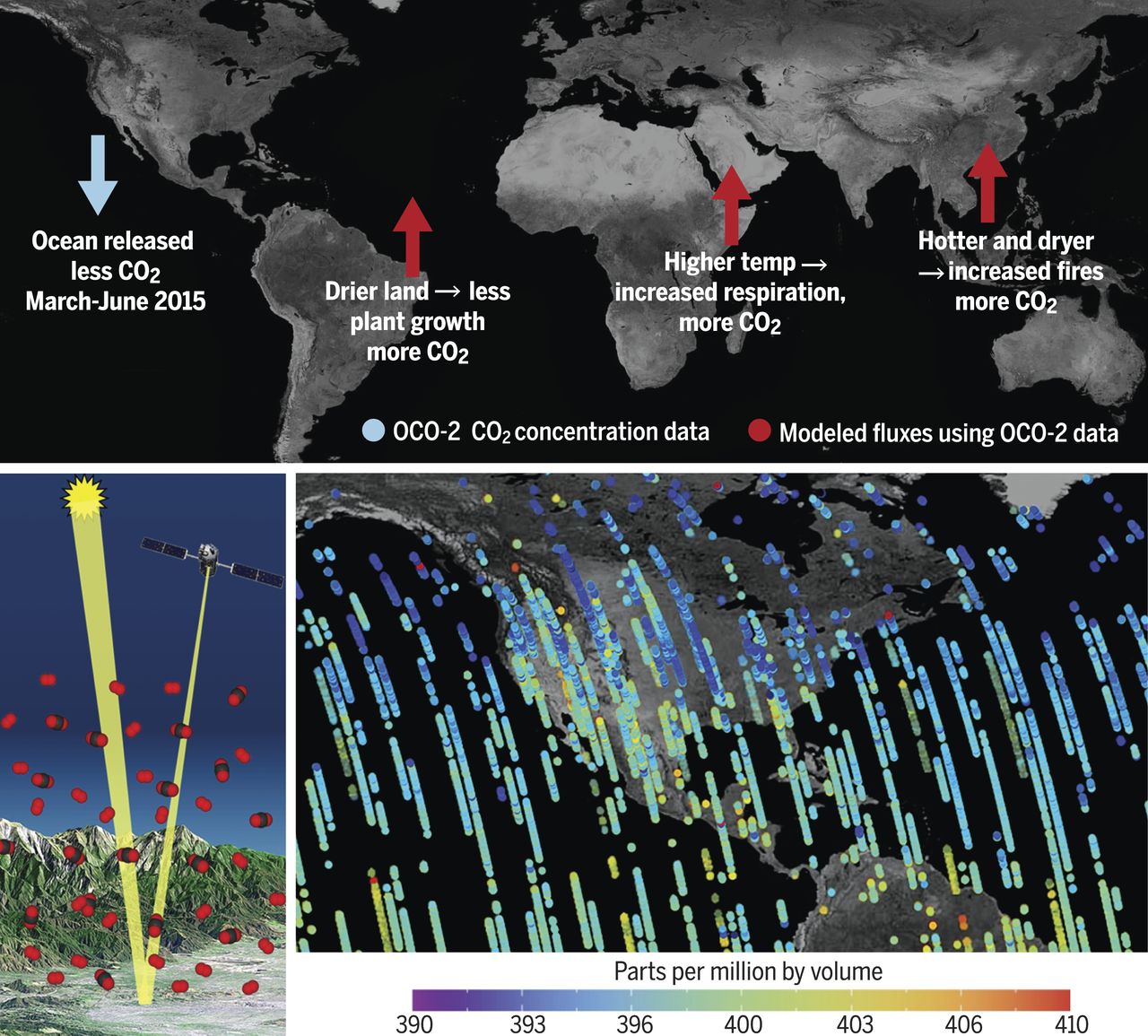
    El Niño impact on carbon flux in 2015 relative to 2011, detected from Greenhouse Gases Observing Satellite (GOSAT) and OCO-2 data. El Nino dried out Australia, Central America, and the southern Amazon basin, while heavy precipitative occured elsewhere. Since dryness means more carbon dioxide in the atmosphere – particularly when forests burn – the global CO2 levels therefore spiked in 2016.

    The amount of carbon dioxide contained in the air is not constant but varies with the seasons, the Earth breathe CO2 with the seasons.

    A team of NASA scientists now presents a two-year worth of measurements made by the agency’s Orbiting Carbon Observatory-2 (OCO-2) satellite. Launched on 2 July 2014, the satellite records how much sunlight is reflected off the CO2 molecules in an air column, making measurements in three different spectral bands.

    The study published in Science shows how the carbon dioxide levels fluxes in the Northern Hemisphere. It shows where and when photosynthesis takes place, by seeing carbon dioxide being absorbed by plants.


    This carbon dioxide visualization was produced by a computer model called GEOS-5, created by scientists at NASA Goddard Space Flight Center’s Global Modeling and Assimilation Office.


    In combination with local measurements, the satellite gives us a greater understanding how the planets carbon dioxide cycles work. It is showing us where and when the concentration of carbon dioxide is the highest and the lowest.

    The buildup of CO2 in the Northern Hemisphere during winter and its rapid decrease in concentration as spring arrives (and the SIF increases) is seen in unprecedented detail.

    The highest concentrations are seen in cities, responsible for more than 70 percent of humanity’s CO2 emissions. The satellite can discerns differences between cities, rural areas, and even within cities as well.

    The enhanced CO2 in urban areas relative to nearby background areas is observed with a single overpass of OCO-2. Increases in CO2 due to the biomass burning in Africa are also clearly observed.

    The overall idea behind the research was to better understand how humanity is changing the Earth and the data may one day help researchers determine the best regional farming practices and even spot early signs of drought.

    The OCO-2 mission data set can now be used to assess regional-scale sources and sinks of CO2 around the globe.

    A new satellite, OCO3, is planned to be launched in 2018 to be attached to the International Space Station (although, the fate of OCO-3 is now being deliberated on in Congress. It will be designed to investigate important questions about the distribution of carbon dioxide on Earth as it relates to growing urban populations and changing patterns of fossil fuel combustion.

    Reference:

    Annmarie Eldering et al. The Orbiting Carbon Observatory-2 early science investigations of regional carbon dioxide fluxes. Science October 13th. DOI: 10.1126 / science.aam5745

    Share. Facebook Twitter Pinterest LinkedIn Tumblr Email Copy Link

    Related Posts

    The Looming Giant: Grindavik’s Potential Volcanic Eruption and its Global Implications

    November 13, 2023

    Small Warning Signs Can Reveal Volcano Eruption – before the Disaster

    October 3, 2019

    Massive Crater under Greenland’s Ice Points to Climate-Altering Impact in the Time of Humans

    November 19, 2018

    Earth’s Core Is Actually Solid According to New Research

    October 22, 2018

    Tree Ring Dating Confirms Historical Accounts of ‘Blood Aurora’ as Extreme Cosmic Radiation

    October 18, 2018

    Scientists Offer Clues to What Caused the Mass Extinction 250 Million Years Ago

    October 12, 2018
    Recent Posts
    • How the End of Bretton Woods Reshaped Our Economies — and Our Politics
    • Can the U.S. Really Handle 250% Debt-to-GDP? Why Jackson Hole’s Daring Paper Is Wrong
    • Japan’s Fiscal Trap: What Happens If Austerity Is No Longer an Option?
    • The Rise of Range Extended Electric Vehicles (REEVs): A New Era of Hybrid Mobility
    • The Great Capital Rotation: A Shift from U.S. Treasuries to Gold and Real Assets
    • The Hidden Risks of Short-Term Debt: A Balancing Act in U.S. Fiscal Policy
    • The Looming U.S. Debt Spiral: Understanding the Risks
    • The Looming Recession: Seven Economic Indicators Flashing Red for 2025
    • Europa Clipper: NASA’s Mission to Unlock the Secrets of Jupiter’s Icy Moon
    • Could Hedge Funds Cause Chaos in the U.S. Treasury Market? And What About Inflation?
    © 2025 Illustrated Curiosity

    Type above and press Enter to search. Press Esc to cancel.

    This website uses cookies to improve your experience. We'll assume you're ok with this, but you can opt-out if you wish.Accept Reject Read More
    Privacy & Cookies Policy

    Privacy Overview

    This website uses cookies to improve your experience while you navigate through the website. Out of these, the cookies that are categorized as necessary are stored on your browser as they are essential for the working of basic functionalities of the website. We also use third-party cookies that help us analyze and understand how you use this website. These cookies will be stored in your browser only with your consent. You also have the option to opt-out of these cookies. But opting out of some of these cookies may affect your browsing experience.
    Necessary
    Always Enabled
    Necessary cookies are absolutely essential for the website to function properly. This category only includes cookies that ensures basic functionalities and security features of the website. These cookies do not store any personal information.
    Non-necessary
    Any cookies that may not be particularly necessary for the website to function and is used specifically to collect user personal data via analytics, ads, other embedded contents are termed as non-necessary cookies. It is mandatory to procure user consent prior to running these cookies on your website.
    SAVE & ACCEPT