Close Menu
Illustrated Curiosity
    Facebook X (Twitter) Instagram YouTube
    Illustrated Curiosity
    • Earth
    • Economics
    • Environment
      • Climate
      • Environmental Tech
      • Pollution
      • Wildlife
    • Health
      • Health Tech
      • Medicine
      • Nutrition
      • Exercise
    • History
      • Prehistory
      • Ancient History
      • Postclassical Era
      • Modern History
    • Humans
      • Human Brain
      • Psychology
    • Life
      • Animals & Plants
      • Genetics
      • Paleontology
      • Evolution
      • Genetic Engineering
    • Physics
    • Space
      • Astrobiology
      • Astronomy
      • Extrasolar Planets
      • Space Tech
      • Spaceflight
    • Technology
      • Artificial Intelligence
      • Energy
      • Engineering
      • Materials
      • Robotics
      • Vehicles
    Illustrated Curiosity
    Home » Rain compensates for shrinking of glaciers in the Himalayas
    Climate

    Rain compensates for shrinking of glaciers in the Himalayas

    February 6, 20162 Mins Read
    Share
    Facebook Twitter LinkedIn Pinterest Email
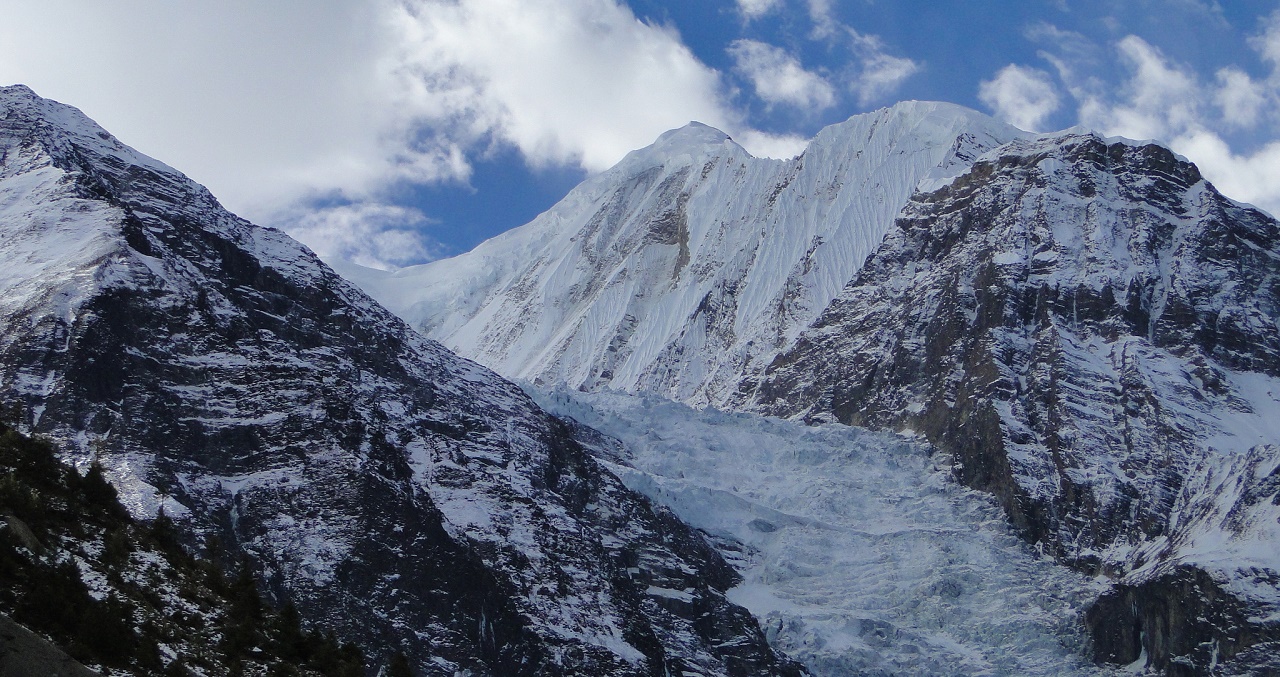
    Photo credit: tcy3282 / Flickr
    Glacier moving into Gangapurna Glacial Lake, Nepal.

    Concerns that the glaciers on the Tibetan plateau will melt away within just a few decades are greatly exaggerated. Instead, the water flow in many of the major rivers within the area will rise, with the risk of flooding. This, according to new research.

    In 2007 the Intergovernmental Panel on Climate Change (IPCC) wrote that the Himalayan glaciers will have melted away in 2035, but this notion was based on an old newspaper interview and not on any peer-reviewed scientific study.

    The whole situation was quickly denied by the IPCC and was not part of the scientific evidence on climate change presented later. Despite this, the notion became widely spread around the world, not least among the hundreds of millions of people that depend on water flowing from the glaciers as a fresh water supply.

    According to a new study published in Global and Planetary Change, the situation is not quite as serious when it comes to the water supply as previously thought.

    The researchers could see that the glaciers will remain in 2070 if extrapolating with data on known global warming effects and steadily rising mean temperatures.

    But with rising temperatures, precipitation will increase in the coming decades. This implies a stable and even increasing water supply.

    The researchers note that the declining water resources from shrinking glaciers will be offset by increased rainfall. But more rain could also mean flooding.

    Glaciologist Regine Hock is a professor of geophysics at the Fairbank University of Alaska and participated in the study, “We have calculated that about half of the volume will have melted away by the end of 2100, they will be around for a while but they will decrease.”

    _____________
    Su, F., L. Zhang, T. Ou, D. Chen, T. Yao, and K. Tong, Y. Qi, 2016: Hydrological response to future climate changes for the major upstream river basins in the Tibetan Plateau, Global and Planetary Change, 136, 82-95, doi:10.1016/j.gloplacha.2015.10.012.
    __________________________
    Glaciers Global Warming Himalayas
    Share. Facebook Twitter Pinterest LinkedIn Tumblr Email Copy Link

    Related Posts

    COVID-19 Recovery Funds Dwarf Clean Energy Investment Needs

    October 26, 2020

    Mont Blanc Glacier in Danger of Collapse, Experts Warn

    September 26, 2019

    The Absorption of Carbon Dioxide by the Sea Is Increasing with Emissions

    March 19, 2019

    Antarctic Ice Is Melting Six Times Faster Than in 1979

    February 12, 2019

    U.N. Says 2018 Will Be Earth’s 4th-Warmest Year on Record, Predicts a 5- to 9-Degree Temperature Rise This Century

    December 12, 2018

    Temperatures to Rise 1.5 Degrees Celsius by 2030-2052 without Rapid Steps According to U.N. Report

    October 19, 2018
    Recent Posts
    • America’s Quiet Shift Into Fiscal Dominance: Why Inflation May Be Preparing for a Second Act
    • How the End of Bretton Woods Reshaped Our Economies — and Our Politics
    • Can the U.S. Really Handle 250% Debt-to-GDP? Why Jackson Hole’s Daring Paper Is Wrong
    • Japan’s Fiscal Trap: What Happens If Austerity Is No Longer an Option?
    • The Rise of Range Extended Electric Vehicles (REEVs): A New Era of Hybrid Mobility
    • The Great Capital Rotation: A Shift from U.S. Treasuries to Gold and Real Assets
    • The Hidden Risks of Short-Term Debt: A Balancing Act in U.S. Fiscal Policy
    • The Looming U.S. Debt Spiral: Understanding the Risks
    • The Looming Recession: Seven Economic Indicators Flashing Red for 2025
    • Europa Clipper: NASA’s Mission to Unlock the Secrets of Jupiter’s Icy Moon
    © 2025 Illustrated Curiosity

    Type above and press Enter to search. Press Esc to cancel.

    This website uses cookies to improve your experience. We'll assume you're ok with this, but you can opt-out if you wish.Accept Reject Read More
    Privacy & Cookies Policy

    Privacy Overview

    This website uses cookies to improve your experience while you navigate through the website. Out of these, the cookies that are categorized as necessary are stored on your browser as they are essential for the working of basic functionalities of the website. We also use third-party cookies that help us analyze and understand how you use this website. These cookies will be stored in your browser only with your consent. You also have the option to opt-out of these cookies. But opting out of some of these cookies may affect your browsing experience.
    Necessary
    Always Enabled
    Necessary cookies are absolutely essential for the website to function properly. This category only includes cookies that ensures basic functionalities and security features of the website. These cookies do not store any personal information.
    Non-necessary
    Any cookies that may not be particularly necessary for the website to function and is used specifically to collect user personal data via analytics, ads, other embedded contents are termed as non-necessary cookies. It is mandatory to procure user consent prior to running these cookies on your website.
    SAVE & ACCEPT