Close Menu
Illustrated Curiosity
    Facebook X (Twitter) Instagram YouTube
    Illustrated Curiosity
    • Earth
    • Economics
    • Environment
      • Climate
      • Environmental Tech
      • Pollution
      • Wildlife
    • Health
      • Health Tech
      • Medicine
      • Nutrition
      • Exercise
    • History
      • Prehistory
      • Ancient History
      • Postclassical Era
      • Modern History
    • Humans
      • Human Brain
      • Psychology
    • Life
      • Animals & Plants
      • Genetics
      • Paleontology
      • Evolution
      • Genetic Engineering
    • Physics
    • Space
      • Astrobiology
      • Astronomy
      • Extrasolar Planets
      • Space Tech
      • Spaceflight
    • Technology
      • Artificial Intelligence
      • Energy
      • Engineering
      • Materials
      • Robotics
      • Vehicles
    Illustrated Curiosity
    Home » Spikes of Graphene Can Kill Bacteria on Implants
    Health Tech

    Spikes of Graphene Can Kill Bacteria on Implants

    June 15, 2018No Comments3 Mins Read
    Share
    Facebook Twitter LinkedIn Pinterest Email
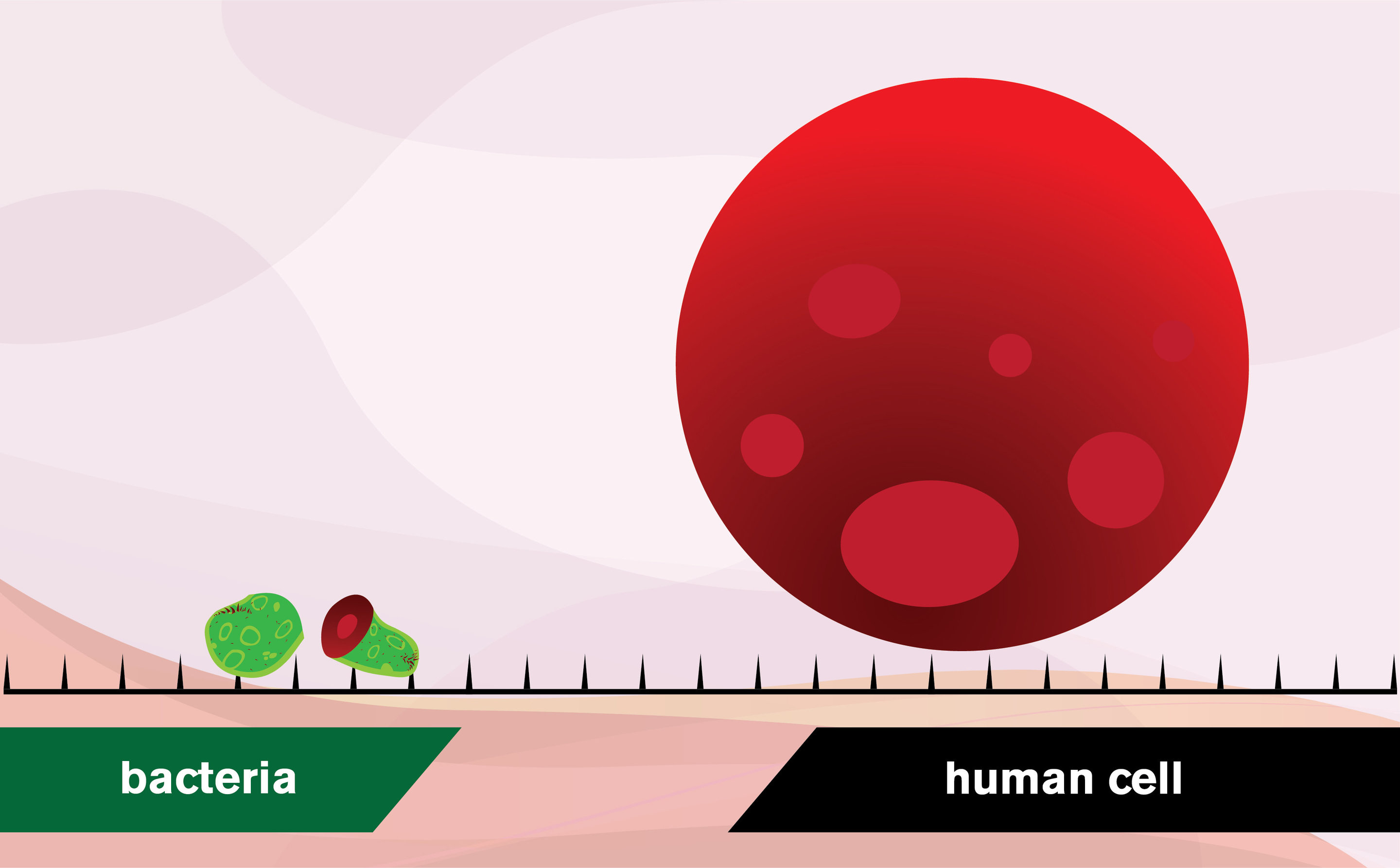
    Vertical graphene flakes form a protective surface that makes it impossible for bacteria to attach. Instead, bacteria are sliced apart by the sharp graphene flakes and killed. Human cells volume is typically 15,000 times larger. So, what constitutes a deadly knife attack for a bacterium, is therefore only a tiny scratch for a human cell. Coating implants with a layer of graphene flakes can therefore help protect the patient against infection, eliminate the need for antibiotic treatment, and reduce the risk of implant rejection. The osseointegration – the process by which the bone structure grows to attach the implant — is not disturbed. In fact, the graphene has been shown to benefit the bone cells. Credit: Yen Strandqvist/Chalmers University of Technology

    Could nano spikes become useful in our ongoing battle against unwanted bacteria? Yes, according to researchers from Chalmers in Sweden.

    A tiny layer of graphene flakes becomes a deadly weapon and kills bacteria, stopping infections during procedures such as implant surgery. The spikes are constructed using a thin layer of carbon atoms, which are vertically shaped, standing, sharp flakes of graphene.

    The spikes simply break when the bacteria come in contact with them and scientists now hope that the material may be useful on implants that bacteria may otherwise attach to.

    “We discovered that the key parameter is to orient the graphene vertically. If it is horizontal, the bacteria are not harmed”

    – Ivan Mijakovic, Professor at the Department of Biology and Biological Engineering, said to Science Daily.

    According to the researchers, the study shows that the body’s own cells are less sensitive to the graphene spikes but that more research is needed. Since a bacterium is one micrometer – one-thousandth of a millimeter – in diameter, and a human cell is 25 micrometers. So, what constitutes a deadly knife attack for a bacterium, is therefore only a scratch for a human cell.

    Vertical flakes of graphene are not a new invention, having existed for a few years. But the Chalmers research teams are the first to use the vertical graphene in this way. The next step for the research team will be to test the graphene flakes further, by coating implant surfaces and studying the effect on animal cells.


    More research is needed to understand how the body’s own cells react to the material for longer periods. And that more different types of bacteria need to be included in future studies.

    Graphene is made of carbon atoms. It is only a single atomic layer thick, and therefore the world’s thinnest material.

    Reference:

    Sun et al. “Vertically Aligned Graphene Coating is Bactericidal and Prevents the Formation of Bacterial Biofilms”. Advanced Materials Interfaces. February 2018. Doi.org/10.1002/admi.201701331.

    Share. Facebook Twitter Pinterest LinkedIn Tumblr Email Copy Link

    Related Posts

    Study Results Suggest Human Aging Can Be Reversed

    September 11, 2019

    Video | World Science Festival: Engineering Immortality: the End of Aging?

    December 20, 2018

    Spinal Cord Stimulation Helps Three Paralyzed People Walk Again

    November 8, 2018

    Man Against Machine: AI Is Better Than Dermatologists at Diagnosing Skin Cancer

    June 22, 2018

    Tiny Injectable Sensor Could Provide Unobtrusive Alcohol Monitoring

    June 3, 2018

    Experimental Glue Could Soon Fix Broken Bones

    April 30, 2018
    Recent Posts
    • How the End of Bretton Woods Reshaped Our Economies — and Our Politics
    • Can the U.S. Really Handle 250% Debt-to-GDP? Why Jackson Hole’s Daring Paper Is Wrong
    • Japan’s Fiscal Trap: What Happens If Austerity Is No Longer an Option?
    • The Rise of Range Extended Electric Vehicles (REEVs): A New Era of Hybrid Mobility
    • The Great Capital Rotation: A Shift from U.S. Treasuries to Gold and Real Assets
    • The Hidden Risks of Short-Term Debt: A Balancing Act in U.S. Fiscal Policy
    • The Looming U.S. Debt Spiral: Understanding the Risks
    • The Looming Recession: Seven Economic Indicators Flashing Red for 2025
    • Europa Clipper: NASA’s Mission to Unlock the Secrets of Jupiter’s Icy Moon
    • Could Hedge Funds Cause Chaos in the U.S. Treasury Market? And What About Inflation?
    © 2025 Illustrated Curiosity

    Type above and press Enter to search. Press Esc to cancel.

    This website uses cookies to improve your experience. We'll assume you're ok with this, but you can opt-out if you wish.Accept Reject Read More
    Privacy & Cookies Policy

    Privacy Overview

    This website uses cookies to improve your experience while you navigate through the website. Out of these, the cookies that are categorized as necessary are stored on your browser as they are essential for the working of basic functionalities of the website. We also use third-party cookies that help us analyze and understand how you use this website. These cookies will be stored in your browser only with your consent. You also have the option to opt-out of these cookies. But opting out of some of these cookies may affect your browsing experience.
    Necessary
    Always Enabled
    Necessary cookies are absolutely essential for the website to function properly. This category only includes cookies that ensures basic functionalities and security features of the website. These cookies do not store any personal information.
    Non-necessary
    Any cookies that may not be particularly necessary for the website to function and is used specifically to collect user personal data via analytics, ads, other embedded contents are termed as non-necessary cookies. It is mandatory to procure user consent prior to running these cookies on your website.
    SAVE & ACCEPT