Close Menu
Illustrated Curiosity
    Facebook X (Twitter) Instagram YouTube
    Illustrated Curiosity
    • Earth
    • Economics
    • Environment
      • Climate
      • Environmental Tech
      • Pollution
      • Wildlife
    • Health
      • Health Tech
      • Medicine
      • Nutrition
      • Exercise
    • History
      • Prehistory
      • Ancient History
      • Postclassical Era
      • Modern History
    • Humans
      • Human Brain
      • Psychology
    • Life
      • Animals & Plants
      • Genetics
      • Paleontology
      • Evolution
      • Genetic Engineering
    • Physics
    • Space
      • Astrobiology
      • Astronomy
      • Extrasolar Planets
      • Space Tech
      • Spaceflight
    • Technology
      • Artificial Intelligence
      • Energy
      • Engineering
      • Materials
      • Robotics
      • Vehicles
    Illustrated Curiosity
    Home » Princeton University Researchers Have Managed to “Freeze” Light
    Physics

    Princeton University Researchers Have Managed to “Freeze” Light

    September 20, 20142 Mins Read
    Share
    Facebook Twitter LinkedIn Pinterest Email
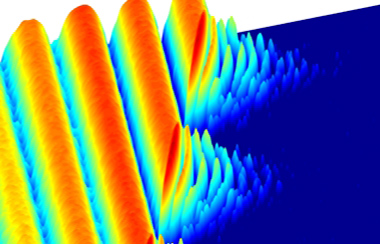
    Researchers at Princeton University have managed to crystallize light as part of an effort to answer fundamental questions about the physics of matter. Credit: Princeton University


    A scientist at Princeton University have been experimenting with superconducting materials, materials for which electrical resistance is nonexistent, and they have seemingly managed the impossible.

    With about 100 billion atoms of superconducting materials, they have managed to build a structure that acts as a single “artificial atom”. They then placed this “artificial atom” next to a superconducting wire containing photons.

    And because of quantum mechanical effects, photons inherits certain properties of the artificial atom, they, therefore, begins to interact with other particles and this is something photons normally doesn’t do.

    So instead of moving at normal speed, the team of researchers has managed to freeze the light, making it create crystal-like structures. That is, the researchers are not shining light through the crystal, they are actually transforming light into crystal as a quantum effect.

    Darius Sadri, a postdoctoral researcher at Princeton University and one of the authors, writes in a press release, “We have used this blending together of the photons and the atom to artificially devise strong interactions among the photons,”. He adds, “These interactions then lead to completely new collective behavior for light – akin to the phases of matter, like liquids and crystals, studied in condensed matter physics.”

    This device is very small but according to a statement by Princeton University, the researchers plan to expand the device and the number of quantum interactions, to expand it from the simulation of a single molecule to that of an entire material. So in the future, the researchers actually plan to build devices with hundreds of sites for with which they hope to observe exotic phases of light such as superfluids and insulators.

    The research team have published their results in Physical Review X, see below.

    _______________
    Observation of a Dissipation-Induced Classical to Quantum Transition
    Princeton press release

    ______________________________
    Light Photons Princeton University Quantum Physics
    Share. Facebook Twitter Pinterest LinkedIn Tumblr Email Copy Link

    Related Posts

    Scientists Race to Test Claimed Room-Temperature Superconductor

    August 3, 2023

    2020 Nobel Prize in Physics Awarded to Trio for Work on Black Hole Formation

    October 6, 2020

    Atomic Clocks So Precise, They Could Detect Space-Time Distortion

    December 4, 2018

    The World Just Redefined the Kilogram

    November 21, 2018

    China Plans to Build a Particle Collider Five Times More Powerful Than the LHC

    November 19, 2018

    Nobel Prize in Physics 2018 Awarded to Scientists Who Put Light to Work

    October 2, 2018
    Recent Posts
    • America’s Quiet Shift Into Fiscal Dominance: Why Inflation May Be Preparing for a Second Act
    • How the End of Bretton Woods Reshaped Our Economies — and Our Politics
    • Can the U.S. Really Handle 250% Debt-to-GDP? Why Jackson Hole’s Daring Paper Is Wrong
    • Japan’s Fiscal Trap: What Happens If Austerity Is No Longer an Option?
    • The Rise of Range Extended Electric Vehicles (REEVs): A New Era of Hybrid Mobility
    • The Great Capital Rotation: A Shift from U.S. Treasuries to Gold and Real Assets
    • The Hidden Risks of Short-Term Debt: A Balancing Act in U.S. Fiscal Policy
    • The Looming U.S. Debt Spiral: Understanding the Risks
    • The Looming Recession: Seven Economic Indicators Flashing Red for 2025
    • Europa Clipper: NASA’s Mission to Unlock the Secrets of Jupiter’s Icy Moon
    © 2025 Illustrated Curiosity

    Type above and press Enter to search. Press Esc to cancel.

    This website uses cookies to improve your experience. We'll assume you're ok with this, but you can opt-out if you wish.Accept Reject Read More
    Privacy & Cookies Policy

    Privacy Overview

    This website uses cookies to improve your experience while you navigate through the website. Out of these, the cookies that are categorized as necessary are stored on your browser as they are essential for the working of basic functionalities of the website. We also use third-party cookies that help us analyze and understand how you use this website. These cookies will be stored in your browser only with your consent. You also have the option to opt-out of these cookies. But opting out of some of these cookies may affect your browsing experience.
    Necessary
    Always Enabled
    Necessary cookies are absolutely essential for the website to function properly. This category only includes cookies that ensures basic functionalities and security features of the website. These cookies do not store any personal information.
    Non-necessary
    Any cookies that may not be particularly necessary for the website to function and is used specifically to collect user personal data via analytics, ads, other embedded contents are termed as non-necessary cookies. It is mandatory to procure user consent prior to running these cookies on your website.
    SAVE & ACCEPT