
The White House approves an increased NASA budget for 2016. This increase would help to fund a long-sought-after mission to Jupiter’s moon Europa.
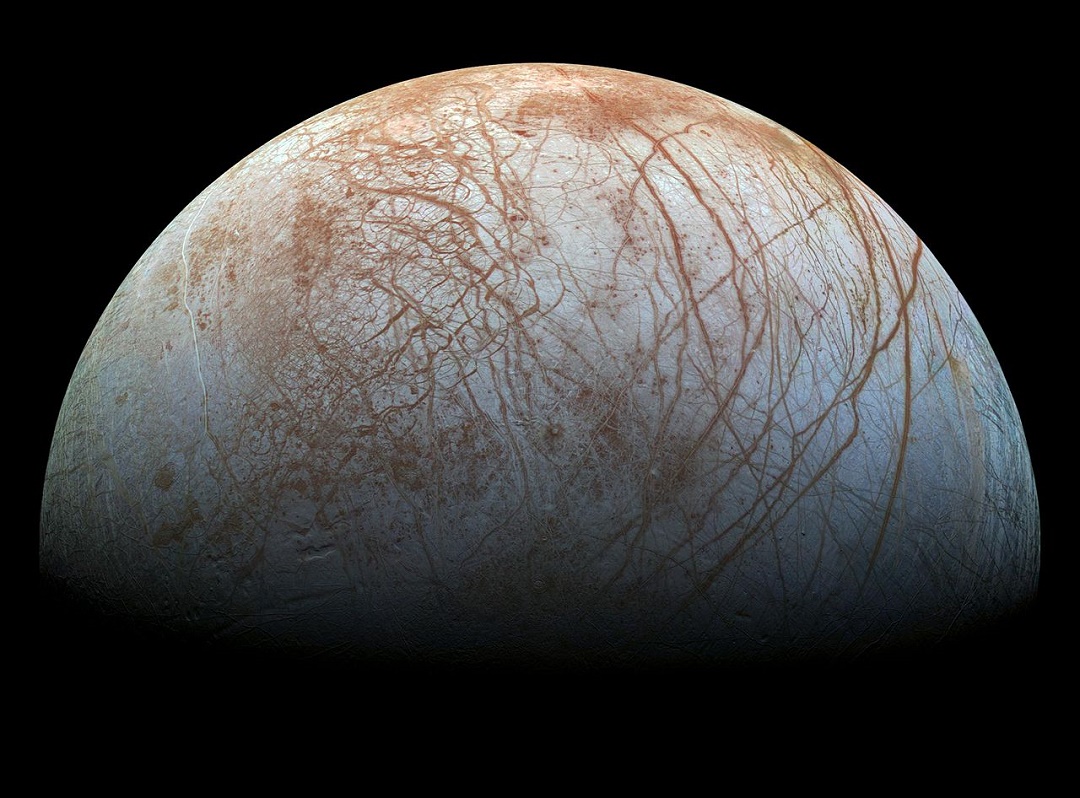
The enigmatic moon Europa with its frozen water surface and perhaps liquid ocean beneath has been a long sought-after destination to visit in our solar system. And now NASA’s Jet Propulsion Laboratory may get their chance as their Europa concept mission called “Europa Clipper” has a good chance to move from concept to reality.
Europa Clipper
NASA made the announcement at a press conference this week when NASA chief financial officer David Radzanowski mentioned that NASA has requested and will allocate $30 million for preliminary studies of a future mission to Europa. Since this mission will probably be quite costly the now approved and boosted the budget of 18.58 billion dollars will surely make NASA more capable to move from concept to reality.
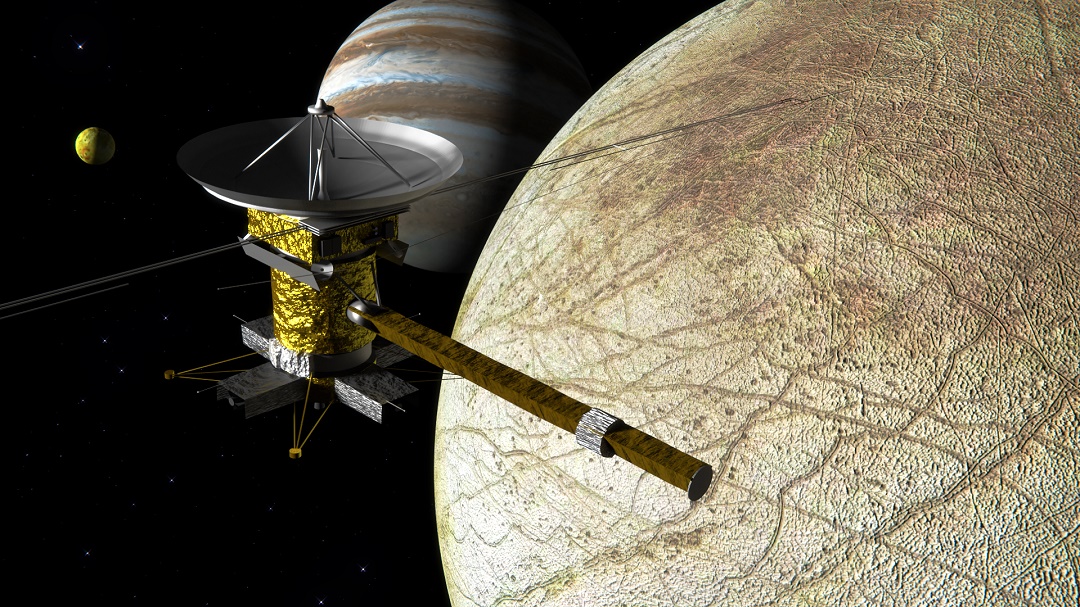
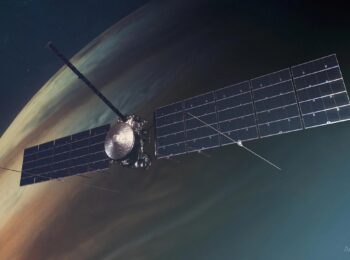
The Europa Clipper concept is actually 15 years old by now and has been an undergoing study for a long time. The concept consists of a large spacecraft that will orbit Jupiter and then make flybys of Europa analyzing the moon and constructing a comprehensive map of its surface – similar to what the Cassini mission did with Saturn’s moon Titan.
Europa: An icy moon
Europa is thought to possibly have a vast sub-surface ocean beneath its thick icy crust, kept liquid due to tidal interactions with Jupiter which generates heat in the moon’s interior. This vast ocean has been speculated to have three times the total volume of all water on Earth.
Since the moon possibly has liquid water, many astrobiologists suggest that Europa’s ocean might be a good place to look for extraterrestrial life. Its deep ocean bottom (probably at a depth of about 100 kilometers (62 miles)) might be similar to that of Earths comparatively shallow Mariana Trench, or the environment surrounding super-heated water where hydrothermal vents are found near volcanically active places on Earth. And since life can indeed be found at both extremes on Earth, why not also on Europa.
The icy crust would also be able to protect its ocean from the radiation found above. A fact that on many other worlds represents a major issue for life to thrive, such as on Mars where the radiation on its surface appears to be too high for life as we know it to exist without protection. The radiation might also be a good thing though, since scientists speculate that it might be a source for nutrient generation on Europa, with its interaction with chemicals found in the ice.
A Spacecraft the Size of a School Bus
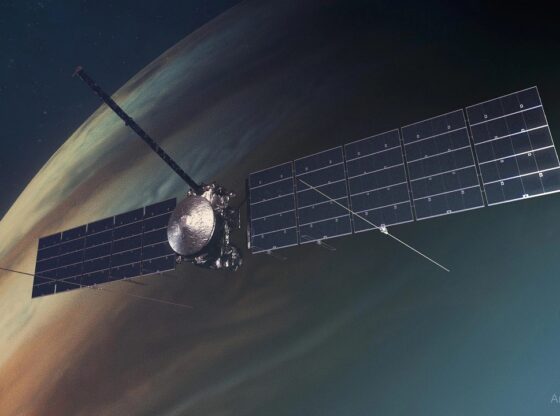
The Europa Clipper spacecraft will be equipped with instruments able to observe Europa at the finest detail, much more powerful instruments than the almost a decade old Cassini spacecraft. It will be able to observe the reddish veins across Europa’s icy crust, for which we know nothing about. It has even been speculated that this “slush” might consist of some organic compounds.
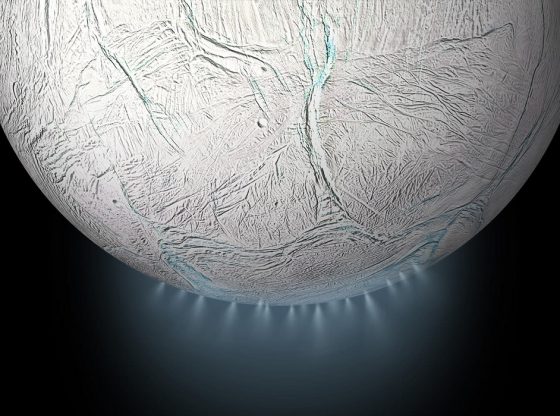
The spacecraft might also be able to take samples at the water-rich geysers as recently seen by the Hubble Space Telescope. Similar to those seen on Saturn’s moon Enceladus.
The spacecraft will also be equipped with powerful shielding to protect the craft against the heavy radiation found around Jupiter and its moon’s. It has been suggested that it will have an elliptical orbit that limits its exposure to radiation to short periods of time when it speeds deep through Jupiter’s radiation belts. But it will also feature a thick and powerful radiation shielding for its more sensitive parts called the “vault”.
The spacecraft will be big with solar panels that span 9 meters (29 feet) by half a meter (4 feet), and the main body being 5,5 meters (18 feet) long. It will be about the size of a school bus. Its sheer size makes it necessary to use a very powerful rocket to get it into space, and NASA’s SLS (Space Launch System) will surely come in handy.
An Extraterrestrial Ocean
The models to the right of Europa’s subsurface structure depicts two proposed subsurface structures. These are based on images taken with the Solid State Imaging (SSI) system on NASA’s Galileo spacecraft.
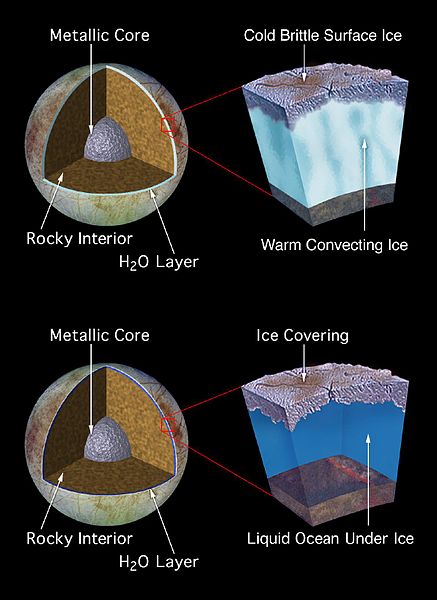
An ice layer located several kilometers below a cold brittle surface ice crust (top model). Or a layer of liquid water with a possible depth of more than 100 kilometers (bottom model).
The 100 kilometer (60 miles) deep ocean would exist below a 15 kilometer (10 miles) thick ice crust. 10 times deeper than any ocean on Earth and would contain twice as much water as Earth’s oceans and rivers combined.
It has been suggested that unlike the Earth, magnesium sulfate might be a major salt component of Europa’s water or ice. Compared to Earth where sodium chloride (common salt) is found in our ocean water.
However, as data from various instruments on the Galileo spacecraft has indicated that a Europan ocean might exist, no conclusive proof has yet been found. And to date, Earth is the only known place in the solar system where large masses of liquid water has been found.
The recent budget boost gives NASA the ability to start initial studies of the mission, buy it is still a long road ahead until launch. The first steps have now been taken in moving concept to plan, to development, then hopefully construction and launch. The hope is for the Europa Clipper mission to be underway within a decade.
_______________
NASA: Europa Clipper
______________________________