
Close Menu
Illustrated Curiosity
    Facebook X (Twitter) Instagram YouTube
    Illustrated Curiosity
    • Earth
    • Economics
    • Environment
      • Climate
      • Environmental Tech
      • Pollution
      • Wildlife
    • Health
      • Health Tech
      • Medicine
      • Nutrition
      • Exercise
    • History
      • Prehistory
      • Ancient History
      • Postclassical Era
      • Modern History
    • Humans
      • Human Brain
      • Psychology
    • Life
      • Animals & Plants
      • Genetics
      • Paleontology
      • Evolution
      • Genetic Engineering
    • Physics
    • Space
      • Astrobiology
      • Astronomy
      • Extrasolar Planets
      • Space Tech
      • Spaceflight
    • Technology
      • Artificial Intelligence
      • Energy
      • Engineering
      • Materials
      • Robotics
      • Vehicles
    Illustrated Curiosity
    Home » New Class Of Materials Could Be Used To Make Batteries That Charge Faster
    Energy

    New Class Of Materials Could Be Used To Make Batteries That Charge Faster

    July 30, 2018No Comments4 Mins Read
    Share
    Facebook Twitter LinkedIn Pinterest Email
    University of Cambridge
    The materials, known as niobium tungsten oxides, offer far less resistance inside the battery, which allows positively-charged particles to travel hundreds of times faster than they would through typical ceramic electrode materials (artist’s impression)

    Cambridge researchers have discovered a new material group that could contribute to flash-charged batteries. It’s all about crystalline structures.

    We have become used to the fact that all technology is constantly shrinking, becoming faster – and at the same time cheaper to produce. The exception has been batteries, but progress is proceeding and the amount of resources invested into battery technology research is increasing remarkably, with ever increasing demand. Now, research at the University of Cambridge can now open up for a real field of research.
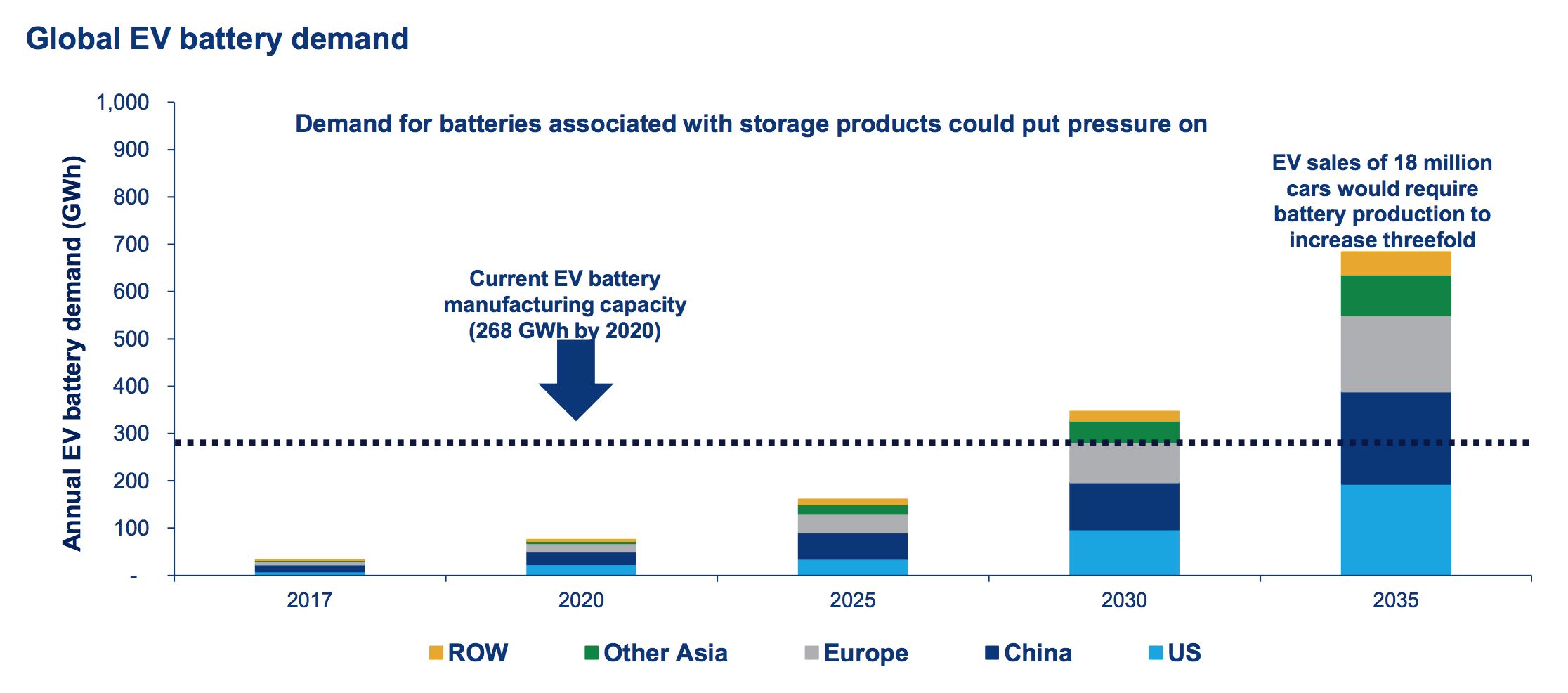
    According to Wood Mackenzie, current capacity for EV batteries sits at 268 gigawatts by 2020. That’s much higher than 2020 demand, which barely touches 100 gigawatts. But in a decade, that picture changes. With spiking demand driven by Europe, the U.S. and China, battery demand exceeds current manufacturing capacity after 2028. By 2035, battery production needs to triple.

    In their simplest form, batteries are made of three components: a positive electrode, a negative electrode and an electrolyte. When a battery is charging, lithium ions are extracted from the positive electrode and move through the crystal structure and electrolyte to the negative electrode, where they are stored. The faster this process occurs, the faster the battery can be charged.

    It has been seen that lithium ions can move much faster through materials with a complex crystalline structure than what is the case with traditional electrode materials. A new discovery could provide much faster battery charging times, with researchers looking at a niobium/tungsten oxide. Although the substance did not provide a higher energy density during a typical cycle, it proved to have a major impact when it comes to fast charging.

    The niobium tungsten oxides material offer far less opposition inside the battery, which permits emphatically charged particles to movement several times speedier than they would through regular earthenware terminal materials. Even better, researchers say niobium tungsten oxides are easier to manufacture and don’t require any extra synthetic compounds or dissolvable used to manufature batteries today.

    The physical structure and chemical behavior of the material have given scientists valuable insights into how to construct a safe and super-fast battery. The results indicate that next-generation batteries will be based on unconventional materials.

    In addition to paving the way for mobile phones that are fully charged in a few minutes, the new materials can eliminate major technical barriers in two important environmental areas – electric cars and networks for storage of solar energy.

    “We’re always looking for materials with high-rate battery performance, which would result in a much faster charge and could also deliver high power output,”

    – Dr Kent Griffith, a postdoctoral researcher in Cambridge’s Department of Chemistry and the paper’s first author.

    In the search for new electrode materials, researchers normally try to make the particles smaller.

    “The idea is that if you make the distance the lithium ions have to travel shorter, it should give you higher rate performance,”

    “But it’s difficult to make a practical battery with nanoparticles: you get a lot more unwanted chemical reactions with the electrolyte, so the battery doesn’t last as long, plus it’s expensive to make.”

    – Kent Griffith.

    Producing nanoparticles can be complicated and they can hardly be difficult to pack close together. However, Niob / tungsten oxide has a larger particle size than many other electronic materials, and its open structure does not trap the inserted lithium.

    Furthermore, Niob / tungsten oxide is easy to manufacture, and Cambridge’s measurements showed that the lithium ions moved many times faster than with more typical electrode materials. Although the oxides have excellent lithium transport rates, they do lead to a lower cell voltage than some electrode materials. However, the operating voltage is beneficial for safety and the high lithium transport rates mean that when cycling fast, the practical (usable) energy density of these materials remains high.

    Reference:

    Kent J. Griffith, Kamila M. Wiaderek, Giannantonio Cibin, Lauren E. Marbella & Clare P. Grey (2018) “Niobium tungsten oxides for high-rate lithium-ion energy storage” Nature volume 559, pages 556–563 doi: 10.1038/s41586-018-0347-0
    Share. Facebook Twitter Pinterest LinkedIn Tumblr Email Copy Link

    Related Posts

    A Fusion Energy Breakthrough? Major Announcement Expected From US Scientists

    December 12, 2022

    New Efficiency Record for Transparent Solar Cells

    August 26, 2020

    IBM’s Lithium Battery Uses Seawater Materials Instead of Heavy Metals

    May 31, 2020

    Demand for batteries will increase tenfold

    May 20, 2020

    Samsung Unveils Groundbreaking All-solid-state Battery Technology

    May 5, 2020

    Global Carbon Dioxide Emissions Leveled Off Last Year

    February 17, 2020
    Recent Posts
    • How the End of Bretton Woods Reshaped Our Economies — and Our Politics
    • Can the U.S. Really Handle 250% Debt-to-GDP? Why Jackson Hole’s Daring Paper Is Wrong
    • Japan’s Fiscal Trap: What Happens If Austerity Is No Longer an Option?
    • The Rise of Range Extended Electric Vehicles (REEVs): A New Era of Hybrid Mobility
    • The Great Capital Rotation: A Shift from U.S. Treasuries to Gold and Real Assets
    • The Hidden Risks of Short-Term Debt: A Balancing Act in U.S. Fiscal Policy
    • The Looming U.S. Debt Spiral: Understanding the Risks
    • The Looming Recession: Seven Economic Indicators Flashing Red for 2025
    • Europa Clipper: NASA’s Mission to Unlock the Secrets of Jupiter’s Icy Moon
    • Could Hedge Funds Cause Chaos in the U.S. Treasury Market? And What About Inflation?
    © 2025 Illustrated Curiosity

    Type above and press Enter to search. Press Esc to cancel.

    This website uses cookies to improve your experience. We'll assume you're ok with this, but you can opt-out if you wish.Accept Reject Read More
    Privacy & Cookies Policy

    Privacy Overview

    This website uses cookies to improve your experience while you navigate through the website. Out of these, the cookies that are categorized as necessary are stored on your browser as they are essential for the working of basic functionalities of the website. We also use third-party cookies that help us analyze and understand how you use this website. These cookies will be stored in your browser only with your consent. You also have the option to opt-out of these cookies. But opting out of some of these cookies may affect your browsing experience.
    Necessary
    Always Enabled
    Necessary cookies are absolutely essential for the website to function properly. This category only includes cookies that ensures basic functionalities and security features of the website. These cookies do not store any personal information.
    Non-necessary
    Any cookies that may not be particularly necessary for the website to function and is used specifically to collect user personal data via analytics, ads, other embedded contents are termed as non-necessary cookies. It is mandatory to procure user consent prior to running these cookies on your website.
    SAVE & ACCEPT