Close Menu
Illustrated Curiosity
    Facebook X (Twitter) Instagram YouTube
    Illustrated Curiosity
    • Earth
    • Economics
    • Environment
      • Climate
      • Environmental Tech
      • Pollution
      • Wildlife
    • Health
      • Health Tech
      • Medicine
      • Nutrition
      • Exercise
    • History
      • Prehistory
      • Ancient History
      • Postclassical Era
      • Modern History
    • Humans
      • Human Brain
      • Psychology
    • Life
      • Animals & Plants
      • Genetics
      • Paleontology
      • Evolution
      • Genetic Engineering
    • Physics
    • Space
      • Astrobiology
      • Astronomy
      • Extrasolar Planets
      • Space Tech
      • Spaceflight
    • Technology
      • Artificial Intelligence
      • Energy
      • Engineering
      • Materials
      • Robotics
      • Vehicles
    Illustrated Curiosity
    Home » Telomerase: Reverse Aging in Mice
    Medicine

    Telomerase: Reverse Aging in Mice

    July 15, 2012No Comments3 Mins Read
    Share
    Facebook Twitter LinkedIn Pinterest Email
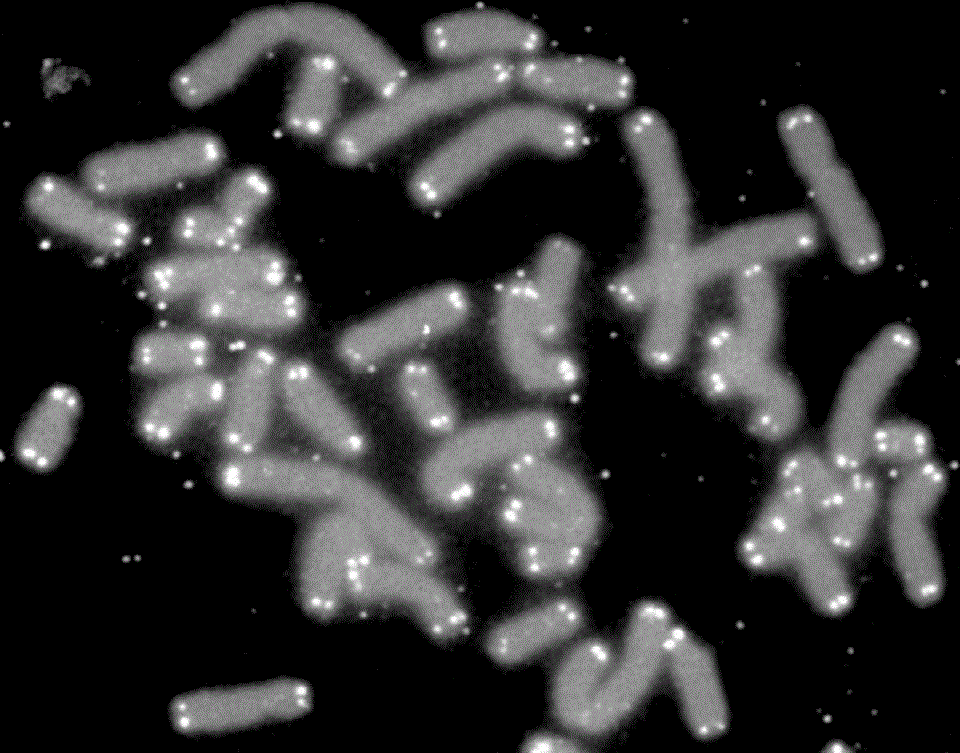
    Human chromosomes (gray) capped by telomeres (white). Credit: U.S. Department of Energy Human Genome Program

    Yes, you read it right, scientists have actually managed to reverse aging and not just slow it down. The research was conducted at Harvard University and the result came as a surprise for the scientist.

    Telomeres and Telomerase

    Researchers have long suspected the enzyme telomerase have an important role in the aging process. As the enzyme, telomerase allows for replacement of short bits of DNA known as telomeres. Which is shortened each time a cell divides via mitosis. As the telomere is the region of repetitive DNA at the end of chromosomes, it protects the ends of the chromosomes from deterioration.

    During each cell division, enzymes that duplicate the chromosome and its DNA cannot continue their duplication forever. With the implication of an ever shorter telomere by each duplication. And when the telomere has reached its end, the cell dies.

    Since its discovery in the 1980s, the enzyme called telomerase gained a reputation as a possible fountain of youth. Since telomerase prevents shortening of the telomeres, the hope was that activating the enzyme could slow cellular aging. And some cells naturally have this ability, such as stem cells.

    Elizabeth Blackburn, Carol Greider, and Jack Szostak were awarded the Nobel Prize in Physiology and Medicine in 2009 for the discovery of how chromosomes are protected by telomeres and the enzyme telomerase.

    Telomerase is also an important enzyme in the research for cancer. Since in cancer cells the activation of telomerase makes some types of cells and their offspring to become immortal, that is, their chromosomes will not become unstable no matter how many cell divisions they undergo.

    Reversed Aging

    In this new research study Telomerase reactivation reverses tissue degeneration in aged telomerase-deficient mice published in Nature, the scientists were able to reactivate the enzyme telomerase, which led to the repair of certainly damaged tissues and reversed signs of aging.

    The scientists bred genetically manipulated mice that lacked the enzyme telomerase and without the enzyme, the mice aged prematurely and developed a poor sense of smell, a smaller brain size, infertility and also damages organs. But when the scientists gave the mice injections to reactivate the enzyme, it repaired the damaged tissues and reversed the signs of aging. And none of the mice developed cancer after the treatment.

    The researchers note that even aged tissues, ones in an advanced state of degeneration, retain a remarkable capacity to renew themselves and telomerase, when activated, and can reverse certain aspects associated with aging.

    “If you look at all those data together, you walk away with the idea that the loss of telomerase could be a very important instigator of the aging process,” according to Dr. Ronald DePinho, of the Dana-Farber Cancer Institute and Harvard Medical School in Boston.

    ____________________________________
    Telomerase reactivation reverses tissue degeneration in aged telomerase-deficient mice
    __________________
    Aging Harvard University Telomeres
    Share. Facebook Twitter Pinterest LinkedIn Tumblr Email Copy Link

    Related Posts

    Groundbreaking Breakthrough: A Potential Cure for Cancer Targets Proliferating Cell Nuclear Antigen (PCNA)

    August 3, 2023

    Data Modeling Can Predict How COVID-19 Will Spread in a Big City

    November 13, 2020

    2020 Nobel Prize in Medicine Jointly Awarded to Scientists Who Discovered the Hepatitis C Virus

    October 6, 2020

    Air Pollution May Be a Contributing Factor behind High Death Rates in COVID-19

    June 8, 2020

    Evidence of Stray Dogs as Possible Intermediate Host of COVID-19 Pandemic

    April 28, 2020

    Promising Progress on Urine Tests for Prostate Cancer

    March 23, 2020
    Recent Posts
    • How the End of Bretton Woods Reshaped Our Economies — and Our Politics
    • Can the U.S. Really Handle 250% Debt-to-GDP? Why Jackson Hole’s Daring Paper Is Wrong
    • Japan’s Fiscal Trap: What Happens If Austerity Is No Longer an Option?
    • The Rise of Range Extended Electric Vehicles (REEVs): A New Era of Hybrid Mobility
    • The Great Capital Rotation: A Shift from U.S. Treasuries to Gold and Real Assets
    • The Hidden Risks of Short-Term Debt: A Balancing Act in U.S. Fiscal Policy
    • The Looming U.S. Debt Spiral: Understanding the Risks
    • The Looming Recession: Seven Economic Indicators Flashing Red for 2025
    • Europa Clipper: NASA’s Mission to Unlock the Secrets of Jupiter’s Icy Moon
    • Could Hedge Funds Cause Chaos in the U.S. Treasury Market? And What About Inflation?
    © 2025 Illustrated Curiosity

    Type above and press Enter to search. Press Esc to cancel.

    This website uses cookies to improve your experience. We'll assume you're ok with this, but you can opt-out if you wish.Accept Reject Read More
    Privacy & Cookies Policy

    Privacy Overview

    This website uses cookies to improve your experience while you navigate through the website. Out of these, the cookies that are categorized as necessary are stored on your browser as they are essential for the working of basic functionalities of the website. We also use third-party cookies that help us analyze and understand how you use this website. These cookies will be stored in your browser only with your consent. You also have the option to opt-out of these cookies. But opting out of some of these cookies may affect your browsing experience.
    Necessary
    Always Enabled
    Necessary cookies are absolutely essential for the website to function properly. This category only includes cookies that ensures basic functionalities and security features of the website. These cookies do not store any personal information.
    Non-necessary
    Any cookies that may not be particularly necessary for the website to function and is used specifically to collect user personal data via analytics, ads, other embedded contents are termed as non-necessary cookies. It is mandatory to procure user consent prior to running these cookies on your website.
    SAVE & ACCEPT