Close Menu
Illustrated Curiosity
    Facebook X (Twitter) Instagram YouTube
    Illustrated Curiosity
    • Earth
    • Economics
    • Environment
      • Climate
      • Environmental Tech
      • Pollution
      • Wildlife
    • Health
      • Health Tech
      • Medicine
      • Nutrition
      • Exercise
    • History
      • Prehistory
      • Ancient History
      • Postclassical Era
      • Modern History
    • Humans
      • Human Brain
      • Psychology
    • Life
      • Animals & Plants
      • Genetics
      • Paleontology
      • Evolution
      • Genetic Engineering
    • Physics
    • Space
      • Astrobiology
      • Astronomy
      • Extrasolar Planets
      • Space Tech
      • Spaceflight
    • Technology
      • Artificial Intelligence
      • Energy
      • Engineering
      • Materials
      • Robotics
      • Vehicles
    Illustrated Curiosity
    Home » DNA reveal how humans first colonized Australia
    Prehistory

    DNA reveal how humans first colonized Australia

    March 13, 2017No Comments2 Mins Read
    Share
    Facebook Twitter LinkedIn Pinterest Email

    Researchers have analyzed how people first made Australia their home and then continuously inhabit the same regions for up to 50,000 years – soon after the peopling of Australia.
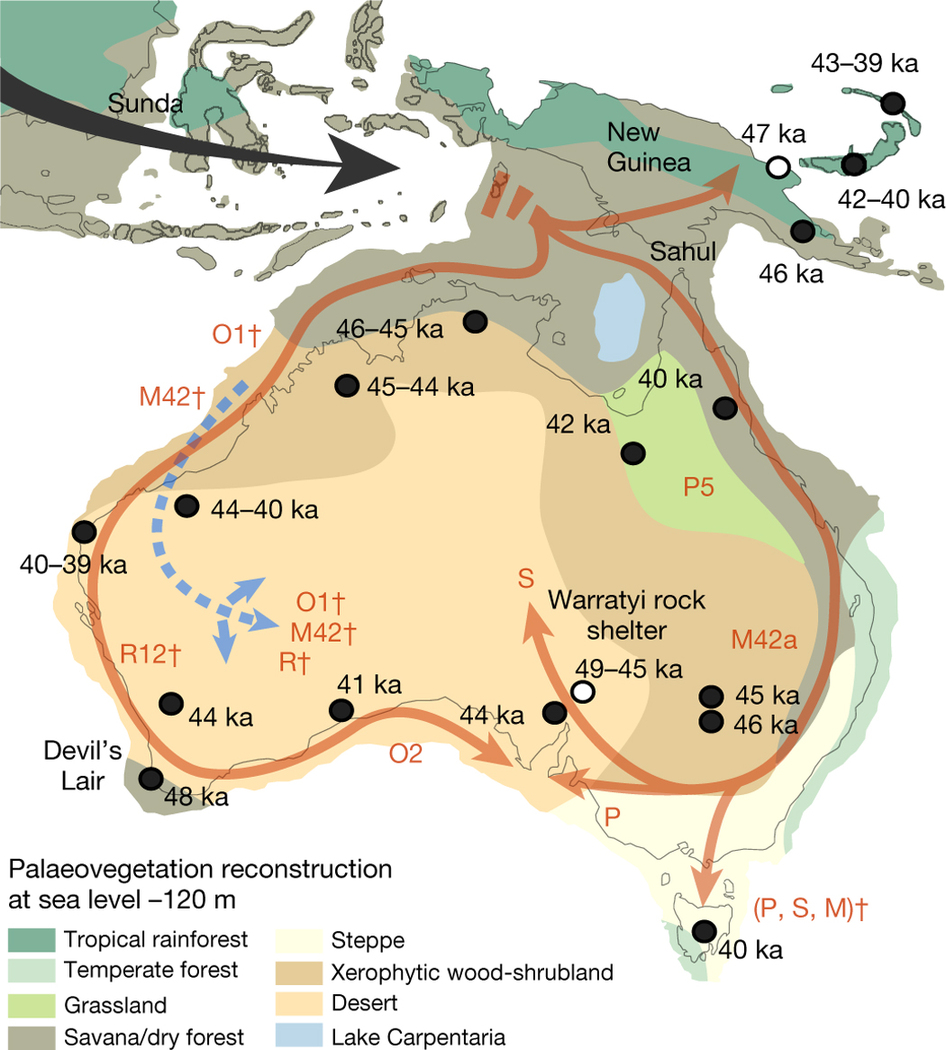
    Source: Nature doi:10.1038/nature21416
    Model of the peopling of Australia combining genetic and archaeological data, showing approximate, and stylised, coastal movements of haplogroups O and R (west) and P, S, and M (east).

    Researchers at the University of Adelaide aimed to investigate how humans colonized the Australian continent.

    They gathered 111 hair samples from Aboriginal people across the continent and analyzed the Mitochondrial DNA, which allows tracing of maternal ancestry.

    The results show that modern Aboriginal Australians are the descendants of a single migrating population that arrived in Australia 50,000 years ago, while the continent was still connected to New Guinea.

    The Mitochondrial DNA also reveal significant differences between different groups of the continent’s indigenous peoples.

    “After reaching Australia about 50,000 years ago, humans colonized the entire continent within a few thousand years. But after settling down in difference parts of the continent, there was little interaction between the group.”

    “Remarkably, we find evidence for the continuous presence of populations in discrete geographic areas dating back to around 50 ka, in agreement with the notable Aboriginal Australian cultural attachment to their country.”
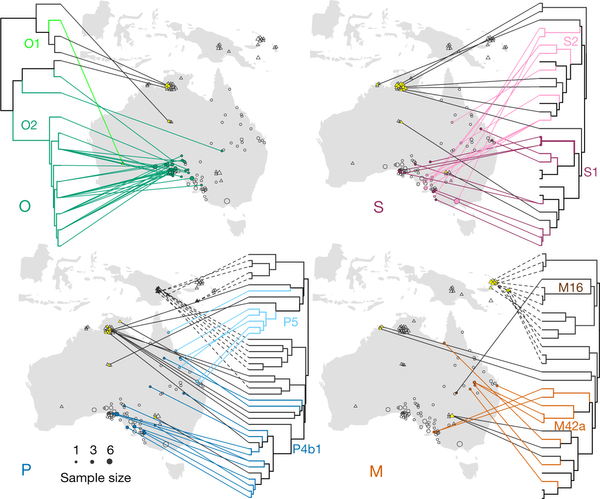
    Source: Nature doi:10.1038/nature21416
    Phylogeographic distributions of Aboriginal Australian mitogenome haplotypes, grouped into the four major haplogroups O, S, P and M with timescales calculated using an ancient-DNA-calibrated molecular clock (see Methods).

    After continent-wide colonization, strong regional patterns developed and these have survived despite substantial climatic and cultural change during the late Pleistocene and Holocene epochs.

    This pattern persisted for thousands of years until the Europeans arrived. This result is a great difference both linguistically and genetically between the different groups.

    The study has been published in Nature.

    Reference:

    Ray Tobler, Adam Rohrlach, Julien Soubrier, Pere Bover et al. Aboriginal mitogenomes reveal 50,000 years of regionalism in Australia doi: 10.1038 / nature21416

    Aborigines Australia
    Share. Facebook Twitter Pinterest LinkedIn Tumblr Email Copy Link

    Related Posts

    Northern Europeans’ Genetic Pre-Historic is Repeated Genocide

    February 6, 2024

    The teeth of the Neanderthals show how similar they were to us

    November 12, 2020

    Sets of 120,000-Year-Old Footprints Belonging to Humans Have Been Discovered in Saudi Arabia

    September 29, 2020

    Ancient Footprints Show Neanderthals May Have Been Taller than Thought

    May 14, 2020

    Fascinating Discovery Suggests Neanderthals Invented String

    April 13, 2020

    The Worlds Oldest Cave Art Found in Indonesia

    December 12, 2019
    Recent Posts
    • How the End of Bretton Woods Reshaped Our Economies — and Our Politics
    • Can the U.S. Really Handle 250% Debt-to-GDP? Why Jackson Hole’s Daring Paper Is Wrong
    • Japan’s Fiscal Trap: What Happens If Austerity Is No Longer an Option?
    • The Rise of Range Extended Electric Vehicles (REEVs): A New Era of Hybrid Mobility
    • The Great Capital Rotation: A Shift from U.S. Treasuries to Gold and Real Assets
    • The Hidden Risks of Short-Term Debt: A Balancing Act in U.S. Fiscal Policy
    • The Looming U.S. Debt Spiral: Understanding the Risks
    • The Looming Recession: Seven Economic Indicators Flashing Red for 2025
    • Europa Clipper: NASA’s Mission to Unlock the Secrets of Jupiter’s Icy Moon
    • Could Hedge Funds Cause Chaos in the U.S. Treasury Market? And What About Inflation?
    © 2025 Illustrated Curiosity

    Type above and press Enter to search. Press Esc to cancel.

    This website uses cookies to improve your experience. We'll assume you're ok with this, but you can opt-out if you wish.Accept Reject Read More
    Privacy & Cookies Policy

    Privacy Overview

    This website uses cookies to improve your experience while you navigate through the website. Out of these, the cookies that are categorized as necessary are stored on your browser as they are essential for the working of basic functionalities of the website. We also use third-party cookies that help us analyze and understand how you use this website. These cookies will be stored in your browser only with your consent. You also have the option to opt-out of these cookies. But opting out of some of these cookies may affect your browsing experience.
    Necessary
    Always Enabled
    Necessary cookies are absolutely essential for the website to function properly. This category only includes cookies that ensures basic functionalities and security features of the website. These cookies do not store any personal information.
    Non-necessary
    Any cookies that may not be particularly necessary for the website to function and is used specifically to collect user personal data via analytics, ads, other embedded contents are termed as non-necessary cookies. It is mandatory to procure user consent prior to running these cookies on your website.
    SAVE & ACCEPT