Close Menu
Illustrated Curiosity
    Facebook X (Twitter) Instagram YouTube
    Illustrated Curiosity
    • Earth
    • Economics
    • Environment
      • Climate
      • Environmental Tech
      • Pollution
      • Wildlife
    • Health
      • Health Tech
      • Medicine
      • Nutrition
      • Exercise
    • History
      • Prehistory
      • Ancient History
      • Postclassical Era
      • Modern History
    • Humans
      • Human Brain
      • Psychology
    • Life
      • Animals & Plants
      • Genetics
      • Paleontology
      • Evolution
      • Genetic Engineering
    • Physics
    • Space
      • Astrobiology
      • Astronomy
      • Extrasolar Planets
      • Space Tech
      • Spaceflight
    • Technology
      • Artificial Intelligence
      • Energy
      • Engineering
      • Materials
      • Robotics
      • Vehicles
    Illustrated Curiosity
    Home » All Dinosaurs Probably had Feathers According to New Study
    Paleontology

    All Dinosaurs Probably had Feathers According to New Study

    July 26, 20142 Mins Read
    Share
    Facebook Twitter LinkedIn Pinterest Email
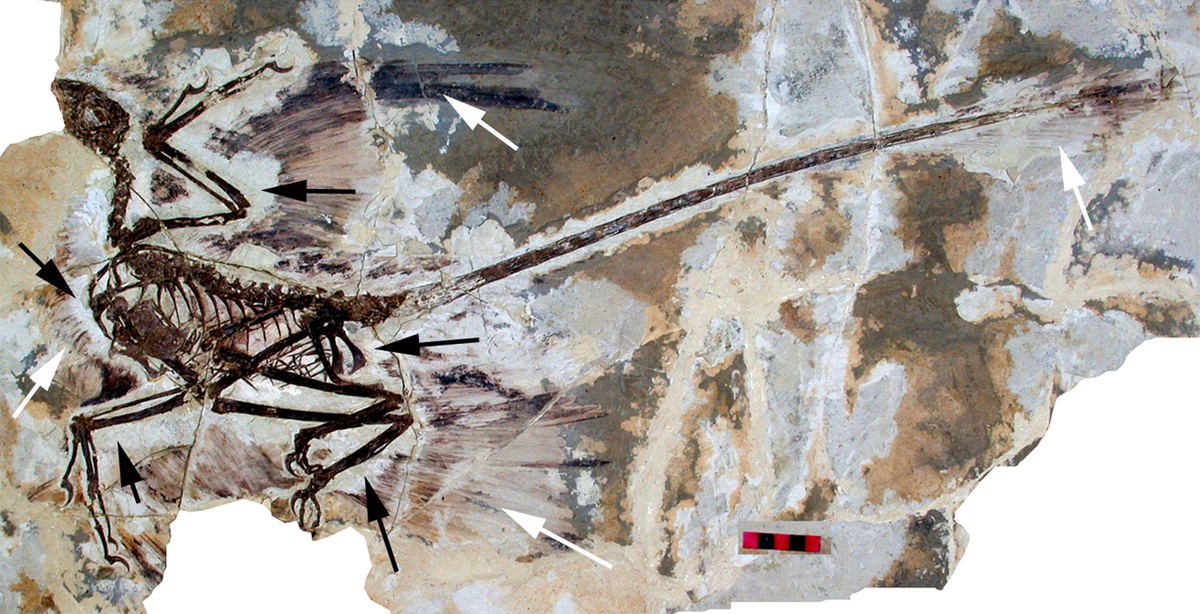
    A well-preserved fossil of “Microraptor gui” with impressions of feathered wings. Credit: David W. E. Hone, Helmut Tischlinger, Xing Xu, Fucheng Zhang

    Perhaps it is time to for us to reimagine the naked giant lizards as seen in Jurassic Park. In recent years many dinosaur fossil findings have indicated the presence of feathers. And according to a new study, most dinosaurs were, in fact, downy and all dinosaurs may have had the potential to develop feathers, or had feathers at a younger age.

    This new conclusion is based on some new discoveries made in Siberia that led researchers to reestablish when feathers first evolved and among which dinosaur families it was prevalent. The scientists unearthed some 150 million-year-old fossils from a plant-eating dinosaur named Kulindadromeus zabaikalicus. Before this discovery, feathered dinosaurs had only been found in China and these have all been theropods, a family of upright dinosaurs like the famous Tyrannosaurus Rex.
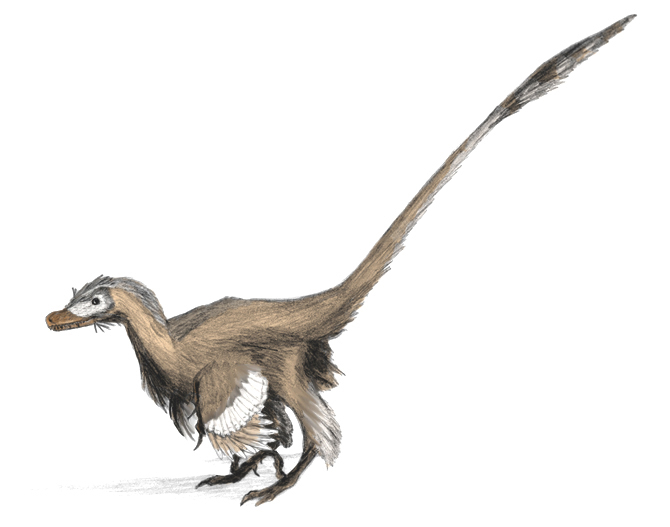
    Velociraptor mongoliensis restored with large wing feathers, as evidenced by fossil quill knobs. Credit: Matt Martyniuk

    So apparently there were at least two different dinosaur families living separated from each other, both with feathers. This implies that they probably had a common evolutionary ancestor, further back in time. This ancestor is believed having existed about 220 million years ago, and it too should have had feathers.

    The other explanation would be that the theropods and this new Kulindadromeus both developed feathers independently, but then hundreds of other dinosaur species could potentially have taken the same route.

    Even though most dinosaurs may have been endowed with feathers, this does not mean that all dinosaurs looked like big birds. As it is now assumed by some scientists that some dinosaurs had feathers throughout their whole life, while others should have lost them at a young age.

    The study has been published in the journal Science.

    _______________
    A Jurassic ornithischian dinosaur from Siberia with both feathers and scales

    ______________________________
    Dinosaurs Feathered Dinosaurs
    Share. Facebook Twitter Pinterest LinkedIn Tumblr Email Copy Link

    Related Posts

    All Dogs Are Descended from the Same Wolf

    November 30, 2020

    A Newly Identified Raptor Hunted With The Terrifying Agility of a Cheetah

    June 16, 2020

    European Neanderthals Feasted on Fresh Seafood, Boosting Their Brain

    March 30, 2020

    Fishing in the Sahara? Yes – 10 000 Years Ago

    March 2, 2020

    18,000-Year-Old Frozen Puppy Found Perfectly Preserved in Siberian Permafrost

    December 9, 2019

    Huge mysterious ape Gigantopithecus was a distant cousin of orangutans

    November 25, 2019
    Recent Posts
    • America’s Quiet Shift Into Fiscal Dominance: Why Inflation May Be Preparing for a Second Act
    • How the End of Bretton Woods Reshaped Our Economies — and Our Politics
    • Can the U.S. Really Handle 250% Debt-to-GDP? Why Jackson Hole’s Daring Paper Is Wrong
    • Japan’s Fiscal Trap: What Happens If Austerity Is No Longer an Option?
    • The Rise of Range Extended Electric Vehicles (REEVs): A New Era of Hybrid Mobility
    • The Great Capital Rotation: A Shift from U.S. Treasuries to Gold and Real Assets
    • The Hidden Risks of Short-Term Debt: A Balancing Act in U.S. Fiscal Policy
    • The Looming U.S. Debt Spiral: Understanding the Risks
    • The Looming Recession: Seven Economic Indicators Flashing Red for 2025
    • Europa Clipper: NASA’s Mission to Unlock the Secrets of Jupiter’s Icy Moon
    © 2025 Illustrated Curiosity

    Type above and press Enter to search. Press Esc to cancel.

    This website uses cookies to improve your experience. We'll assume you're ok with this, but you can opt-out if you wish.Accept Reject Read More
    Privacy & Cookies Policy

    Privacy Overview

    This website uses cookies to improve your experience while you navigate through the website. Out of these, the cookies that are categorized as necessary are stored on your browser as they are essential for the working of basic functionalities of the website. We also use third-party cookies that help us analyze and understand how you use this website. These cookies will be stored in your browser only with your consent. You also have the option to opt-out of these cookies. But opting out of some of these cookies may affect your browsing experience.
    Necessary
    Always Enabled
    Necessary cookies are absolutely essential for the website to function properly. This category only includes cookies that ensures basic functionalities and security features of the website. These cookies do not store any personal information.
    Non-necessary
    Any cookies that may not be particularly necessary for the website to function and is used specifically to collect user personal data via analytics, ads, other embedded contents are termed as non-necessary cookies. It is mandatory to procure user consent prior to running these cookies on your website.
    SAVE & ACCEPT