Close Menu
Illustrated Curiosity
    Facebook X (Twitter) Instagram YouTube
    Illustrated Curiosity
    • Earth
    • Economics
    • Environment
      • Climate
      • Environmental Tech
      • Pollution
      • Wildlife
    • Health
      • Health Tech
      • Medicine
      • Nutrition
      • Exercise
    • History
      • Prehistory
      • Ancient History
      • Postclassical Era
      • Modern History
    • Humans
      • Human Brain
      • Psychology
    • Life
      • Animals & Plants
      • Genetics
      • Paleontology
      • Evolution
      • Genetic Engineering
    • Physics
    • Space
      • Astrobiology
      • Astronomy
      • Extrasolar Planets
      • Space Tech
      • Spaceflight
    • Technology
      • Artificial Intelligence
      • Energy
      • Engineering
      • Materials
      • Robotics
      • Vehicles
    Illustrated Curiosity
    Home » A Four-Star Planetary System Discovered
    Extrasolar Planets

    A Four-Star Planetary System Discovered

    October 16, 2012No Comments2 Mins Read
    Share
    Facebook Twitter LinkedIn Pinterest Email
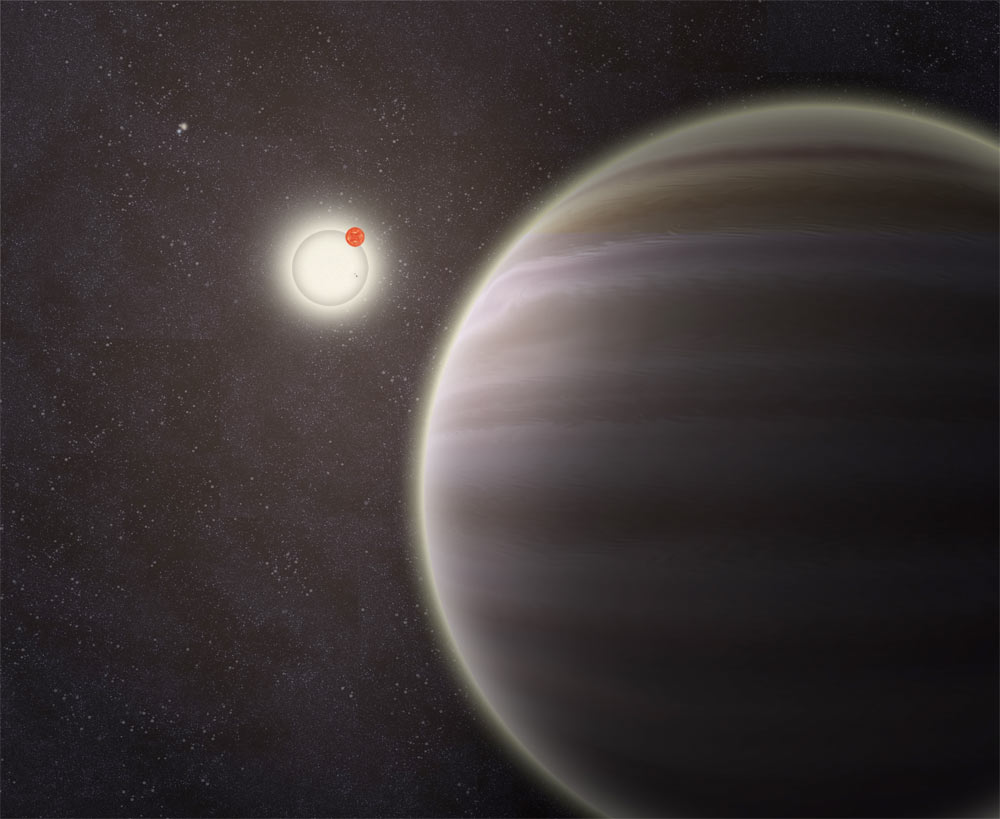
    Artist depiction of PH1, a planet with two parent stars and two more stars orbiting the entire system. Credit: Haven Giguere at Yale.

    If one sun wasn’t enough, or for that matter two, this newly found star system appears to have a total of four suns. Systems with two suns appear to be relatively common in the universe.

    But this is the first four-star system discovered and it happens to reside within our own galaxy, The Milky Way.

    The astronomers have also discovered a planet within this system. named “PH1”, it is located at a distance of 5,000 light years from the Earth, it revolves around two suns, one slightly larger than our own sun, the other slightly smaller.

    But orbiting around these two stars there are two more stars revolving. With a total of four stars in one system. All of which must be having a gravitational pull on each other, probably a unique process in system creation and circumstance.

    The discovery of PH1 and the two nearest stars were initially made by private planet hunters led by the Yale University but was later confirmed by NASA’s Kepler space telescope. The planet PH1 appears to be approximately the same size as Neptune. Then later closer examination by NASA revealed the system to be made up by a total of four stars.

    Planetary systems with two suns have been discovered on six occasions at the time of writing. So it appears to not be uncommon in the universe. But the question is how common four suns are.

    _______________
    Armchair astronomers find planet in four-star system
    ______________________________
    Exoplanets Kepler Space Telescope (NASA) Star System Stars Yale University
    Share. Facebook Twitter Pinterest LinkedIn Tumblr Email Copy Link

    Related Posts

    James Webb Telescope Discovers Methane & Carbon Dioxide in the Atmosphere of Exoplanet K2-18b

    September 14, 2023

    Tranquil Planetary System Just 11 Light-Years Away Raises Hopes of Habitability

    July 13, 2020

    TESS Mission Spots Earth-Size Potentially Habitable Planet 100 Light-Years Away

    January 8, 2020

    Water is Common—Yet Scarce—in Exoplanets

    December 17, 2019

    Astronomers Discover Jupiter-like Planet Orbiting A Tiny Star

    September 30, 2019

    Water Discovered in the Atmosphere of an Exoplanet in the Habitable zone

    September 12, 2019
    Recent Posts
    • How the End of Bretton Woods Reshaped Our Economies — and Our Politics
    • Can the U.S. Really Handle 250% Debt-to-GDP? Why Jackson Hole’s Daring Paper Is Wrong
    • Japan’s Fiscal Trap: What Happens If Austerity Is No Longer an Option?
    • The Rise of Range Extended Electric Vehicles (REEVs): A New Era of Hybrid Mobility
    • The Great Capital Rotation: A Shift from U.S. Treasuries to Gold and Real Assets
    • The Hidden Risks of Short-Term Debt: A Balancing Act in U.S. Fiscal Policy
    • The Looming U.S. Debt Spiral: Understanding the Risks
    • The Looming Recession: Seven Economic Indicators Flashing Red for 2025
    • Europa Clipper: NASA’s Mission to Unlock the Secrets of Jupiter’s Icy Moon
    • Could Hedge Funds Cause Chaos in the U.S. Treasury Market? And What About Inflation?
    © 2025 Illustrated Curiosity

    Type above and press Enter to search. Press Esc to cancel.

    This website uses cookies to improve your experience. We'll assume you're ok with this, but you can opt-out if you wish.Accept Reject Read More
    Privacy & Cookies Policy

    Privacy Overview

    This website uses cookies to improve your experience while you navigate through the website. Out of these, the cookies that are categorized as necessary are stored on your browser as they are essential for the working of basic functionalities of the website. We also use third-party cookies that help us analyze and understand how you use this website. These cookies will be stored in your browser only with your consent. You also have the option to opt-out of these cookies. But opting out of some of these cookies may affect your browsing experience.
    Necessary
    Always Enabled
    Necessary cookies are absolutely essential for the website to function properly. This category only includes cookies that ensures basic functionalities and security features of the website. These cookies do not store any personal information.
    Non-necessary
    Any cookies that may not be particularly necessary for the website to function and is used specifically to collect user personal data via analytics, ads, other embedded contents are termed as non-necessary cookies. It is mandatory to procure user consent prior to running these cookies on your website.
    SAVE & ACCEPT