Close Menu
Illustrated Curiosity
    Facebook X (Twitter) Instagram YouTube
    Illustrated Curiosity
    • Earth
    • Economics
    • Environment
      • Climate
      • Environmental Tech
      • Pollution
      • Wildlife
    • Health
      • Health Tech
      • Medicine
      • Nutrition
      • Exercise
    • History
      • Prehistory
      • Ancient History
      • Postclassical Era
      • Modern History
    • Humans
      • Human Brain
      • Psychology
    • Life
      • Animals & Plants
      • Genetics
      • Paleontology
      • Evolution
      • Genetic Engineering
    • Physics
    • Space
      • Astrobiology
      • Astronomy
      • Extrasolar Planets
      • Space Tech
      • Spaceflight
    • Technology
      • Artificial Intelligence
      • Energy
      • Engineering
      • Materials
      • Robotics
      • Vehicles
    Illustrated Curiosity
    Home » Lost in Space: A Rogue Planet Spotted?
    Extrasolar Planets

    Lost in Space: A Rogue Planet Spotted?

    November 15, 2012No Comments3 Mins Read
    Share
    Facebook Twitter LinkedIn Pinterest Email
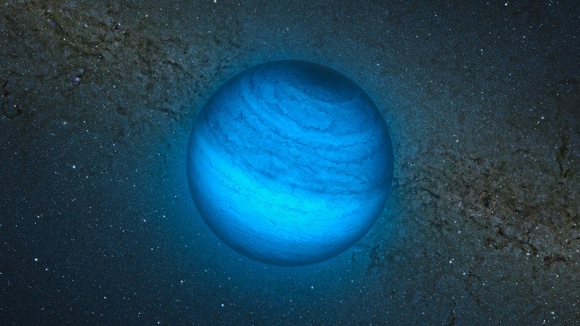
    Artist’s depiction of the free-floating planet. Credit: ESO/P.J214947.2-040308.9. This is the closest such object to the Solar System. It does not orbit a star and hence does not shine by reflected light; the faint glow it emits can only be detected in infrared light. Here we see an artist???s impression of an infrared view of the object with an image of the central parts of the Milky Way from the VISTA infrared survey telescope in the background.??The object appears blueish in this near-infrared view because much of the light at longer infrared wavelengths is absorbed by methane and other molecules in the planet’s atmosphere. In visible light the object is so cool that it would only shine dimly with a deep red colour when seen close-up.

    Astronomers using ESO’s (European Southern Observatory) Very Large Telescope and the Canada-France-Hawaii Telescope have identified a celestial body that is very probably a planet wandering through space without a parent star. Finding planets without the sun to orbit is very rare, and this newly found planet called CFBDSIR2149 is very rare indeed.

    CFBDSIR2149 has a mass that is about four to seven times the mass of Jupiter and it is located about 100 light years from our solar system, which by distances in space, is relatively close.

    Scientists have long cherished theories about the existence of free-floating planets, not bound by gravity to nearby stars. And with the exoplanet CFBDSIR2149 they have found the first proof that these theories are solid.

    Philippe Delorme at the “Institut de planétologie et d’ Astro physique de Grenoble”, “Looking for planets around their stars is akin to studying a firefly sitting one centimeter away from a distant, powerful car headlight.” “These objects are important, as they can either help us understand more about how planets may be ejected from planetary systems, or how very light objects can arise from the star formation process,” “If this little object is a planet that has been ejected from its native system, it conjures up the striking image of orphaned worlds, drifting in the emptiness of space.”

    Joseph Fourier, France, is the lead author of the study, “This nearby free-floating object offered the opportunity to study the firefly in detail without the dazzling lights of the car messing everything up.”

    Philippe Delorme concludes, “Further work should confirm CFBDSIR2149 as a free-floating planet,” “This object could be used as a benchmark for understanding the physics of any similar exoplanets that are discovered by future special high-contrast imaging systems, including the SPHERE instrument that will be installed on the VLT.”

    Below an artist’s impression of the free-floating planet CFBDSIR. The planet appears as a dark disc in visible light, silhouetted against the star clouds of the Milky Way.

    _______________
    ESO/P. Delorme/Nick Risinger (skysurvey.org)/R. Saito/VVV Consortium
    ______________________________
    Exoplanets Planets Rogue Planets
    Share. Facebook Twitter Pinterest LinkedIn Tumblr Email Copy Link

    Related Posts

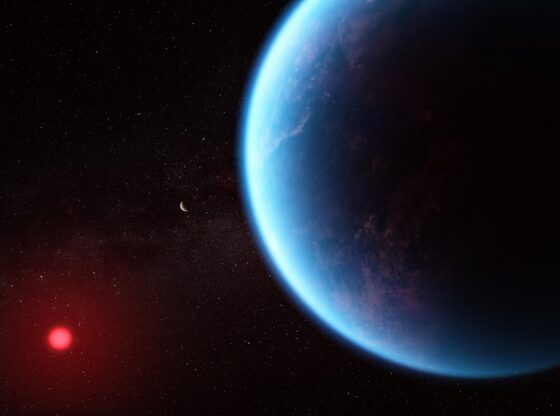
    James Webb Telescope Discovers Methane & Carbon Dioxide in the Atmosphere of Exoplanet K2-18b

    September 14, 2023

    Tranquil Planetary System Just 11 Light-Years Away Raises Hopes of Habitability

    July 13, 2020

    TESS Mission Spots Earth-Size Potentially Habitable Planet 100 Light-Years Away

    January 8, 2020

    Water is Common—Yet Scarce—in Exoplanets

    December 17, 2019

    Astronomers Discover Jupiter-like Planet Orbiting A Tiny Star

    September 30, 2019

    Water Discovered in the Atmosphere of an Exoplanet in the Habitable zone

    September 12, 2019
    Recent Posts
    • How the End of Bretton Woods Reshaped Our Economies — and Our Politics
    • Can the U.S. Really Handle 250% Debt-to-GDP? Why Jackson Hole’s Daring Paper Is Wrong
    • Japan’s Fiscal Trap: What Happens If Austerity Is No Longer an Option?
    • The Rise of Range Extended Electric Vehicles (REEVs): A New Era of Hybrid Mobility
    • The Great Capital Rotation: A Shift from U.S. Treasuries to Gold and Real Assets
    • The Hidden Risks of Short-Term Debt: A Balancing Act in U.S. Fiscal Policy
    • The Looming U.S. Debt Spiral: Understanding the Risks
    • The Looming Recession: Seven Economic Indicators Flashing Red for 2025
    • Europa Clipper: NASA’s Mission to Unlock the Secrets of Jupiter’s Icy Moon
    • Could Hedge Funds Cause Chaos in the U.S. Treasury Market? And What About Inflation?
    © 2025 Illustrated Curiosity

    Type above and press Enter to search. Press Esc to cancel.

    This website uses cookies to improve your experience. We'll assume you're ok with this, but you can opt-out if you wish.Accept Reject Read More
    Privacy & Cookies Policy

    Privacy Overview

    This website uses cookies to improve your experience while you navigate through the website. Out of these, the cookies that are categorized as necessary are stored on your browser as they are essential for the working of basic functionalities of the website. We also use third-party cookies that help us analyze and understand how you use this website. These cookies will be stored in your browser only with your consent. You also have the option to opt-out of these cookies. But opting out of some of these cookies may affect your browsing experience.
    Necessary
    Always Enabled
    Necessary cookies are absolutely essential for the website to function properly. This category only includes cookies that ensures basic functionalities and security features of the website. These cookies do not store any personal information.
    Non-necessary
    Any cookies that may not be particularly necessary for the website to function and is used specifically to collect user personal data via analytics, ads, other embedded contents are termed as non-necessary cookies. It is mandatory to procure user consent prior to running these cookies on your website.
    SAVE & ACCEPT