Close Menu
Illustrated Curiosity | Economics, History, Science, Space, Technology, Health, Physics, Earth
    Facebook X (Twitter) Instagram YouTube
    Illustrated Curiosity | Economics, History, Science, Space, Technology, Health, Physics, Earth
    • Earth
    • Economics
    • Environment
      • Environmental Tech
      • Pollution
      • Wildlife
    • Health
      • Health Tech
      • Medicine
      • Nutrition
      • Exercise
    • History
      • Prehistory
      • Ancient History
      • Postclassical Era
      • Modern History
    • Humans
      • Human Brain
      • Psychology
    • Life
      • Animals & Plants
      • Genetics
      • Paleontology
      • Evolution
      • Genetic Engineering
    • Physics
    • Space
      • Astrobiology
      • Astronomy
      • Extrasolar Planets
      • Space Tech
      • Spaceflight
    • Technology
      • Artificial Intelligence
      • Energy
      • Engineering
      • Materials
      • Robotics
      • Vehicles
    Illustrated Curiosity | Economics, History, Science, Space, Technology, Health, Physics, Earth
    Home » NASA’s Voyager 2 Enters Interstellar Space
    Spaceflight

    NASA’s Voyager 2 Enters Interstellar Space

    December 21, 20182 Mins Read
    Image via NASA/JPL-Caltech.
    Share
    Facebook Twitter LinkedIn Pinterest Email
     Image via NASA/JPL-Caltech.
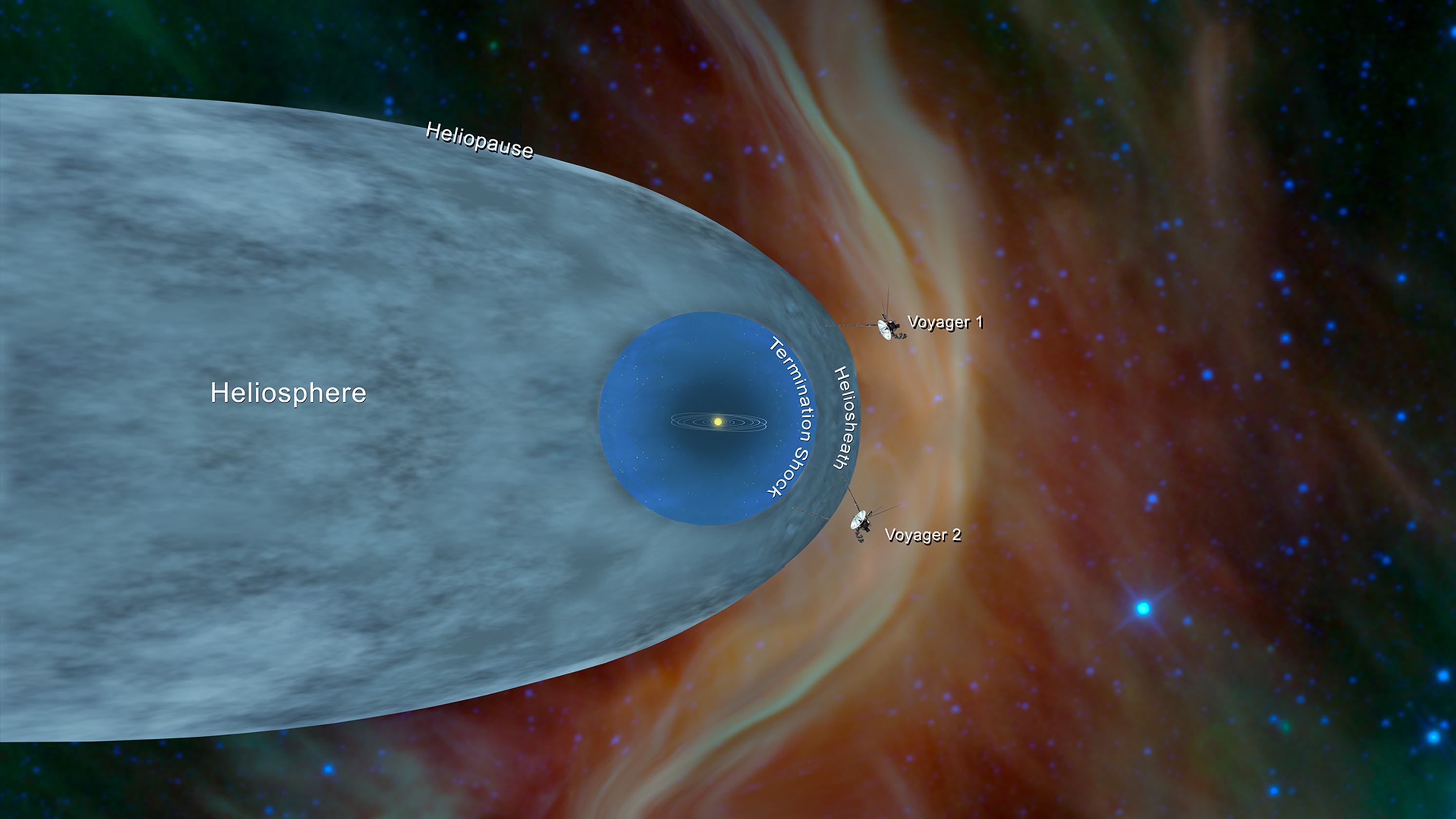
    Artist’s concept showing the positions of the Voyager 1 and Voyager 2 probes, now both outside the heliosphere, or sphere of our sun’s influence. Image via NASA/JPL-Caltech.

    NASA announced last week that the grizzled Voyager 2 probe crossed into interstellar space.

    The Voyager 2 probe, which left Earth in 1977, has become the second human-made object to leave our Solar System NASA announced last week.

    It was launched 16 days before its twin craft, Voyager 1, but that probe’s faster trajectory meant that it was in “the space between the stars” six years before Voyager 2. The news was revealed at the American Geophysical Union (AGU) meeting in Washington.

    NASA’s Voyager 2 probe exited the heliosphere – the protective bubble of particles and magnetic fields created by the Sun and defining what we know as our own planetary system. This boundary is where the hot solar wind meets the cold, dense interstellar medium. Voyager 2’s twin spacecraft, Voyager 1, crossed this boundary in 2012, but Voyager 2 carries a working instrument that will provide first-of-its-kind observations of the nature of this gateway into interstellar space.

    Comparing data from different instruments aboard the spacecraft, mission scientists determined the probe crossed the outer edge of the heliosphere on November 5, 2018. Voyager 2 is now more than 18 billion kilometers (11 billion miles) from Earth.

    During a news conference held at the annual meeting of the American Geophysical Union today (Dec. 10), scientists and engineers said that while they’re excited about crossing the boundary, both Voyager 2 and its twin probe have plenty of life left in them. Their continuing science will help shed light on how particles flowing off the sun collide with the particles on the interstellar wind beyond.


    The most compelling evidence of Voyager 2’s exit from the heliosphere came from its onboard Plasma Science Experiment (PLS). The PLS uses the electrical current of the plasma to detect the speed, density, temperature, pressure, and flux of the solar wind.

    The PLS aboard Voyager 2 observed a steep decline in the speed of the solar wind particles on Nov. 5. Since that date, the plasma instrument has observed no solar wind flow in the environment around Voyager 2, which makes mission scientists confident the probe has left the heliosphere.
    Share. Facebook Twitter Pinterest LinkedIn Tumblr Email Copy Link

    Related Posts

    Europa Clipper: NASA’s Mission to Unlock the Secrets of Jupiter’s Icy Moon

    October 20, 2024

    Spinlaunch Hurls Satellites into Orbit With a Giant Centrifuge

    December 6, 2021

    SpaceX Capsule and NASA Crew Make Historic Splashdown

    August 3, 2020

    NASA and SpaceX are Making History Launching Astronauts to Space! | NASA Live

    May 27, 2020

    Red Space Salad Given Green Light

    May 26, 2020

    NASA Will Launch a Lunar VIPER to Hunt Moon Water in 2022

    November 12, 2019
    Recent Posts
    • Oil Shocks, Policy Mistakes, and the Risk of a Second Inflation Wave (Part II)
    • Oil Shocks, Policy Mistakes, and the Risk of a Second Inflation Wave (Part I)
    • Microsoft Stored a Movie on Glass — And It Could Last Centuries
    • AI, Automatic Stabilizers & Inflation
    • Largest Battles in History: Cannae — Rome’s Darkest Day
    • The Day the Alliance Died
    • Evaluating Heart Disease: How Cumulative Diet Choices Compound Your Risk
    • What Would Happen If China Attacked Taiwan?
    • Geopoliticisation as a Structural Tailwind for Commodity Prices
    • America’s Economic Remodel: Who’s Really Paying the Bill?
    © 2025 Illustrated Curiosity

    Type above and press Enter to search. Press Esc to cancel.