Close Menu
Illustrated Curiosity
    Facebook X (Twitter) Instagram YouTube
    Illustrated Curiosity
    • Earth
    • Economics
    • Environment
      • Climate
      • Environmental Tech
      • Pollution
      • Wildlife
    • Health
      • Health Tech
      • Medicine
      • Nutrition
      • Exercise
    • History
      • Prehistory
      • Ancient History
      • Postclassical Era
      • Modern History
    • Humans
      • Human Brain
      • Psychology
    • Life
      • Animals & Plants
      • Genetics
      • Paleontology
      • Evolution
      • Genetic Engineering
    • Physics
    • Space
      • Astrobiology
      • Astronomy
      • Extrasolar Planets
      • Space Tech
      • Spaceflight
    • Technology
      • Artificial Intelligence
      • Energy
      • Engineering
      • Materials
      • Robotics
      • Vehicles
    Illustrated Curiosity
    Home » Red Space Salad Given Green Light
    Spaceflight

    Red Space Salad Given Green Light

    May 26, 20203 Mins Read
    Share
    Facebook Twitter LinkedIn Pinterest Email
    NASA
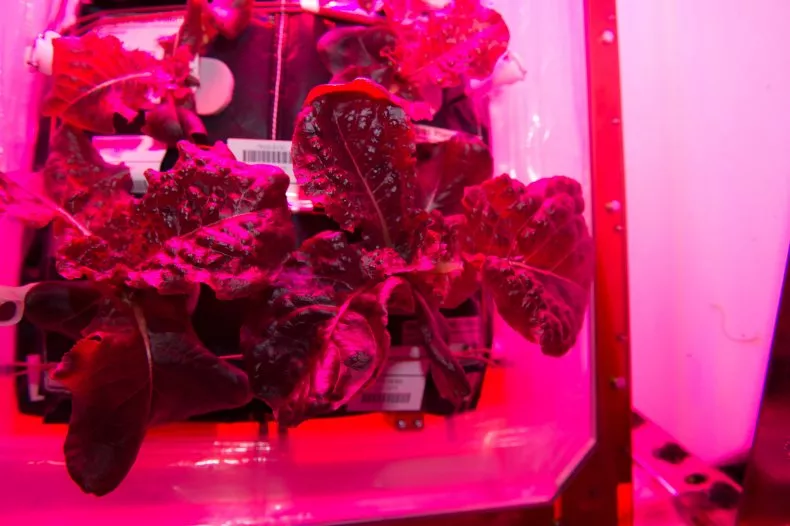
    Lettuce grown on the ISS. Researchers have found the crop was as nutritious and safe as a control group grown on Earth.

    A new study shows that lettuce grown on board the International Space Station ISS is at least as nutritious as the lettuce grown on Earth.

    Red romaine lettuce seeds were sent to the ISS as part of an experiment to see if cultivation in space was possible. The ISS astronauts grew and ate the lettuce as part of the Vegetable Production System experiment, dubbed “Veggie” for short.

    The lettuce (Lactuca sativa, cv ‘Outredgeous’) thrived despite growing in zero gravity and exposed to higher radiation doses in space. The space lettuce was also found to have the same microbiome as lettuce grown on Earth, which leads the authors to conclude that it is safe as human food.

    Today’s astronauts get their nutrition from foods that have been processed in one way or another to increase sustainability, but the processing affects the amount of certain nutrients.

    The study authors examined the microbiological and nutritional quality of the lettuce after its stint on the ISS. Samples of the lettuce were frozen and sent back to Earth, where researchers conducted experiments to test the lettuce for any differences. As a control, the team also grew the crop in the same conditions on Earth. The plants were cultivated in chambers with LED lighting and a watering system.

    The fact that it is possible to grow vegetables on the ISS is of utmost interest to NASA and other space organizations, as the availability of food is one of many tasks that should be solved before we venture out further into space, for example to the planet Mars.

    “Right now we cannot guarantee that we will have a diet to meet the needs of the crew for these longer, deep space missions, so one potential solution will be to supplement the packaged diet with fresh produce,”

    ”
    This [space-grown lettuce] will provide additional vitamins and other nutrients, flavors, textures and variety to the packaged diet. Growing plants may also help with menu fatigue and provide psychological benefits when astronauts are far from home. In the long term, if we ever want to have space colonization, growth of crops will be crucial for establishing any level of sustainability and self-sufficiency.
    ”

    ”
    In addition to providing food, plants may also play a role in future Life Support Systems needed for long-duration missions. Plants generate oxygen as well as remove and fix carbon dioxide, which is critical in closed systems like the ISS or future moon/Mars facilities.
    “

    – NASA’s Christina Khodadad and Gioia Massa, from the Kennedy Space Center,

    The authors conclude that lettuce grown in space-borne Veggie units is safe to eat. These encouraging results open the door for experiments with other nutritious and tasty crops on board the space station, to help propel astronauts further into space.

    The study has been published in the journal Frontiers in Plant Science.

    Reference:
    Khodadad, C.L. et al. “Microbiological and nutritional analysis of lettuce crops grown on the International Space Station” Front. Plant Sci. 2020: 00199th (Https://www.frontiersin.org/articles/10.3389/fpls.2020.00199/full)
    Share. Facebook Twitter Pinterest LinkedIn Tumblr Email Copy Link

    Related Posts

    Europa Clipper: NASA’s Mission to Unlock the Secrets of Jupiter’s Icy Moon

    October 20, 2024

    Spinlaunch Hurls Satellites into Orbit With a Giant Centrifuge

    December 6, 2021

    SpaceX Capsule and NASA Crew Make Historic Splashdown

    August 3, 2020

    NASA and SpaceX are Making History Launching Astronauts to Space! | NASA Live

    May 27, 2020

    NASA Will Launch a Lunar VIPER to Hunt Moon Water in 2022

    November 12, 2019

    NASA Wants to Land a Flying Robot on Titan, the Moon

    August 9, 2019
    Recent Posts
    • America’s Quiet Shift Into Fiscal Dominance: Why Inflation May Be Preparing for a Second Act
    • How the End of Bretton Woods Reshaped Our Economies — and Our Politics
    • Can the U.S. Really Handle 250% Debt-to-GDP? Why Jackson Hole’s Daring Paper Is Wrong
    • Japan’s Fiscal Trap: What Happens If Austerity Is No Longer an Option?
    • The Rise of Range Extended Electric Vehicles (REEVs): A New Era of Hybrid Mobility
    • The Great Capital Rotation: A Shift from U.S. Treasuries to Gold and Real Assets
    • The Hidden Risks of Short-Term Debt: A Balancing Act in U.S. Fiscal Policy
    • The Looming U.S. Debt Spiral: Understanding the Risks
    • The Looming Recession: Seven Economic Indicators Flashing Red for 2025
    • Europa Clipper: NASA’s Mission to Unlock the Secrets of Jupiter’s Icy Moon
    © 2025 Illustrated Curiosity

    Type above and press Enter to search. Press Esc to cancel.

    This website uses cookies to improve your experience. We'll assume you're ok with this, but you can opt-out if you wish.Accept Reject Read More
    Privacy & Cookies Policy

    Privacy Overview

    This website uses cookies to improve your experience while you navigate through the website. Out of these, the cookies that are categorized as necessary are stored on your browser as they are essential for the working of basic functionalities of the website. We also use third-party cookies that help us analyze and understand how you use this website. These cookies will be stored in your browser only with your consent. You also have the option to opt-out of these cookies. But opting out of some of these cookies may affect your browsing experience.
    Necessary
    Always Enabled
    Necessary cookies are absolutely essential for the website to function properly. This category only includes cookies that ensures basic functionalities and security features of the website. These cookies do not store any personal information.
    Non-necessary
    Any cookies that may not be particularly necessary for the website to function and is used specifically to collect user personal data via analytics, ads, other embedded contents are termed as non-necessary cookies. It is mandatory to procure user consent prior to running these cookies on your website.
    SAVE & ACCEPT