

A first prototype for what is going to become the world’s largest telescope is complete. A telescope that may reveal the secrets of dark matter.
The prototype telescope was revealed yesterday in China, Science reports. The telescope is part of the radio telescope Square Kilometer Array (SKA) which is expected to be completed in about eight years.
The SKA radio telescope will then be composed of several telescopes operating together in a network, together establishing a radio telescope far more sensitive to capturing signals than the biggest radio telescopes today.
The collection of various types of antennae is spread over long distances with up to one square kilometer (hence the name) in total collecting surface area. Upon completion, it will be the world’s largest public science data project that will generate data at a rate more than 10 times today’s global internet traffic.
We first wrote about the SKA telescope back in 2012, the telescope was then only in its early stages. But the project started much earlier than that, in the early 1990s already, when the International Union of Radio Science created the Large Telescope Working Group aimed at developing the next-generation radio observatory.
The prototype now completed in China is the first real step in assembling the telescope and in itself a culmination of a three-year effort that includes institutions in China acting as the consortium lead, Australia, Canada, France, Germany, Italy, South Africa, Spain, the United Kingdom and Sweden, overseen by the SKA Organisation based in Manchester.
China’s vice minister of science and technology Huang Wei said China’s involvement in SKA was “the realization of the Chinese dream to be engaged in international mega-science”. But the work has just begun, the SKA Organisation is now to build a second dish in South Africa.
“A second dish, currently under production at CETC54 and funded by the German Max Planck Society, will be shipped to South Africa and assembled at the South African SKA site in the next few months where it will be equipped with its instrumentation and used to conduct real observations for the first time to test its performance and calibrate all the systems,”
– SKA Organization in a statement press release.
The SKA instruments will mainly be located in two countries-South Africa and Australia. Eight other African nations including Botswana, Ghana, and Kenya will also have the system’s components.
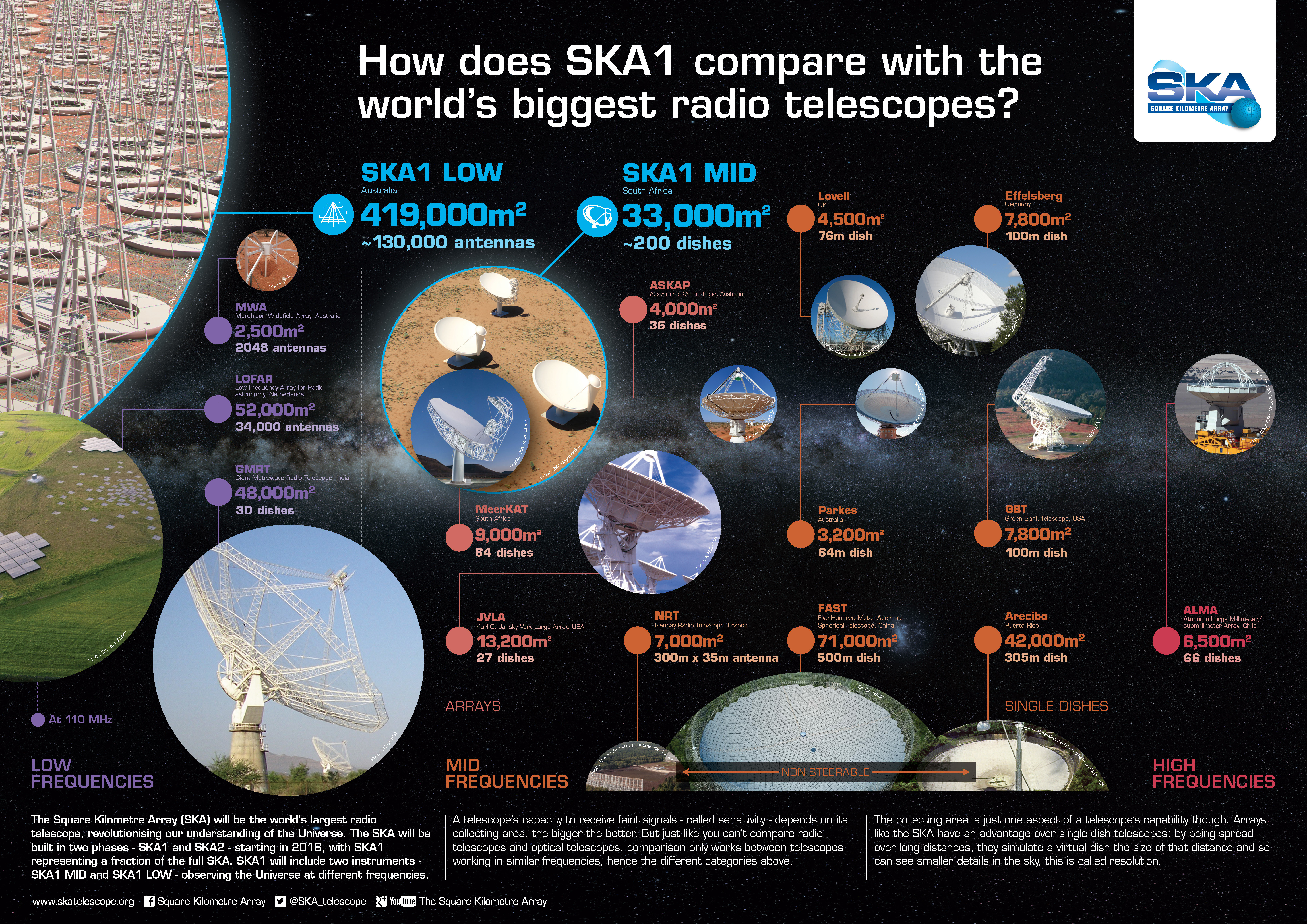
The idea is that the new super radio telescopes should provide more knowledge of the very first stars, dark energy, and cosmic magnetic fields. It will be powerful enough to detect very faint radio signals emitted by cosmic sources billions of light years away from Earth. Signals emitted in the first billion years of the Universe (more than 13 billion years ago) when the first galaxies and stars started forming.