Close Menu
Illustrated Curiosity
    Facebook X (Twitter) Instagram YouTube
    Illustrated Curiosity
    • Earth
    • Economics
    • Environment
      • Climate
      • Environmental Tech
      • Pollution
      • Wildlife
    • Health
      • Health Tech
      • Medicine
      • Nutrition
      • Exercise
    • History
      • Prehistory
      • Ancient History
      • Postclassical Era
      • Modern History
    • Humans
      • Human Brain
      • Psychology
    • Life
      • Animals & Plants
      • Genetics
      • Paleontology
      • Evolution
      • Genetic Engineering
    • Physics
    • Space
      • Astrobiology
      • Astronomy
      • Extrasolar Planets
      • Space Tech
      • Spaceflight
    • Technology
      • Artificial Intelligence
      • Energy
      • Engineering
      • Materials
      • Robotics
      • Vehicles
    Illustrated Curiosity
    Home » Scientists Say They Have Made Significant Nuclear Fusion Progress
    Energy

    Scientists Say They Have Made Significant Nuclear Fusion Progress

    June 7, 2014No Comments4 Mins Read
    Share
    Facebook Twitter LinkedIn Pinterest Email
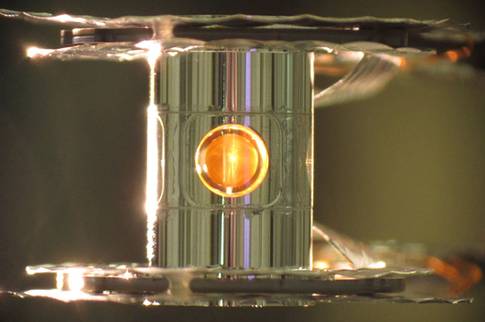
    A metallic case called a hohlraum holds the fuel capsule for NIF experiments. Inside this hohlraum, there is a confinement fusion fuel microcapsule (“micro balloon”). That can be filled with deuterium or tritium (hydrogen isotopes). Then to be targeted with laser energy. Credit: Lawrence Livermore National Laboratory/Eduard Dewald.

    For a very long time, mankind has had a dream of abundant energy by recreating the sun’s inner working on Earth. Nuclear fusion has the potential of being an ecologically friendly source of energy that would last forever and produce more than abundant amounts of energy. Making energy cheaper for everyone and with the great implications this would involve, for instance, it would make many forms of electrically powered transportation economically viable.

    There is a great difference between nuclear fission and fusion. Fission is the physical principal and technology presently harnessed in our nuclear power plants. These power plants use very heavy atomic nucleus such as uranium and split these into smaller nuclei, other particles, and radiation. Heat is created that is used to boil water, create steam that passes through a steam generator, that produce electricity.

    In a fusion reaction, two or more light atomic nuclei such as hydrogen, fuse to form a single heavier nucleus such as helium. The mass change in the process is the source of nuclear energy.

    The amount of energy produced as a percentage of the potential energy, the energy efficiency, is higher for fusion than fission. Fission provides more energy per reaction, using heavy elements (Uranium, Plutonium or Thorium). But fusion provides more energy per unit mass for these reactions (Deuterium, Tritium).

    For this reason, there is a great deal of research conducted on nuclear fusion across the world. Not least at ITER (International Thermonuclear Experimental Reactor) that is presently being built in France and is expected to be finished in 2019 and start commissioning the reactor that same year, to initiate plasma experiments in 2020. It will be the world’s largest experimental Tokamak nuclear fusion reactor, using a magnetic field to confine a plasma.

    Inside the gold hohlraum seen on above picture, there is a confinement fusion fuel microcapsule (“micro balloon”) that can be filled with deuterium or tritium (hydrogen isotopes). Then to be targeted with laser energy. Credit: Lawrence Livermore National Laboratory

    Now, researchers at The Lawrence Livermore Laboratory in California has managed to produce more fusion energy than was required to ignite the fusion reaction.

    This is the first time that the amount of produced energy exceeds the amount of used energy. It, therefore, represents a milestone in fusion research. It took the researchers more than two years of unsuccessful attempts at the National Ignition Facility.

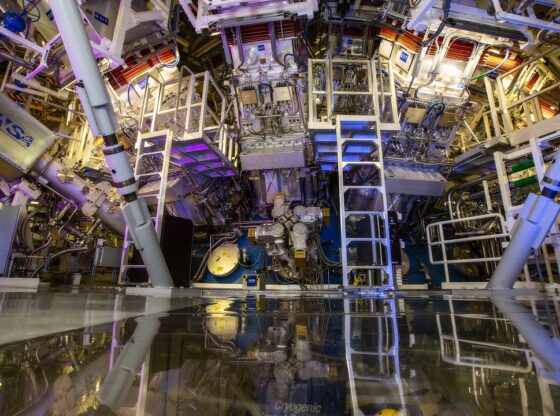
    The experiment and the technology used in this experiment differs from the previously mentioned Tokamak reactor design at ITER. The scientists instead used a method of laser-based inertial confinement. Built for the Department of National Ignition Facility at the Lawrence Livermore Laboratory.

    The scientists placed small amounts of hydrogen inside a plastic capsule called a microcapsule, enclosed inside a gold cylinder called a hohlraum. They then used 192 laser beams to heat the gold cylinder, which began emitting X-rays (electromagnetic radiation).

    This radiation, in turn, heated the hydrogen to nearly 100 million degrees Celsius. This was enough for the hydrogen atoms to fuse together and begin a nuclear fusion reaction.

    Although the reaction only lasted for 20 billionths of a second, the amount of energy output was huge; more energy than all of the world’s power plants could produce within the same time period.

    The energy released was twice that of the X-ray radiation from the gold container and thereby implies a net gain in energy. However, if also counting the laser cannons, the net surplus disappears. Besides this, it is regarded as a major achievement. The results have been published in the scientific journal Nature (see below).

    The prospect of near limitless, sustainable energy ensures continued interest and research investments. NIF itself will come up for review in 2015 but just last year the U.S. National Research Council endorsed continued investment in inertial confinement fusion.

    _________________
    Lawrence Livermore Laboratory
    NIF experiments show initial gain in fusion fuel
    Fuel gain exceeding unity in an inertially confined fusion implosion
    __________________________________
    ITER - International Thermonuclear Experimental Reactor Lawrence Livermore Laboratory Nuclear Fission Nuclear Fusion Tokamak Reactor
    Share. Facebook Twitter Pinterest LinkedIn Tumblr Email Copy Link

    Related Posts

    A Fusion Energy Breakthrough? Major Announcement Expected From US Scientists

    December 12, 2022

    New Efficiency Record for Transparent Solar Cells

    August 26, 2020

    IBM’s Lithium Battery Uses Seawater Materials Instead of Heavy Metals

    May 31, 2020

    Demand for batteries will increase tenfold

    May 20, 2020

    Samsung Unveils Groundbreaking All-solid-state Battery Technology

    May 5, 2020

    Global Carbon Dioxide Emissions Leveled Off Last Year

    February 17, 2020
    Recent Posts
    • How the End of Bretton Woods Reshaped Our Economies — and Our Politics
    • Can the U.S. Really Handle 250% Debt-to-GDP? Why Jackson Hole’s Daring Paper Is Wrong
    • Japan’s Fiscal Trap: What Happens If Austerity Is No Longer an Option?
    • The Rise of Range Extended Electric Vehicles (REEVs): A New Era of Hybrid Mobility
    • The Great Capital Rotation: A Shift from U.S. Treasuries to Gold and Real Assets
    • The Hidden Risks of Short-Term Debt: A Balancing Act in U.S. Fiscal Policy
    • The Looming U.S. Debt Spiral: Understanding the Risks
    • The Looming Recession: Seven Economic Indicators Flashing Red for 2025
    • Europa Clipper: NASA’s Mission to Unlock the Secrets of Jupiter’s Icy Moon
    • Could Hedge Funds Cause Chaos in the U.S. Treasury Market? And What About Inflation?
    © 2025 Illustrated Curiosity

    Type above and press Enter to search. Press Esc to cancel.

    This website uses cookies to improve your experience. We'll assume you're ok with this, but you can opt-out if you wish.Accept Reject Read More
    Privacy & Cookies Policy

    Privacy Overview

    This website uses cookies to improve your experience while you navigate through the website. Out of these, the cookies that are categorized as necessary are stored on your browser as they are essential for the working of basic functionalities of the website. We also use third-party cookies that help us analyze and understand how you use this website. These cookies will be stored in your browser only with your consent. You also have the option to opt-out of these cookies. But opting out of some of these cookies may affect your browsing experience.
    Necessary
    Always Enabled
    Necessary cookies are absolutely essential for the website to function properly. This category only includes cookies that ensures basic functionalities and security features of the website. These cookies do not store any personal information.
    Non-necessary
    Any cookies that may not be particularly necessary for the website to function and is used specifically to collect user personal data via analytics, ads, other embedded contents are termed as non-necessary cookies. It is mandatory to procure user consent prior to running these cookies on your website.
    SAVE & ACCEPT