Close Menu
Illustrated Curiosity
    Facebook X (Twitter) Instagram YouTube
    Illustrated Curiosity
    • Earth
    • Economics
    • Environment
      • Climate
      • Environmental Tech
      • Pollution
      • Wildlife
    • Health
      • Health Tech
      • Medicine
      • Nutrition
      • Exercise
    • History
      • Prehistory
      • Ancient History
      • Postclassical Era
      • Modern History
    • Humans
      • Human Brain
      • Psychology
    • Life
      • Animals & Plants
      • Genetics
      • Paleontology
      • Evolution
      • Genetic Engineering
    • Physics
    • Space
      • Astrobiology
      • Astronomy
      • Extrasolar Planets
      • Space Tech
      • Spaceflight
    • Technology
      • Artificial Intelligence
      • Energy
      • Engineering
      • Materials
      • Robotics
      • Vehicles
    Illustrated Curiosity
    Home » Tokyo to Build ‘Solar Roads’ Ahead of 2020 Olympics
    Energy

    Tokyo to Build ‘Solar Roads’ Ahead of 2020 Olympics

    June 21, 2018No Comments3 Mins Read
    Share
    Facebook Twitter LinkedIn Pinterest Email
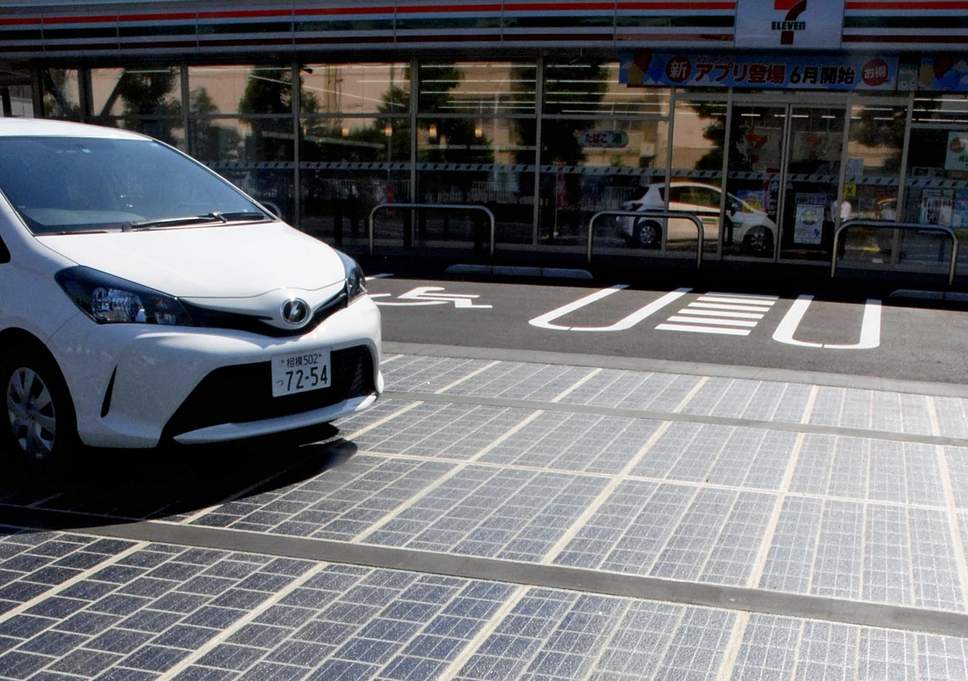
    Solar panels at a parking lot in Kanagawa Prefecture, Tokyo. ( Japan News-Yomiuri )

    The next Olympic games will take place in Tokyo in two years and the Japanese government is aiming to boost the city’s eco reputation. Among the ideas presented are ready-made solar roads and electricity-generating building floors. The ambitious goal is that renewable energy should account for 30 percent of the city’s needs by 2030.

    Some roads in the Japanese capital will be replaced by electricity generating ‘solar panel roads’. These roads have been around for a while, being tested in e.g. France and China is currently building a solar motorway. But even if solar roads is a smart way to use space – there’s a lot of technical issues. These solar cells need to be very resilient and the fact is that these solar cells are less effective compared to the regular solar panels – and they are expensive.

    Japan has a precarious energy problem in the wake of the Fukushima nuclear power plant disaster. The earthquake, tsunami and subsequent nuclear meltdown meant that nuclear the power plant was suspended – and to a large extent replaced by fossil fuels. Finding energy alternatives has become an ever more pressing need.

    Japan already has some solar roads. A parking lot at a shop in Sagamihara, Kanagawa, has been rebuilt with solar cells and can generate 16 145 kWh annually – which covers nine percent of the energy that the store consumes per year.

    The intended roll-out of the solar roads for the Olympic Games is a much more ambitious project – but it is in line with what Tokyo’s city government wants: to position itself as an eco-friendly-high-technology-city of the future.

    The idea is for Tokyo to reach a goal of generating close to a third of its energy from renewable sources by 2030 – compared to the 12 percent in 2016.

    But solar roads are not the only solution to reach that goal. The city rulers are also planning to introduce electricity-generating floors. These floors are made in a special frame that generates a small potential difference when subjected to pressure.

    According to Soundpower Corporation, the company behind the technology, a 60-kilo person walking at normal speed can generate an equivalent to 2 mW – enough to provide enough electricity to a small LED display. When applied at scale, the technology can generate enough energy to light up a walkway at night.
    Share. Facebook Twitter Pinterest LinkedIn Tumblr Email Copy Link

    Related Posts

    A Fusion Energy Breakthrough? Major Announcement Expected From US Scientists

    December 12, 2022

    New Efficiency Record for Transparent Solar Cells

    August 26, 2020

    IBM’s Lithium Battery Uses Seawater Materials Instead of Heavy Metals

    May 31, 2020

    Demand for batteries will increase tenfold

    May 20, 2020

    Samsung Unveils Groundbreaking All-solid-state Battery Technology

    May 5, 2020

    Global Carbon Dioxide Emissions Leveled Off Last Year

    February 17, 2020
    Recent Posts
    • How the End of Bretton Woods Reshaped Our Economies — and Our Politics
    • Can the U.S. Really Handle 250% Debt-to-GDP? Why Jackson Hole’s Daring Paper Is Wrong
    • Japan’s Fiscal Trap: What Happens If Austerity Is No Longer an Option?
    • The Rise of Range Extended Electric Vehicles (REEVs): A New Era of Hybrid Mobility
    • The Great Capital Rotation: A Shift from U.S. Treasuries to Gold and Real Assets
    • The Hidden Risks of Short-Term Debt: A Balancing Act in U.S. Fiscal Policy
    • The Looming U.S. Debt Spiral: Understanding the Risks
    • The Looming Recession: Seven Economic Indicators Flashing Red for 2025
    • Europa Clipper: NASA’s Mission to Unlock the Secrets of Jupiter’s Icy Moon
    • Could Hedge Funds Cause Chaos in the U.S. Treasury Market? And What About Inflation?
    © 2025 Illustrated Curiosity

    Type above and press Enter to search. Press Esc to cancel.

    This website uses cookies to improve your experience. We'll assume you're ok with this, but you can opt-out if you wish.Accept Reject Read More
    Privacy & Cookies Policy

    Privacy Overview

    This website uses cookies to improve your experience while you navigate through the website. Out of these, the cookies that are categorized as necessary are stored on your browser as they are essential for the working of basic functionalities of the website. We also use third-party cookies that help us analyze and understand how you use this website. These cookies will be stored in your browser only with your consent. You also have the option to opt-out of these cookies. But opting out of some of these cookies may affect your browsing experience.
    Necessary
    Always Enabled
    Necessary cookies are absolutely essential for the website to function properly. This category only includes cookies that ensures basic functionalities and security features of the website. These cookies do not store any personal information.
    Non-necessary
    Any cookies that may not be particularly necessary for the website to function and is used specifically to collect user personal data via analytics, ads, other embedded contents are termed as non-necessary cookies. It is mandatory to procure user consent prior to running these cookies on your website.
    SAVE & ACCEPT