Close Menu
Illustrated Curiosity
    Facebook X (Twitter) Instagram YouTube
    Illustrated Curiosity
    • Earth
    • Economics
    • Environment
      • Climate
      • Environmental Tech
      • Pollution
      • Wildlife
    • Health
      • Health Tech
      • Medicine
      • Nutrition
      • Exercise
    • History
      • Prehistory
      • Ancient History
      • Postclassical Era
      • Modern History
    • Humans
      • Human Brain
      • Psychology
    • Life
      • Animals & Plants
      • Genetics
      • Paleontology
      • Evolution
      • Genetic Engineering
    • Physics
    • Space
      • Astrobiology
      • Astronomy
      • Extrasolar Planets
      • Space Tech
      • Spaceflight
    • Technology
      • Artificial Intelligence
      • Energy
      • Engineering
      • Materials
      • Robotics
      • Vehicles
    Illustrated Curiosity
    Home » Graphene Nano Filters: A New Approach to Water Desalination
    Materials

    Graphene Nano Filters: A New Approach to Water Desalination

    March 1, 2014No Comments2 Mins Read
    Share
    Facebook Twitter LinkedIn Pinterest Email
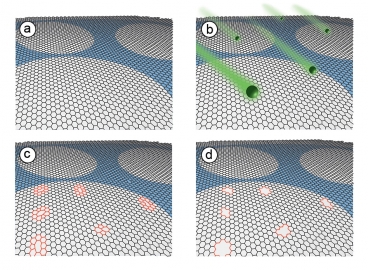
    The MIT researchers used a four-step process to create filters from graphene. Credit: O’HERN/S. C. ET AL. NANO LETTERS/AMERICAN CHEMICAL SOCIETY

    U.S. scientists at the Massachusetts Institute of Technology have developed a new method of filtering salt water using graphene. This is potentially a technology that would make oceans a much more viable source of drinkable fresh water in the future.

    Graphene truly appears to be a miracle material, with plenty of revolutionary aspects and potential future applications. It is one of the strongest materials available, it has an exceptional ability to conduct electric current and is extremely light.

    The scientists perforated a sheet of graphene with holes smaller than a nanometre. The resulting filter effectively allows water atoms to pass through, but larger atoms or molecules are stopped.

    Graphene is among the densest materials known to man and does not permit even a single atom to pass through it, even when extremely thin. It is therefore very suitable to be used as a filter.

    The use of graphene as a filter is not new by itself, but the ability of the U.S scientists to precisely and to a much greater extent control how large and how many holes are created – is. Their work enables the filter to take the leap from the lab to production on a larger scale.

    Manufacturing is key since it is indeed difficult to create a filter with holes at a precise size. The new method developed by the researchers gives them the power of effectively choosing what substances to pass through and what not to.

    The researchers manufacture the filter by combining two methods:

    First, they bombarded the graphene with gallium ions to weaken the structure, making it more reactive. They then gave the graphene a bath in an oxidizing solution that etches and produces small holes where the gallium ions met a carbon atom on its surface – creating holes with sizes directly correlated to the time of the bath.

    The research was done at Massachusetts Institute of Technology (MIT) and the project received support from the Center for Clean Water and Clean Energy at MIT and KFUPM and the U.S. Department of Energy. The research has been published in Nano Letters.

    _______________

    Water Desalination across Nanoporous Graphene
    Selective Ionic Transport through Tunable Subnanometer Pores in Single-Layer Graphene Membranes
    MIT press release
    ______________________________

    Desalination Drinkable Water Fresh water Graphene
    Share. Facebook Twitter Pinterest LinkedIn Tumblr Email Copy Link

    Related Posts

    New Commercial-like White Lime Paint May Counteract Climate Heat

    November 9, 2020

    Engineers Develop ‘Blackest Black’ Material Out of Carbon Nanotubes

    September 23, 2019

    New Concrete Developed using Graphene by Engineers at the University of Exeter

    May 22, 2018

    This Plastic Can Be Recycled An “Infinite” Number of Times

    May 8, 2018

    The U.S. ‘ Next Tank Could Be Protected by ‘Steel Foam’

    April 18, 2018

    World’s Blackest Material will Supercharge Telescopes

    March 15, 2018
    Recent Posts
    • How the End of Bretton Woods Reshaped Our Economies — and Our Politics
    • Can the U.S. Really Handle 250% Debt-to-GDP? Why Jackson Hole’s Daring Paper Is Wrong
    • Japan’s Fiscal Trap: What Happens If Austerity Is No Longer an Option?
    • The Rise of Range Extended Electric Vehicles (REEVs): A New Era of Hybrid Mobility
    • The Great Capital Rotation: A Shift from U.S. Treasuries to Gold and Real Assets
    • The Hidden Risks of Short-Term Debt: A Balancing Act in U.S. Fiscal Policy
    • The Looming U.S. Debt Spiral: Understanding the Risks
    • The Looming Recession: Seven Economic Indicators Flashing Red for 2025
    • Europa Clipper: NASA’s Mission to Unlock the Secrets of Jupiter’s Icy Moon
    • Could Hedge Funds Cause Chaos in the U.S. Treasury Market? And What About Inflation?
    © 2025 Illustrated Curiosity

    Type above and press Enter to search. Press Esc to cancel.

    This website uses cookies to improve your experience. We'll assume you're ok with this, but you can opt-out if you wish.Accept Reject Read More
    Privacy & Cookies Policy

    Privacy Overview

    This website uses cookies to improve your experience while you navigate through the website. Out of these, the cookies that are categorized as necessary are stored on your browser as they are essential for the working of basic functionalities of the website. We also use third-party cookies that help us analyze and understand how you use this website. These cookies will be stored in your browser only with your consent. You also have the option to opt-out of these cookies. But opting out of some of these cookies may affect your browsing experience.
    Necessary
    Always Enabled
    Necessary cookies are absolutely essential for the website to function properly. This category only includes cookies that ensures basic functionalities and security features of the website. These cookies do not store any personal information.
    Non-necessary
    Any cookies that may not be particularly necessary for the website to function and is used specifically to collect user personal data via analytics, ads, other embedded contents are termed as non-necessary cookies. It is mandatory to procure user consent prior to running these cookies on your website.
    SAVE & ACCEPT