Close Menu
Illustrated Curiosity
    Facebook X (Twitter) Instagram YouTube
    Illustrated Curiosity
    • Earth
    • Economics
    • Environment
      • Climate
      • Environmental Tech
      • Pollution
      • Wildlife
    • Health
      • Health Tech
      • Medicine
      • Nutrition
      • Exercise
    • History
      • Prehistory
      • Ancient History
      • Postclassical Era
      • Modern History
    • Humans
      • Human Brain
      • Psychology
    • Life
      • Animals & Plants
      • Genetics
      • Paleontology
      • Evolution
      • Genetic Engineering
    • Physics
    • Space
      • Astrobiology
      • Astronomy
      • Extrasolar Planets
      • Space Tech
      • Spaceflight
    • Technology
      • Artificial Intelligence
      • Energy
      • Engineering
      • Materials
      • Robotics
      • Vehicles
    Illustrated Curiosity
    Home » Larsen C ice shelf crack is rapidly spreading, speeding up calving process
    Climate

    Larsen C ice shelf crack is rapidly spreading, speeding up calving process

    May 5, 2017No Comments2 Mins Read
    Share
    Facebook Twitter LinkedIn Pinterest Email

    The Larsen C ice shelf crack has now begun to spread faster and branches out, researchers announced this Wednesday.
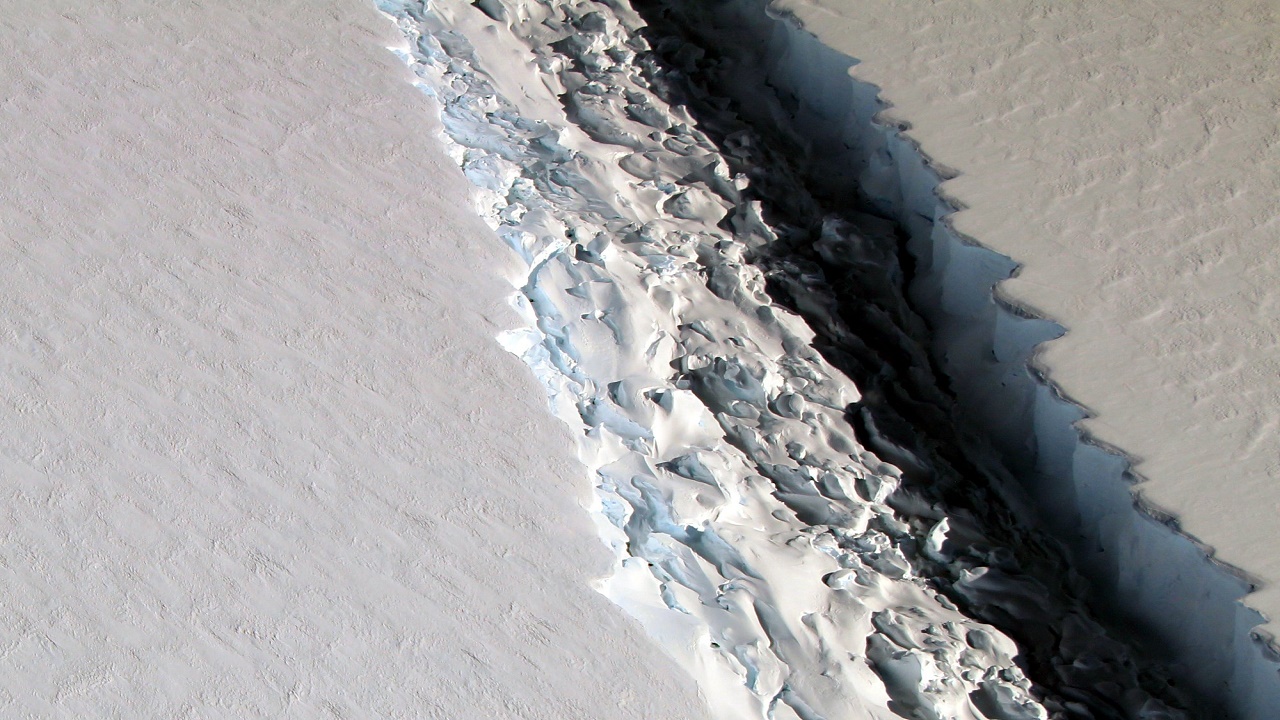
    Massive rift in the Antarctic Peninsula’s Larsen C ice shelf is shown in this November 10, 2016 photo taken by scientists on NASA’s IceBridge mission in Antarctica. Credit: John Sonntag NASA

    As reported on earlier, the Larsen C ice shelf is breaking apart in northeastern Antarctica. The big crack was discovered in 2014 but movements in the glacier have now increased.

    Project MIDAS is a UK-based Antarctic research project, investigating the effects of a warming climate on the Larsen C ice shelf in West Antarctica. They continually monitor the development of the rift and assess its ongoing impact on the ice shelf and regularly update their twitter feed.

    The MIDAS scientists reported they had observed the new rift, or crack, on the ice shelf, based on synthetic aperture radar (SAR) interferometry from ESA’s Sentinel-1 satellites. The new rift is about 10 kilometers (6.2 miles) behind the previous tip, heading towards the ice-front.

    “It’s taking basically a sharp hook toward the calving front,”

    – Dan McGrath, a geophysicist at the US Geological Survey.

    If the crack continues to grow, a giant iceberg will be broken off. This iceberg is estimated to become around 6,500 square kilometers. To put that size into perspective, it would be 75 times the size of Manhattan island, or about the size of New Jersey or Greek island Crete.

    The iceberg would be 300,000 times larger than the iceberg that sunk Titanic. One of the largest shelf glaciers in Antarctica would be also be severely destabilized.

    The crack opens up at a pace of one meter a day. According to Dan McGrath, the increasing spread suggests that the iceberg will be broken by soon, perhaps this summer already.

    Larsen C Ice Shelf rift update: No major advance since February, but #Sentinel1 InSAR shows the rift branched in the last 6 days @ESA_EO pic.twitter.com/7rhjcGjnKs

    — Adrian Luckman (@adrian_luckman) May 1, 2017


    Professor Adrian Luckman is head of the MIDAS project and based at the Swansea University College of Science.
    Antarctica Sea Level Rise
    Share. Facebook Twitter Pinterest LinkedIn Tumblr Email Copy Link

    Related Posts

    COVID-19 Recovery Funds Dwarf Clean Energy Investment Needs

    October 26, 2020

    Mont Blanc Glacier in Danger of Collapse, Experts Warn

    September 26, 2019

    The Absorption of Carbon Dioxide by the Sea Is Increasing with Emissions

    March 19, 2019

    Antarctic Ice Is Melting Six Times Faster Than in 1979

    February 12, 2019

    U.N. Says 2018 Will Be Earth’s 4th-Warmest Year on Record, Predicts a 5- to 9-Degree Temperature Rise This Century

    December 12, 2018

    Temperatures to Rise 1.5 Degrees Celsius by 2030-2052 without Rapid Steps According to U.N. Report

    October 19, 2018
    Recent Posts
    • How the End of Bretton Woods Reshaped Our Economies — and Our Politics
    • Can the U.S. Really Handle 250% Debt-to-GDP? Why Jackson Hole’s Daring Paper Is Wrong
    • Japan’s Fiscal Trap: What Happens If Austerity Is No Longer an Option?
    • The Rise of Range Extended Electric Vehicles (REEVs): A New Era of Hybrid Mobility
    • The Great Capital Rotation: A Shift from U.S. Treasuries to Gold and Real Assets
    • The Hidden Risks of Short-Term Debt: A Balancing Act in U.S. Fiscal Policy
    • The Looming U.S. Debt Spiral: Understanding the Risks
    • The Looming Recession: Seven Economic Indicators Flashing Red for 2025
    • Europa Clipper: NASA’s Mission to Unlock the Secrets of Jupiter’s Icy Moon
    • Could Hedge Funds Cause Chaos in the U.S. Treasury Market? And What About Inflation?
    © 2025 Illustrated Curiosity

    Type above and press Enter to search. Press Esc to cancel.

    This website uses cookies to improve your experience. We'll assume you're ok with this, but you can opt-out if you wish.Accept Reject Read More
    Privacy & Cookies Policy

    Privacy Overview

    This website uses cookies to improve your experience while you navigate through the website. Out of these, the cookies that are categorized as necessary are stored on your browser as they are essential for the working of basic functionalities of the website. We also use third-party cookies that help us analyze and understand how you use this website. These cookies will be stored in your browser only with your consent. You also have the option to opt-out of these cookies. But opting out of some of these cookies may affect your browsing experience.
    Necessary
    Always Enabled
    Necessary cookies are absolutely essential for the website to function properly. This category only includes cookies that ensures basic functionalities and security features of the website. These cookies do not store any personal information.
    Non-necessary
    Any cookies that may not be particularly necessary for the website to function and is used specifically to collect user personal data via analytics, ads, other embedded contents are termed as non-necessary cookies. It is mandatory to procure user consent prior to running these cookies on your website.
    SAVE & ACCEPT