Close Menu
Illustrated Curiosity
    Facebook X (Twitter) Instagram YouTube
    Illustrated Curiosity
    • Earth
    • Economics
    • Environment
      • Climate
      • Environmental Tech
      • Pollution
      • Wildlife
    • Health
      • Health Tech
      • Medicine
      • Nutrition
      • Exercise
    • History
      • Prehistory
      • Ancient History
      • Postclassical Era
      • Modern History
    • Humans
      • Human Brain
      • Psychology
    • Life
      • Animals & Plants
      • Genetics
      • Paleontology
      • Evolution
      • Genetic Engineering
    • Physics
    • Space
      • Astrobiology
      • Astronomy
      • Extrasolar Planets
      • Space Tech
      • Spaceflight
    • Technology
      • Artificial Intelligence
      • Energy
      • Engineering
      • Materials
      • Robotics
      • Vehicles
    Illustrated Curiosity
    Home » A brain–spine wireless interface restore leg movement in paralyzed primates
    Health Tech

    A brain–spine wireless interface restore leg movement in paralyzed primates

    November 10, 20163 Mins Read
    Share
    Facebook Twitter LinkedIn Pinterest Email

    A Swiss research team has managed to get a monkey with a spinal cord injury to walk – by artificially transmitting nerve signals past the damaged area to its legs. The technique could be used on humans in the future, according to the researchers.
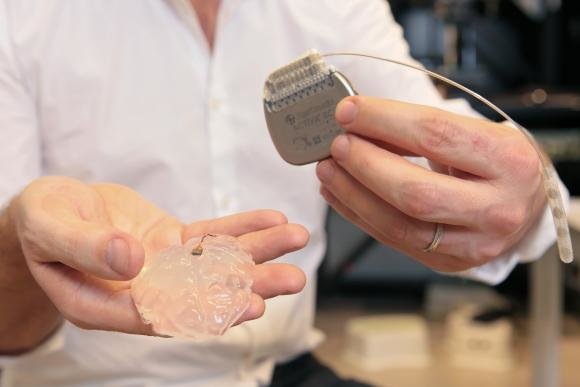
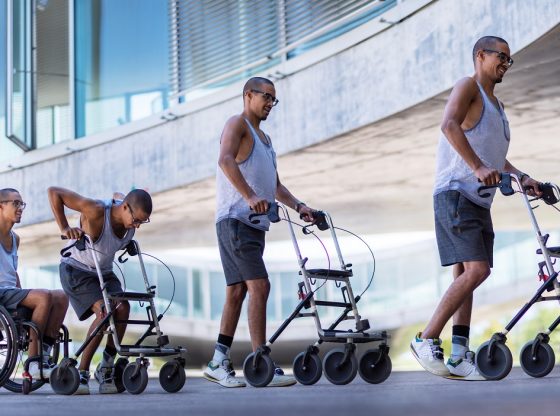
    The brain-spine interface developed by the research team uses a brain implant as seen in this photo. Credit: Alain Herzog / EPFL

    The researchers put small electrodes on the part of the brain that controls the monkey’s legs, that is, the left part of the motor cortex. These electrodes collected and sent nerve signals to a computer which in turn converted them into electrical signals.

    These signals were then wirelessly sent to a receiver in the spinal cord on the other side of the injury, telling the nerve cells in the spinal cord to move the legs.

    “The system we have developed uses signals recorded from the motor cortex of the brain to trigger coordinated electrical stimulation of nerves in the spine that are responsible for locomotion,” said David Borton, assistant professor of engineering at Brown and one of the study’s co-lead authors. “With the system turned on, the animals in our study had nearly normal locomotion.”

    Although the experiment is built with technology that is directly transferable to humans, the researchers stress that there is still much to do before this interaction between technology and biology is to function for humans with spinal cord injuries. They also point out some limitations of the study.

    The system they used is a one-way transmission of signals from the brain to the legs, it lacks the ability to return sensory information to the brain. The team did not test how much pressure the animals were able to apply to the affected leg.

    “In a full translational study, we would want to do more quantification about how balanced the animal is walking and measure the forces they’re able to apply,” Borton said.

    But despite the limitations, the research sets the stage for future studies in primates and, at some point, potentially as a rehabilitation aid in humans.

    The study was performed by scientists and neuro-engineers in a collaboration led by Ecole Polytechnique Federale Lausanne (EPFL) in Switzerland, together with Brown University, Medtronic and Fraunhofer ICT-IMM in Germany. It has been published in the journal Nature.

    Reference:

    Marco Capogrosso et al. A brain-spine interface alleviating gait deficits after spinal cord injury in primates. Nature, 2016. DOI: 10.1038 / nature20118

    Brain–computer Interface
    Share. Facebook Twitter Pinterest LinkedIn Tumblr Email Copy Link

    Related Posts

    Study Results Suggest Human Aging Can Be Reversed

    September 11, 2019

    Video | World Science Festival: Engineering Immortality: the End of Aging?

    December 20, 2018

    Spinal Cord Stimulation Helps Three Paralyzed People Walk Again

    November 8, 2018

    Man Against Machine: AI Is Better Than Dermatologists at Diagnosing Skin Cancer

    June 22, 2018

    Spikes of Graphene Can Kill Bacteria on Implants

    June 15, 2018

    Tiny Injectable Sensor Could Provide Unobtrusive Alcohol Monitoring

    June 3, 2018
    Recent Posts
    • America’s Quiet Shift Into Fiscal Dominance: Why Inflation May Be Preparing for a Second Act
    • How the End of Bretton Woods Reshaped Our Economies — and Our Politics
    • Can the U.S. Really Handle 250% Debt-to-GDP? Why Jackson Hole’s Daring Paper Is Wrong
    • Japan’s Fiscal Trap: What Happens If Austerity Is No Longer an Option?
    • The Rise of Range Extended Electric Vehicles (REEVs): A New Era of Hybrid Mobility
    • The Great Capital Rotation: A Shift from U.S. Treasuries to Gold and Real Assets
    • The Hidden Risks of Short-Term Debt: A Balancing Act in U.S. Fiscal Policy
    • The Looming U.S. Debt Spiral: Understanding the Risks
    • The Looming Recession: Seven Economic Indicators Flashing Red for 2025
    • Europa Clipper: NASA’s Mission to Unlock the Secrets of Jupiter’s Icy Moon
    © 2025 Illustrated Curiosity

    Type above and press Enter to search. Press Esc to cancel.

    This website uses cookies to improve your experience. We'll assume you're ok with this, but you can opt-out if you wish.Accept Reject Read More
    Privacy & Cookies Policy

    Privacy Overview

    This website uses cookies to improve your experience while you navigate through the website. Out of these, the cookies that are categorized as necessary are stored on your browser as they are essential for the working of basic functionalities of the website. We also use third-party cookies that help us analyze and understand how you use this website. These cookies will be stored in your browser only with your consent. You also have the option to opt-out of these cookies. But opting out of some of these cookies may affect your browsing experience.
    Necessary
    Always Enabled
    Necessary cookies are absolutely essential for the website to function properly. This category only includes cookies that ensures basic functionalities and security features of the website. These cookies do not store any personal information.
    Non-necessary
    Any cookies that may not be particularly necessary for the website to function and is used specifically to collect user personal data via analytics, ads, other embedded contents are termed as non-necessary cookies. It is mandatory to procure user consent prior to running these cookies on your website.
    SAVE & ACCEPT