Close Menu
Illustrated Curiosity
    Facebook X (Twitter) Instagram YouTube
    Illustrated Curiosity
    • Earth
    • Economics
    • Environment
      • Climate
      • Environmental Tech
      • Pollution
      • Wildlife
    • Health
      • Health Tech
      • Medicine
      • Nutrition
      • Exercise
    • History
      • Prehistory
      • Ancient History
      • Postclassical Era
      • Modern History
    • Humans
      • Human Brain
      • Psychology
    • Life
      • Animals & Plants
      • Genetics
      • Paleontology
      • Evolution
      • Genetic Engineering
    • Physics
    • Space
      • Astrobiology
      • Astronomy
      • Extrasolar Planets
      • Space Tech
      • Spaceflight
    • Technology
      • Artificial Intelligence
      • Energy
      • Engineering
      • Materials
      • Robotics
      • Vehicles
    Illustrated Curiosity
    Home » Video | Neil Price: Life and Afterlife: Dealing with the Dead in the Viking Age
    Postclassical Era

    Video | Neil Price: Life and Afterlife: Dealing with the Dead in the Viking Age

    January 11, 2014No Comments2 Mins Read
    Share
    Facebook Twitter LinkedIn Pinterest Email
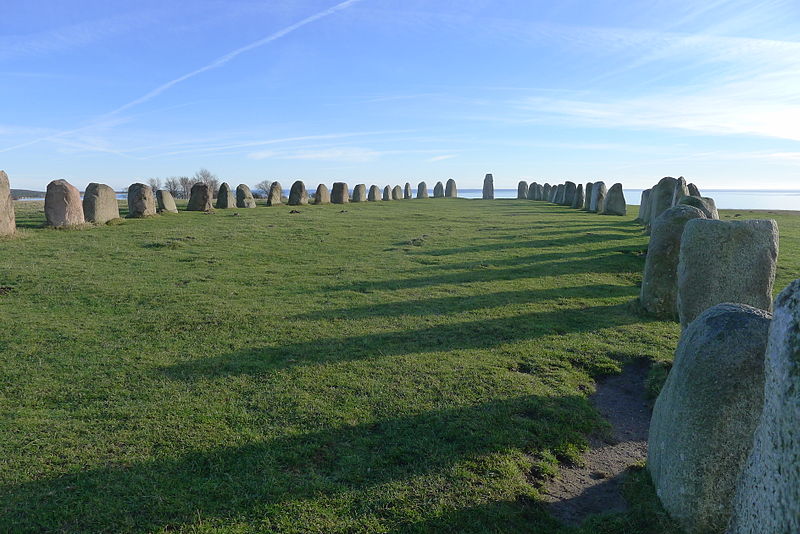
    Ale’s Stones is a megalithic monument in Skåne in southern Sweden. It is a so called “stone ship”. 67 m long and formed by 59 large boulders, weighing up to 1.8 tonnes each. Carbon-14 dating for organic remains has provided seven results at the site. One indicates that the material is around 5,500 years old whereas the remaining six indicate a date about 1,400 years ago, which is considered to be most likely. A stone ship (or ship setting) was an early burial custom, characteristically Scandinavian but also found in Germany and the Baltic states.

    Professor Neil Price delivers the second of three lectures (part I), part III), focusing on the fundamental role that narrative, storytelling, and dramatisation played in the mindset of the Viking Age (8th-11th centuries), occupying a crucial place not only in the cycles of life but particularly in the ritual responses to dying and the dead.

    Early medieval Scandinavians’ attitudes to death provide a window on the Viking mind, and they were monumentalized in some of the most spectacular burials known to archaeology. A study of these complex and spectacular funeral rituals is not only fascinating in its own right but is inevitably also a meditation on this particular culture’s responses to the human condition. The Vikings’ unique view of the world can provide genuinely deep perspectives on the fundamentals of life, on the fears of mortality that confronted them as they still confront us.

     

    Norse Norse mythology Vikings
    Share. Facebook Twitter Pinterest LinkedIn Tumblr Email Copy Link

    Related Posts

    Vikings Were in the Americas Exactly 1,000 Years Ago

    October 25, 2021

    The DNA Fingerprint of the Vikings is Found All Over Europe

    October 12, 2020

    The Game-Changing Swedish Warship That Sank in Its First Battle

    January 15, 2020

    Henbane Made the Vikings Go Berserk

    October 7, 2019

    Hoard of 1,000-Year-Old Coins Found By Metal Detecting Couple In England

    September 9, 2019

    Ireland’s Population in ‘Serious Decline’ before Vikings’ Arrival

    September 5, 2019
    Recent Posts
    • How the End of Bretton Woods Reshaped Our Economies — and Our Politics
    • Can the U.S. Really Handle 250% Debt-to-GDP? Why Jackson Hole’s Daring Paper Is Wrong
    • Japan’s Fiscal Trap: What Happens If Austerity Is No Longer an Option?
    • The Rise of Range Extended Electric Vehicles (REEVs): A New Era of Hybrid Mobility
    • The Great Capital Rotation: A Shift from U.S. Treasuries to Gold and Real Assets
    • The Hidden Risks of Short-Term Debt: A Balancing Act in U.S. Fiscal Policy
    • The Looming U.S. Debt Spiral: Understanding the Risks
    • The Looming Recession: Seven Economic Indicators Flashing Red for 2025
    • Europa Clipper: NASA’s Mission to Unlock the Secrets of Jupiter’s Icy Moon
    • Could Hedge Funds Cause Chaos in the U.S. Treasury Market? And What About Inflation?
    © 2025 Illustrated Curiosity

    Type above and press Enter to search. Press Esc to cancel.

    This website uses cookies to improve your experience. We'll assume you're ok with this, but you can opt-out if you wish.Accept Reject Read More
    Privacy & Cookies Policy

    Privacy Overview

    This website uses cookies to improve your experience while you navigate through the website. Out of these, the cookies that are categorized as necessary are stored on your browser as they are essential for the working of basic functionalities of the website. We also use third-party cookies that help us analyze and understand how you use this website. These cookies will be stored in your browser only with your consent. You also have the option to opt-out of these cookies. But opting out of some of these cookies may affect your browsing experience.
    Necessary
    Always Enabled
    Necessary cookies are absolutely essential for the website to function properly. This category only includes cookies that ensures basic functionalities and security features of the website. These cookies do not store any personal information.
    Non-necessary
    Any cookies that may not be particularly necessary for the website to function and is used specifically to collect user personal data via analytics, ads, other embedded contents are termed as non-necessary cookies. It is mandatory to procure user consent prior to running these cookies on your website.
    SAVE & ACCEPT