Close Menu
Illustrated Curiosity
    Facebook X (Twitter) Instagram YouTube
    Illustrated Curiosity
    • Earth
    • Economics
    • Environment
      • Climate
      • Environmental Tech
      • Pollution
      • Wildlife
    • Health
      • Health Tech
      • Medicine
      • Nutrition
      • Exercise
    • History
      • Prehistory
      • Ancient History
      • Postclassical Era
      • Modern History
    • Humans
      • Human Brain
      • Psychology
    • Life
      • Animals & Plants
      • Genetics
      • Paleontology
      • Evolution
      • Genetic Engineering
    • Physics
    • Space
      • Astrobiology
      • Astronomy
      • Extrasolar Planets
      • Space Tech
      • Spaceflight
    • Technology
      • Artificial Intelligence
      • Energy
      • Engineering
      • Materials
      • Robotics
      • Vehicles
    Illustrated Curiosity
    Home » 200 Billion Starless “Rogue Planets” Roam the Milky Way
    Extrasolar Planets

    200 Billion Starless “Rogue Planets” Roam the Milky Way

    August 22, 2013No Comments2 Mins Read
    Share
    Facebook Twitter LinkedIn Pinterest Email
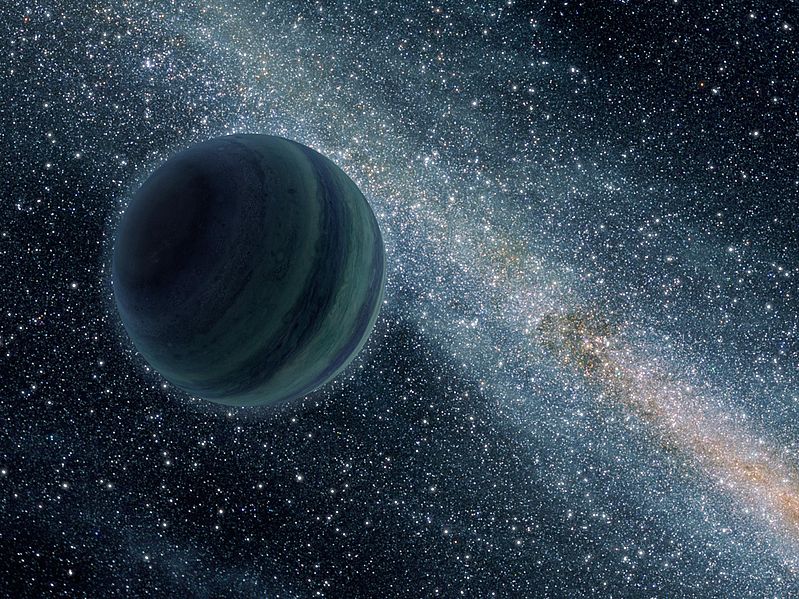
    Artist’s concept art of a Jupiter-like planet alone in the dark of space, floating freely without a parent star. Credit: NASA/JPL-Caltech

    Rogue planets are free-floating planets roaming interstellar space between and beyond any solar system. And astronomers have calculated that there can be as many as 200 billion rogue planets in the Milky Way alone.

    These rogue planets have previously been believed to be results of ejections from solar systems, for one reason or another. But now following analysis of observations made by Swedish and Finnish astronomers, new evidence has emerged providing deeper insight into what could be natural incubators for these strange planets.

    The team believes that at least a portion of them may have been formed by their own beyond planetary systems, within dark clouds in space. These dark clouds have now been closely examined by the astronomers, particularly those found within the Rosette Nebula. When examining that nebula they detected more than a hundred of these tiny clouds, now named “globulettes”.

    These clouds are small in an astronomic sense, about 50 times the distance between the Sun and Neptune (the planet furthers from our Sun). They have a density less than 13 times the mass of Jupiter. But this is relatively dense for such a large object nevertheless and this implies that they may sometimes collapse under their own weight – and thereby create rogue planets or even brown dwarfs (which are too low in mass to sustain fusion reactions within their cores).

    A typical globulette have an initial mass of about 29.5 Jupiter masses and a lifetime of 50,000 yrs. They are believed to form together with young stars, but then broken off these immense gas clouds and instead accelerated away and are now giving birth to planets on their own. Perhaps there are plenty of dark planetary systems without a host star roaming around the galaxy. If so, these would be very difficult to see for astronomers.

    _______________
    Mass and motion of globulettes in the Rosette Nebula
    Mass and motion of globulettes in the Rosette Nebula Harvard
    ______________________________
    Exoplanets Planetary System Planets Rogue Planets Stars
    Share. Facebook Twitter Pinterest LinkedIn Tumblr Email Copy Link

    Related Posts

    James Webb Telescope Discovers Methane & Carbon Dioxide in the Atmosphere of Exoplanet K2-18b

    September 14, 2023

    Tranquil Planetary System Just 11 Light-Years Away Raises Hopes of Habitability

    July 13, 2020

    TESS Mission Spots Earth-Size Potentially Habitable Planet 100 Light-Years Away

    January 8, 2020

    Water is Common—Yet Scarce—in Exoplanets

    December 17, 2019

    Astronomers Discover Jupiter-like Planet Orbiting A Tiny Star

    September 30, 2019

    Water Discovered in the Atmosphere of an Exoplanet in the Habitable zone

    September 12, 2019
    Recent Posts
    • How the End of Bretton Woods Reshaped Our Economies — and Our Politics
    • Can the U.S. Really Handle 250% Debt-to-GDP? Why Jackson Hole’s Daring Paper Is Wrong
    • Japan’s Fiscal Trap: What Happens If Austerity Is No Longer an Option?
    • The Rise of Range Extended Electric Vehicles (REEVs): A New Era of Hybrid Mobility
    • The Great Capital Rotation: A Shift from U.S. Treasuries to Gold and Real Assets
    • The Hidden Risks of Short-Term Debt: A Balancing Act in U.S. Fiscal Policy
    • The Looming U.S. Debt Spiral: Understanding the Risks
    • The Looming Recession: Seven Economic Indicators Flashing Red for 2025
    • Europa Clipper: NASA’s Mission to Unlock the Secrets of Jupiter’s Icy Moon
    • Could Hedge Funds Cause Chaos in the U.S. Treasury Market? And What About Inflation?
    © 2025 Illustrated Curiosity

    Type above and press Enter to search. Press Esc to cancel.

    This website uses cookies to improve your experience. We'll assume you're ok with this, but you can opt-out if you wish.Accept Reject Read More
    Privacy & Cookies Policy

    Privacy Overview

    This website uses cookies to improve your experience while you navigate through the website. Out of these, the cookies that are categorized as necessary are stored on your browser as they are essential for the working of basic functionalities of the website. We also use third-party cookies that help us analyze and understand how you use this website. These cookies will be stored in your browser only with your consent. You also have the option to opt-out of these cookies. But opting out of some of these cookies may affect your browsing experience.
    Necessary
    Always Enabled
    Necessary cookies are absolutely essential for the website to function properly. This category only includes cookies that ensures basic functionalities and security features of the website. These cookies do not store any personal information.
    Non-necessary
    Any cookies that may not be particularly necessary for the website to function and is used specifically to collect user personal data via analytics, ads, other embedded contents are termed as non-necessary cookies. It is mandatory to procure user consent prior to running these cookies on your website.
    SAVE & ACCEPT